Published
Name: Gábor Lázár
Occupation: Producer, composer, sound artist
Nationality: Hungarian
Recent release: Gábor Lázár's Reflex is out via Raster.
If you enjoyed Gábor Lázár interview and would like to find out more about his music, visit his official homepage. He is also on Instagram, and Facebook.
For a deeper dive, we recommend our conversation with one of his collaborators in our Mark Fell interview.
When it comes to arranging, sound design, performing, composing, etc – what are currently concrete topics and aspects that interest you and where you want to improve or simply challenge yourself?
I’m always moving in and out of the contexts of club music and computer music, constantly constructing, deconstructing, and reevaluating. I’m changing, and I can notice that, but I don’t change intentionally because I know that change happens regardless.
Change is also relative; a small change for one person can mean a huge difference for others. In terms of making music, instead of doing something completely different, I change the starting point or techniques to find alternative routes.
Generally speaking, I get bored immediately when I end up with the same musical results, but I also lose interest when I get far away from what I usually do. I like to dig deeper into my own practice and find undiscovered territories.
Do you keep up with recent developments in terms of gear and software? If not, why not? If so, what are you looking for?
I think I’ve found my own tools. I prefer to work with just a few tools and explore them.
How and for what reasons has your music set-up evolved over the years and what are currently some of the most important pieces of gear and software for you?
I started using Max MSP around 2010, and my releases in 2013-2014 were the first instances where I applied it.
I mostly use Max to create compositions, patterns, and timings, but I also use VST synths to synthesize sound.
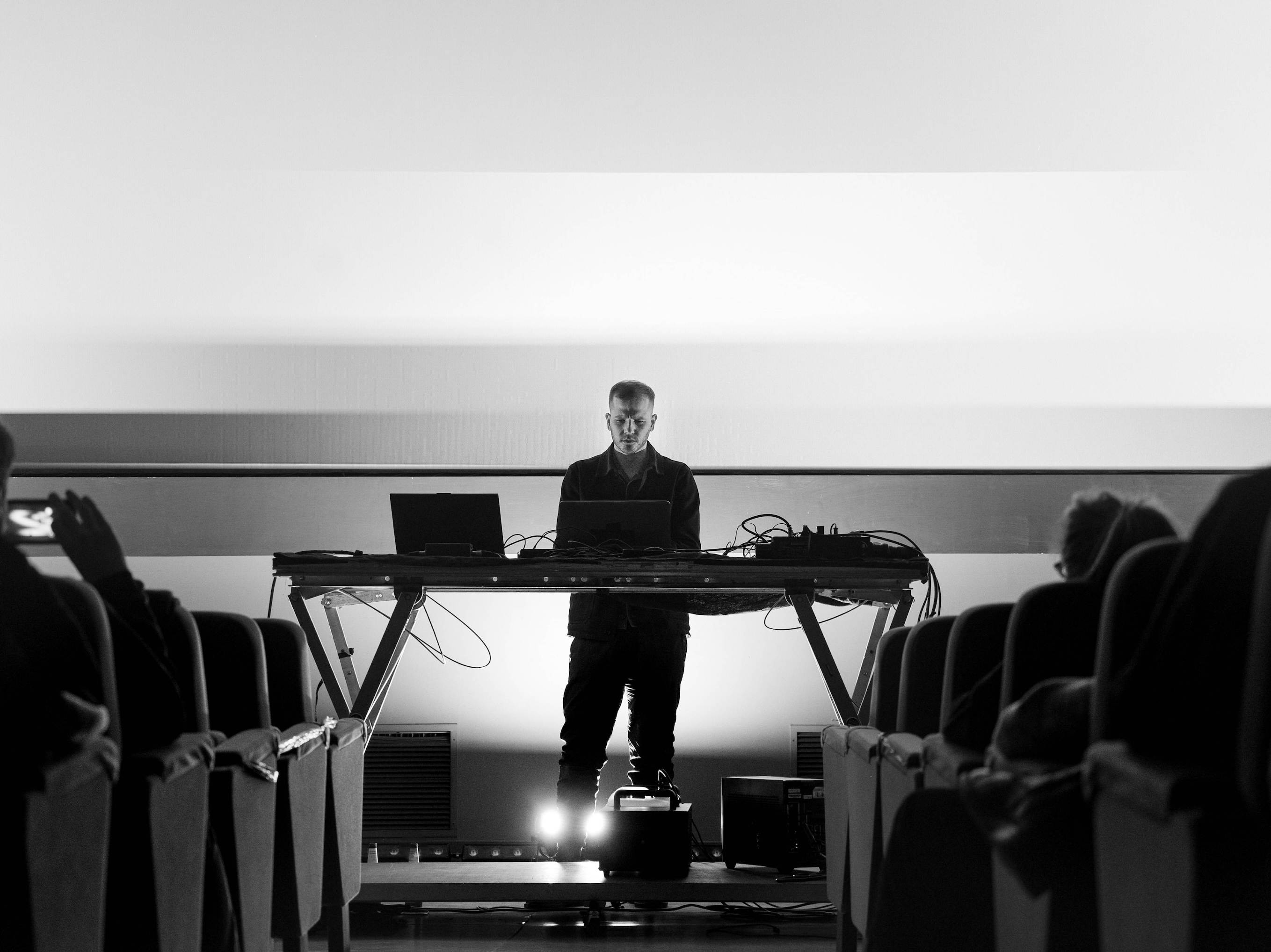
Currently, I work almost exclusively with Max; I’ve built my entire studio within it. I use it for studio recording and live performances, as well as for composing visuals and controlling stage lighting.
Jean-Michel Jarre maintained that, despite the advances in virtual technology, we are still "analogue animals made out of blood and bones who need buttons and knobs to touch.” In how far is this statement true or false for your own music?
I don’t feel the desire or need to touch buttons.
What are examples of production tools/instruments that you bought for a specific purpose?
As a production tool, I recently bought a new office chair at a 50% discount.
Healthy and comfy.
Late producer SOPHIE said: “You have the possibility with electronic music to generate any texture, and any sound. So why would any musician want to limit themselves?” What's your take on that?
I don’t know the context of that conversation, so I wouldn’t take this quote as a fact. However, if you listen to her music, it’s clear she was 100% aware of what she was doing, and her production was actually quite limited—in a good way.
Her music is specific and straight to the point, really focused. Being focused means blocking out distractions and prioritizing a few key elements, while choosing the right tools to explore their full potential. That’s a kind of limitation.
What does your own way of working with sound look like? Do you find using presets lazy?
Absolutely not. I don’t use presets, but I don’t think they’re a bad starting point to explore and learn synthesis. Not just synth presets; even General MIDI sounds can be fun. A sine wave is also a preset, just on a different level.
When it comes to this question, I often feel it’s about generalizing people into those who use presets and those who don’t. I don’t like to do that.
Richie Hawtin, speaking about semi-modular equipment, has stated that a deeper understanding of sound synthesis can lead to “life lessons that go beyond what we can hear.” Can you relate to that statement?
I’m not exactly sure what Richie meant by that. It’s interesting because physics extends beyond our human senses, and most people don’t understand its complex phenomena.
But with sound, it feels like we can truly interact with it through a synthesizer in an intuitive way, which allows us to learn about these invisible sound waves even without any prior knowledge. Maybe this kind of experience could be useful in other situations.
What were some of your most positive collaboration experiences? How did this "human element" enhance your solo approach? Did you record via filesharing or in the same room and if so, what did the recording process look like?
I used to make music a lot with a friend of mine, Martin Mikolai, when we were teenagers. We did this for years, and it was a natural way of spending time together.
Later, when I started working alone on my own material, I met Mark Fell in Budapest, and we recorded our collaborative album, The Neurobiology of Moral Decision Making. That’s the only collaboration I’ve done, and it was actually very similar to what I did with Martin as a teenager.
With Mark, we spent 3-4 days recording sketches in Budapest, and the album was essentially ready. We did a bit of macro-editing over the internet afterward, but we didn’t change anything on a micro level in the compositions.
To some, the advent of AI and 'intelligent' composing tools offers potential for machines to contribute to the creative process. What are your hopes, fears, expectations and possible concrete plans in this regard?
Well, we should ask Jean-Michel Jarre about it.
Have you used AI or generative music tools for your own productions? If so, in which way and what did they add?
No, I haven’t.