Published
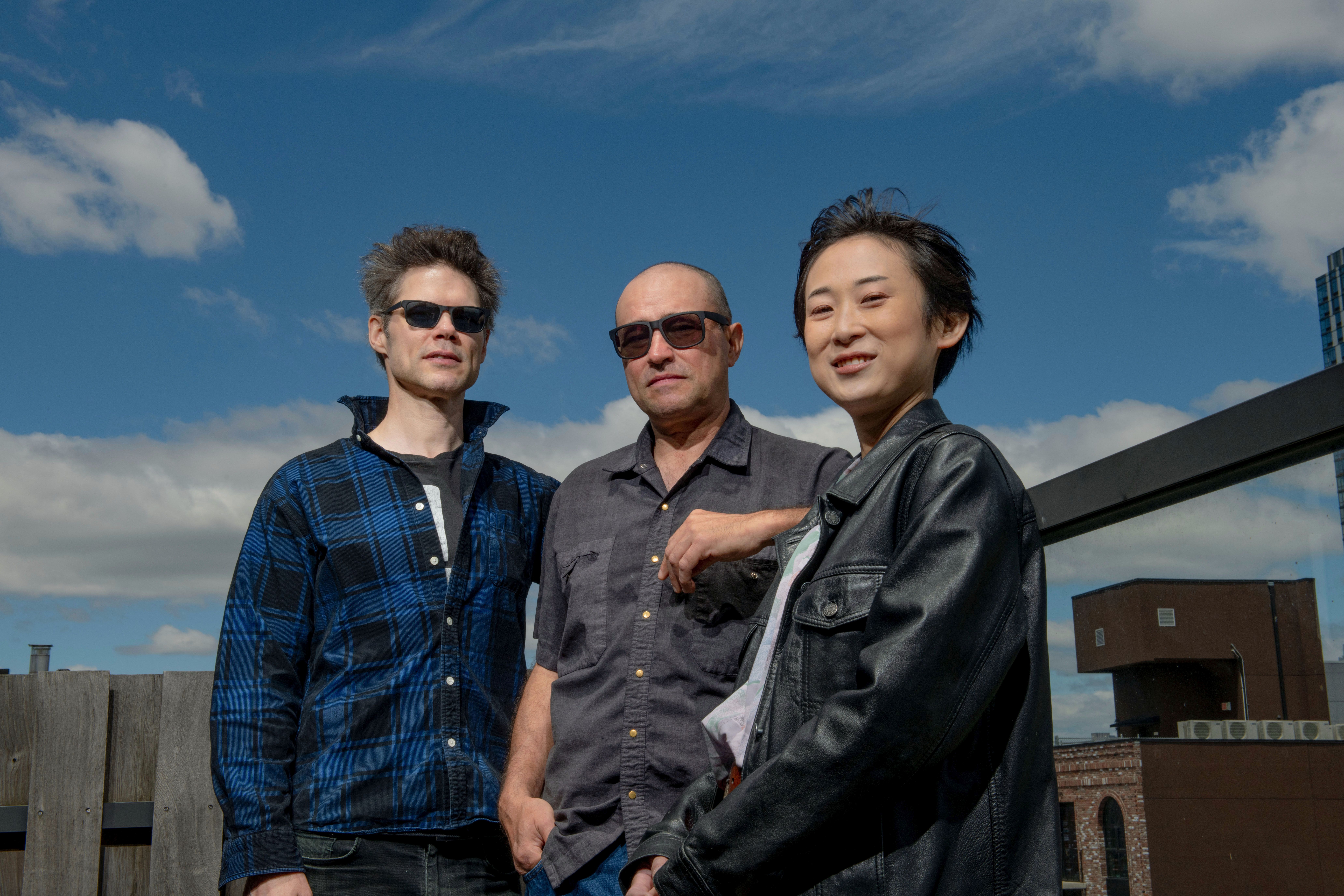
Name: Roboquarians
Members: Ayumi Ishito (saxophone with effects), George Draguns (guitar), Kevin Shea (drums)
Interviewee: George Draguns
Nationality: American
Current release: Roboquarians' new album Roboquarians Vol. 2 is out via 577.
Recommendations for Philadelphia, USA: John’s roast pork sandwich. Skip the cheesesteak. The people are genuinely awful in my city, so avoid interactions with them. That said, Philadelphia is a architecturally beautiful city, so walking around old city is always a good option. See a Fire Museum show!
Topic that I am passionate about but rarely get to talk about: I love ice hockey! I’ve been playing in a “beer league” for 4 seasons now. My son is a travel team goalie, so we bond that way. I’m very proud of his progress. Hockey is the physical form of “Black Flag Jazz”. I spent my formative years vertical skateboarding, and picked up hockey after I broke my leg skateboarding. It’s perfect because it has less impact on the body (I play in a “no checking” league) and keeps my legs strong.
[Read our Ayumi Ishito interview]
[Read our Kevin Shea interview]
When did you first consciously start getting interested in musical improvisation? What was your first improvisation on stage or in the studio and what was the experience like?
It was somewhat accidental.
It was Bob Cozzolino (drummer) who encouraged me to mix it up a little and see what happens. He was the first musician that came from an eclectic background that wasn’t mildly hostile to the idea of “jamming”.
Tell me about your instrument and/or tools, please. What made you seek it out, what makes it “your” instrument, and what are some of the most important aspects of playing it?
Guitar really isn’t my instrument, but I play it anyway. I came to guitar accidentally as well.
I was primarily an electric bass player. It occurred to me that guitar had a much stronger sonic sensibility and demanded to be heard. Whereas when I was playing and writing on bass, the guitarists I was playing with at the time were baffled when it came to playing over my bass lines.
I’m not saying that my bass lines were overly complicated, I’m saying that I was coming from a group of indie rock/post rock musicians that had a narrow and rigid approach. The school of thought was: “you're here to uplift my guitar playing and I run the show”.
My approach to playing guitar is very “bass-like”. I don’t play chords that much and play a lot of single note stuff. I read something once that Sonny Sharrock tried to play his guitar like a saxophone. That really stuck with me.
As of late, I’m trying to make my playing more unique by elevating my right hand technique. I’m also trying to play with less effects.
How would you describe your own relationship with your instrument – is it an extension of your self/body, a partner and companion, a creative catalyst, a challenge to be overcome, something else entirely?
I don’t think I have a healthy relationship with my instrument. I’m far too self critical to enjoy my playing and think that it’s special in any way.
There have been many times where I wish I could stop playing music because of the static of human relations that are involved with playing music. I generally don’t get along with musicians. Most of my artistic friends are visual artists.
I started studying classical guitar because I had so many musicians flake on projects I was in. I also wanted to get away from being creative on my instrument and play music that was written by great composers.
I’ve since returned to playing with people again, but I had a long stretch of dealing with musicians who weren’t on my wavelength and vice versa.
Derek Bailey defined improvising as the search for material which is endlessly transformable. What kind of materials have turned to be particularly transformable and stimulating for you?
I love science fiction epics. Always inspiring.
I also draw from the 1980s hardcore scene and try to play in a style I describe as “Black Flag Jazz”. That usually results in a lot of tension in the music if it’s done right.
I can understand that it doesn’t appeal to a lot of people, but it’s the most accurate extension of my musical personality.
Do you feel as though there are at least elements of composition and improvisation which are entirely unique to each? Based on your own work or maybe performances or recordings by other artists, do you feel that there are results which could only have happened through one of them?
I do. Improvisation allows you to play over a recognizable melody in an infinite amount of ways. That makes it almost a living thing.
A piece of music that is played uniquely by each individual playing it is a high form of human interaction. Whereas mastering a piece of composed music is the same as building a model ship in a bottle. Always impressive but not as sophisticated in my opinion.
I never understood the appeal of music to musicians that don’t compose and/or don’t improvise.
When you're improvising, does it actually feel like you're inventing something on the spot – or are you inventively re-arranging patterns from preparations, practise or previous performances? What balance is there between forgetting and remembering in your work?
I do both. I try to play something different as much as possible.
That becomes easier as you get older because you forget lots of things.
Artists from all corner of the musical spectrum, not just “free jazz” have emphasised the importance of freedom in their creativity. What defines freedom for your improvisations?
I feel most free when the music melds together as one. It provides a foundation for the player then to take more chances and channel spirits.
Taking your recent projects, releases, and performances as examples, what, would you say, are the key ideas behind your approach to improvisation?
I am shooting towards playing with maximum intent and no holding back. And presenting something tense, vibrant and varied with moments of love and beauty.
In your best improvisations, do you feel a strong sense of personal presence or do you (or your ego) “disappear”?
It’s definitely an extension of my persona.
What are some of your favourite collaborators and how do they enrich your improvisations?
I have been blessed with playing with so many fine percussionists, so let’s start there (in no particular order):
Bob Cozzolino - the whole enchilada of rock, jazz, everything.
Kevin Shea - the Berserker! Always plays full tilt.
Ed Wilcox - the supreme textualist who doesn’t play beats.
That’s the current line up of percussionists. Now on to all others:
Ayumi Ishito - a perfect compliment to Kevin Shea. She plays straight saxophone with the chops of Wayne Shorter and no one sounds like her when she breaks out the effects on her saxophone. Truly unique and creative.
Daniel Carter - How many multi instrumentalists play all their instruments well? He does, and his playing always uplifts the other players.
I’m also always looking to play with other musicians, so if you dig what I’m doing, look me up! No flakes or dabblers, please.
In a live situation, decisions between creatives often work without words. From your experience and current projects, what does this process feel like and how does it work?
It usually comes from someone standing out with a musical idea that guides you to compliment it, imitate it or dropping out completely to let an idea boil to the top.
Stewart Copeland said: “Listening is where the cool stuff comes from. And that listening thing, magically, turns all of your chops into gold.” What do you listen for?
I feed off the drummers first. If you have percussive propulsion behind you, that’s always powerful. Then I’ll try to pick up what the other players are playing and help “reduce” the flavors, like making a sound soup.
I totally agree with the above statement regarding my chops. On guitar I always search for intervals that sound good anywhere on the neck, and stretch that out.
There can be surprising moments during improvisations – from one of the performers not playing a single note to another shaking up a quiet section with an outburst of noise. Can you tell me about such situations from your own performances and how they impacted the performance?
Changes in the dynamics of the music usually are an excellent way to change musical direction in an effective manner. If you’re playing at “11” for too long, that usually indicates that you’re too enthralled with your own playing.
There’s always time to pivot-usually with good results.
As a listener, do you also have a preference for improvised music? If so, what is it about this music that you appreciate as part of the audience?
I guess I prefer the “jazz” style of improvisation. I don’t dig the jam band thing. Much like visual art, I’m attracted to color and competence.
That’s not to say I don’t appreciate a player that may not have the best ability. I look for players who play with intent.
In a way, we improvise all the time. In which way is your creative work feeding back and possibly supporting other areas of your life?
I have to improvise every day in my day job. I’m a carpenter that specializes in historic preservation, so you never know what degree of rot and decay you may encounter and every situation is different. It’s all practical improvisation. Nothing is plumb, level or square ever.
I’m always amazed at the low level of creativity in today’s society. Creativity is seen as something reserved for Bohemians and not for the everyday person. Once we get back to uplifting the creative types in all aspects of life, the world will be a better place.
I personally have done very well by going against all the horrible advice I received in college and high school by unenlightened guidance councilors.