Published
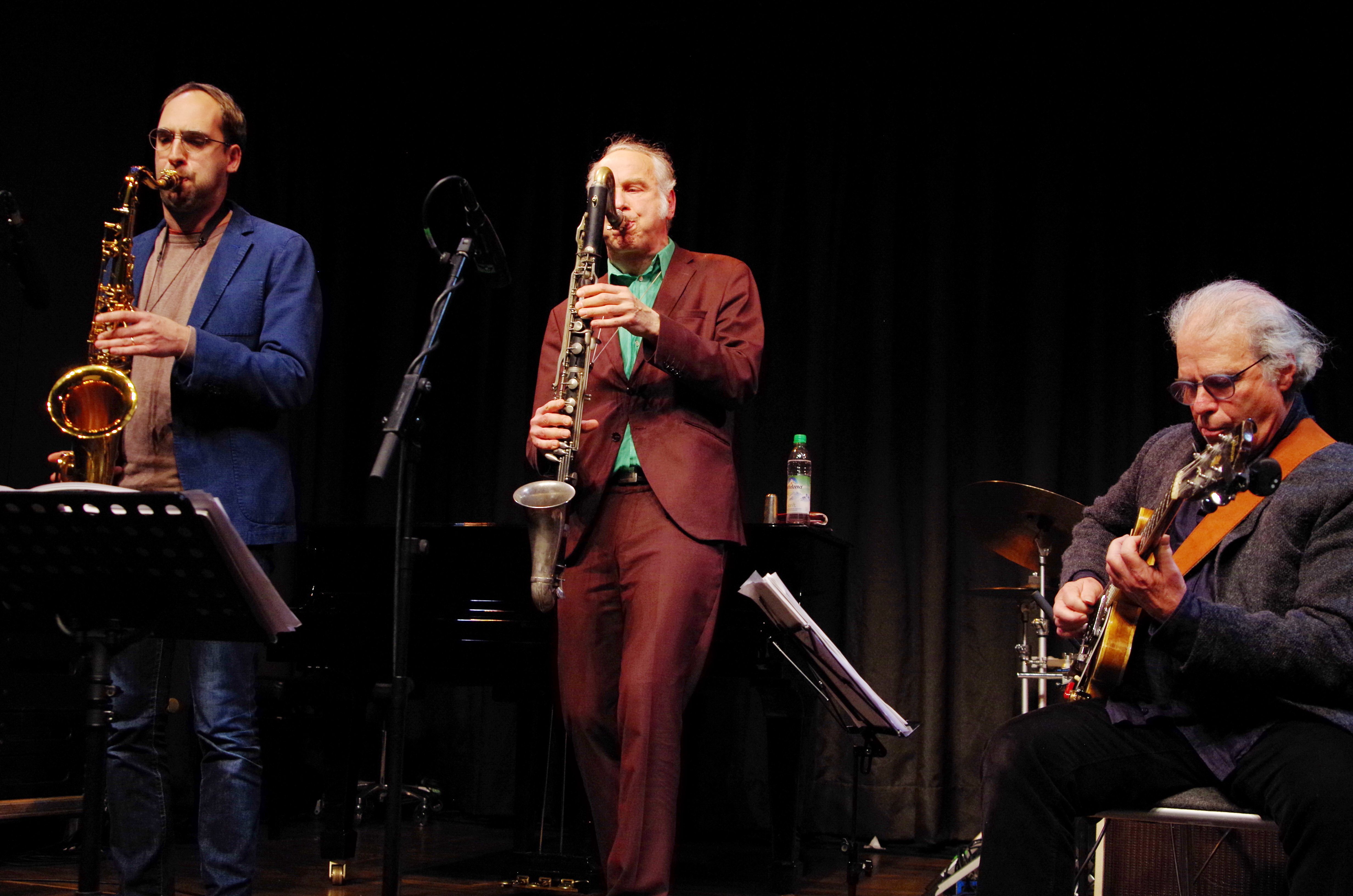
Name: Goodman/Bordenave/Mahall
Musicians: Geoff Goodman (guitar), Matthieu Bordenave (saxophone, clarinet), Rudi Mahall (bass clarinet)
Nationalities: American (Geoff), French (Matthieu),
Recent release: Goodman/Bordenave/Mahall's Mostly Monk is out via unit.
Recommendations for Munich, Germany:
Geoff Goodman: Jazz+ in the Seidlvilla; Freies Musikzentrum
Matthieu Bordenave: Visit Munich’s Lenbachhaus, home to the Blaue Reiter movement. Their bold use of color and abstraction—pioneered by Kandinsky and Marc— echoes jazz’s spirit: revolutionary, emotional, and timeless.
Topic that I am passionate about but rarely get to talk about:
Matthieu Bordenave: Modern poetry captivates me—how poets distill vast emotions into sparse lines. Their economy of language mirrors my approach to melody: saying more with less.
Shoutouts:
Geoff Goodman: The jazz radio stations, which keep fighting for more broadcasting time.
Matthieu Bordenave: European jazz deserves celebration. It’s carved its own identity, blending American roots with continental innovation. Festivals, educators, and artists here refuse to treat jazz as a museum piece, ensuring it remains a vibrant, evolving force.
If you enjoyed this Goodman/Bordenave/Mahall interview and would like to stay up to date with the band, visit the online presences of its members: Geoff Goodman; Matthieu Bordenave
What were some of the musical experiences which planted a seed for your interest in jazz?
Geoff Goodman: As a teenage guitarist, and coming from rock music, I was first attracted to George Benson and Joe Pass and this new way (for me) the guitar can sound.
But my very first jazz awakening was when I was around fifteen. I used to listen to the radio (a small transistor radio) next to my bed while falling asleep.
While turning the dial one night, all of a sudden, I stumbled on the jazz station. “Afro Blue” performed by Coltrane from his Live at Birdland recording was playing.
I never heard anything like it. That did it for me ….
Aso all the concerts I heard in the 70s – Roland Kirk, George Benson, Bill Evans, Dewey Redman … to name a few ...
Matthieu Bordenave: After years of studying classical saxophone, I received a John Coltrane album as a Christmas gift. That moment was transformative—his innovation and emotional depth ignited an enduring fascination with jazz, bridging the discipline of classical training with the boundless creativity of improvisation.
Rudi Mahall: For me, it was an Oskar Peterson concert, 1982 in Nuremberg. And then, an Anthony Braxton concert, same year, at the Nuremberg Jazz Studio
What does the term jazz mean today, would you say?
Rudi Mahall: It don't mean a thing, if it don't got that swing!
Geoff Goodman: The term jazz has always meant the same to me – Freedom. Freedom to improvise, to express oneself, to tell a story, to take risks, to experiment, and to feel spirituality.
Matthieu Bordenave: Jazz exists in the dynamic interplay between composition and spontaneity. It’s a living dialogue where structure and improvisation coexist, demanding both individual creativity and collective responsiveness.
It’s about balancing tradition with the thrill of the unexpected.
As of today, what kind of materials, ideas, and technologies are particularly stimulating for you?
Rudi Mahall: My old RECORDS from 1920-1968.
Geoff Goodman: Ideas come from different inspirations –the musicians around me, books, poetry, art, nature, also music of course.
As a guitarist, I’m always interested in the newest forms of electronics (loops, delays, etc.) which are available – they never cease. My setup is rather primitive, though.
Matthieu Bordenave: I’m drawn to distilling melody to its essence. By stripping away excess, I explore how simplicity can evoke profound emotion. While technology offers tools, my focus remains on the raw, organic power of musical expression.
Where do most of your inspirations to create come from – rather from internal impulses or external ones? Which current social / political / ecological or other developments make you feel like you need to respond as an artist?
Geoff Goodman: I think just by playing jazz you’re making a statement – jazz has always been political …
Matthieu Bordenave: Inspiration flows from diverse creative processes, particularly artists who craft abstract yet emotionally resonant languages. As a musician, I feel a responsibility to advocate for equitable access to education and culture.
Art builds bridges; it’s vital we dismantle barriers so creativity can thrive as a universal language.
Tell me a bit about the sounds & creative directions, artists & communities, as well as the colleagues & creative hotspots of your current hometown, please. How do they influence your music?
Rudi Mahall: I have most definitely been inspired by all the musicians I've played with. But this has nothing to do with where I live.
Geoff Goodman: I have a circle of musicians I love playing with and learning from, in and outside of Munich – I wouldn’t consider anything in Munich a “hotspot”, but there are some good places to listen to jazz ...
Matthieu Bordenave: Munich’s transient energy shapes my perspective. Unlike New York’s entrenched scene, Europe’s fluidity encourages exploration. Musicians here come and go, fostering a restless creativity.
This instability pushes me to seek my own voice rather than conform to a local “sound”—a gift of self-discovery.
What role do electronic tools and instruments play for your creative process?
Geoff Goodman: I’m an electric guitarist – what can I say?
Rudi Mahall: For me, they play absolutely no role - I like acoustic music.
Matthieu Bordenave: I’m proudly analog as well. Give me a saxophone, and I’m content. The immediacy of acoustic expression—the breath, the reed, the metal—connects me to music’s primal core.
Technology can’t replicate that visceral dialogue between body and instrument.
Thanks to technological advances, collaboration has become a lot easier. What have been some of the most fruitful collaborations for you recently and what approaches to and modes of collaboration currently seem best to you?
Matthieu Bordenave: Collaborating with musicians who challenge me has been invaluable. As Stan Getz once said, “If you want to be better, play with people better than you.”
These partnerships are laboratories for growth, where trust and risk-taking yield unexpected magic.
Geoff Goodman: I’ve worked with many of the same musicians over decades. Working with Rudi Mahall and Matthieu Bordenave at the moment is tops …
Rudi Mahall: For me, too - playing with Geoff Goodman and Matthieu Bordenave is the best!
Jazz has always had an interesting relationship between honouring its roots and exploring the unknown. What does the balance between these two poles look like in your music?
Matthieu Bordenave: I view tradition as a foundation, not a cage. Honoring legends like Coltrane means embodying their fearless curiosity, not replicating their steps. Jazz is a living art—stagnation betrays its spirit. My focus is forward motion, ensuring the music evolves while retaining its soul.
Rudi Mahall: Learning from the past means developing the future.
Geoff Goodman: My musical development/roots has gone from rock, to folk, to country, to blues, ragtime, and eventually to jazz. All play a part in my music. My jazz composing has always been deeply influenced by the “jazz tradition – swing”
How much potential for something “new” is there still in jazz? What could this “new” look like?
Geoff Goodman: There should always be room for something new….
Matthieu Bordenave: Absolutely. Jazz has always absorbed the world around it.
Consider how social media reshaped society in mere decades—who can predict the next cultural shift? My role isn’t to forecast the future but to stay curious, letting today’s innovations infuse my work organically.
For many artists, life-changing musical experiences take place live. How do you see that yourself?
Rudi Mahall: The best music comes from RECORDS.
Geoff Goodman: But playing live can be a very spiritual experience.
Matthieu Bordenave: Generalizations miss the point. The alchemy of music—whether live or in the studio—stems from the musician’s focus and ferocity, not the space itself.
A moment of truth can ignite anywhere; what matters is the fire you bring to it.
How, would you say are your live performances and your recording projects connected at the moment?
Matthieu Bordenave: Both thrive on spontaneity. In the studio, I chase the electric unpredictability of a live performance—embracing imperfections, trusting instincts. Whether onstage or recording, the goal is to capture moments where creativity feels urgent and alive.
Rudi Mahall: Live concerts are the goal, records are the tool for that.
Ímprovisation is obviously an essential element of jazz, but I would assume that just like composition, it is transforming. How do you feel has the role of improvisation changed in jazz?
Geoff Goodman: I believe it’s become more academic and less spiritual which is a shame ...
Rudi Mahall: Unfortunately, there is more music without swing now. Improvisation changed into the more straight eight feel which I'm not such a big fan of.
Matthieu Bordenave: Improvisation remains jazz’s heartbeat, but today’s musicians inherit a rich legacy. The challenge is to honor that history while pushing into uncharted territory.
It’s about dialogue—responding to the past, conversing with the present, and inventing languages for the future.
What, would you say, are the key ideas behind your approach to improvisation?
Geoff Goodman: Listening to others.
Matthieu Bordenave: Conversation. Improvising is less about soloing than listening—exchanging ideas, rhythms, and emotions in real time.
It’s a shared journey where every note is both a statement and a question, inviting collaboration.
The Montreux Festival intends to preserve its archive of recordings for future generations. Do you personally feels it's important that everything should remain available forever - or is there something to be said for letting beautiful moments pass and linger in the memories of those that experienced them?
Geoff Goodman: I love listening to old recordings.
Rudi Mahall: Me, too - if there are recordings, I'd like to hear them!
Matthieu Bordenave: Archives like Montreux’s are invaluable for education and legacy.
Yet jazz’s ephemeral nature is part of its beauty—a solo vanishes as quickly as it emerges. Preservation and impermanence aren’t opposites; they’re twin pillars of the art form’s mystique.