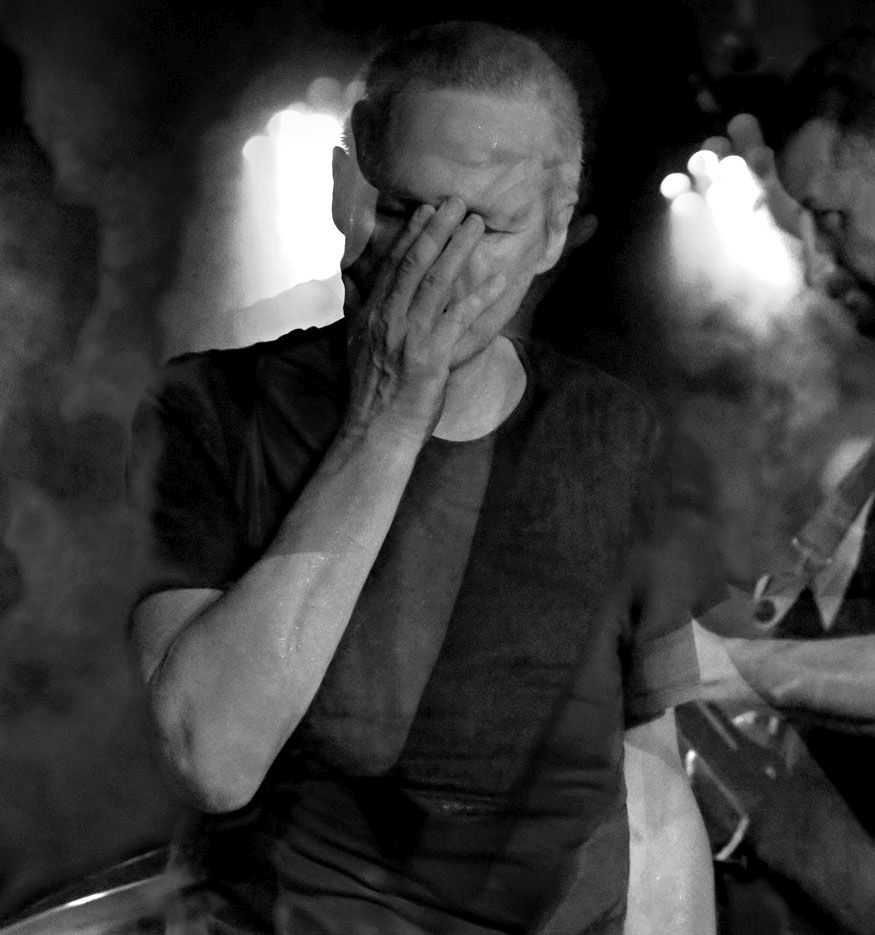
Published
Name: Jos Kleij aka G.W. Sok
Occupation: Vocalist, lyricist,
Nationality: Dutch
Current release: G.W. Sok teams up with Pavel Tchikov under their duo name of Sopa Boba for the album That Moment, out via Sub Rosa.
Recommendations for Amsterdam, the Netherlands: Well, I live in a beautiful city which I love to leave at times, because once being away for a while it always feels nice coming back and realize that I actually live in quite a pretty city. But, because I do live there, I hardly ever go to tourist attractions and the likes, too many people there anyway.
But, if you ever decide to go to Amsterdam after all, and you like adventurous off the beaten track alternative music, you could consider a visit to Occii, located in a beautiful building at the rear end of the Vondelpark. For over 30 years it’s been an independent non-commercial breeding ground and meeting place for all kinds of music and musicians and music lovers and still gong strong. (The park nearby, though, is not that bad either. But, of course, true, quite a different Cattle Office indeed.)
[Read our Pavel Tchikov interview]
If you enjoyed this G.W. Sok interview and would like to stay up to date with his music, visit his official homepage. He is also on bandcamp, and Facebook.
For the views of some of his collaborators, read our Andy Moor interview, Kyle Bruckmann interview, and Jessica Moss interview.
Do you think that some of your earliest musical experiences planted a seed for your interest in writing lyrics or poetry? How and when did you start writing?
To be honest, when I was a kid I wasn’t very busy with or interested in making music. I didn’t think I was capable of making any. I did like music though. To listen to.
Around 1970 I was in my early teens and I was a big fan of bands such as Shocking Blue, Slade, the Sweet. (Ssssstrangely enough I seemed to be sparked by bandnames starting with an S. Around 1974 I was a big fan of Sparks.
So I', starting to wonder now, is me making an S of myself (Sok being my alias) in 1979 a Freudian slip or something after all? Haha, too late to change that now, I guess.
Anyway, I digress. From an early age on I liked reading. A lot. I liked a lot to read a lot. But I didn’t write, at first. But around the ages of 14, 15 I started to like to write little poems, although I wouldn’t call it poetry or something, this was all adolescent stuff, and I still had to learn, like, e-v-e-r-y-t-h-i-n-g about how one could write something coherent. When I was about 17 a short story got published in a cultural magazine for young people. That actually felt good. Apparently I was not totally talentless.
Around 1977, 1978 me and my friends started to go and see a lot of punk rock shows. Now that did plant a seed. It seemed that you could just start from scratch and start a band called The Ex. Was it that easy? Great!
So mid 1979 we started a band. And since I had no clue of playing an instrument and since I wrote the occasional poem, it was decided that I would be the vocalist. Haha, as if I could actually sing! How little did they know. (Well, in fact, they did know, but we didn’t care. Because somehow it kind of worked.) And since I was the vocalist, I was supposed to write the lyrics. And since I said okay to that, I though I might as well do it as good as I can, because I don’t want to make a fool of myself.
Basically it started there and then: as a band we believed everything was possible, and once we decided to go for that, we didn’t want to waste our time with not doing our very best.
Entering new worlds and escapism through music and literature have always exerted a very strong pull on me. What do you think you are drawn to most when it comes to writing?
Most of the time, I used to mainly write when I had to. Well, perhaps not in the early years, back then I just wrote and wrote and wrote, because our band was always hungry for new songs and eager to get better. That was a good way of slowly developing some writing skills.
With the years, though, I have realized that I am a bit of a deadline man: sometimes I don’t feel like writing, partly because I am not always per se inspired and don’t know how to get started, so I don’t get any far. But when there are deadlines, I manage to suddenly find a way to get a foot in the door, somehow my brain more quickly starts to be able to find interesting and useful elements of lines and words, and once it starts rolling I am really on a roll.
I realize that this is not at all an answer to the question. Sooo, basically, what I am really drawn to in writing is the playing with language, to find your way through the idea of a story, either abstract or concrete, giving it body, with a head and a tail, and with a certain cadence in it that fits the music involved.
What were some of the artists and albums which inspired you early on purely on the strength of their lyrics? What moves you in the lyrics of other artists?
In 1972 I bought the Ziggy Stardust album, and the next ten years I bought each and every Bowie album (a stretch that took a break in 1983, as I didn’t like the Let’s Dance one and all the stuff that came after it.)
I, the teenager, didn’t always understand the lyrics, but they were catchy and full of imagery, and they felt important. And there was the ever-changing visual aspect.
All this also applied to Sparks, their lyrics are always funny and weird and with a twist.
Later on, I got into the early Roxy Music stuff. The lyrics of “In Every Dreamhome A Heartache” are pure poetry.
All of them are not all how I myself would write song-lyrics, but I can totally enjoy a good text that adds something extra to the music.
It doesn’t have to be clever or anything, it can also be simple, but if a lyric is good it makes a song so much better.
It is sometimes said that “music begins where words end.” What do you make of that?
I guess that is a very simple way of talking nonsense. I don’t know much about music, I can’t tune or play an instrument and I have no idea of my vocal range or if I even have one, but I do know something about words used in music.
In my opinion, when used well, whether they’re concrete or abstract, the musicality is both in the words and in the way they are being used. Like, a well-spoken poem can have a very musical quality.
Words are a part of an instrument, in this case the voice, and it all depends on what you do with them.
The relationship between words and music has always intrigued me. How do you see it? In how far can music take you to places with your writing you would possibly not have visited without it?
As said before, I am a kind of deadline writer. Once I know when a text has to be ready and that date is getting closer and closer, I am able to, well, to come to the point, so to speak. And when it has to be a song lyric, I write best when I know more or less what the melody will be like, where the music is going to, where it is leading me towards.
When we are practising, I listen to what the others are doing, for instance a jam that somehow slowly takes the shape of a song. I usually don’t “sing” much then, I listen, observe, and take notes for myself. I hum along with the music, might bump into some sort of melody, mumble a bit of mumbo jumbo, perhaps a couple of nice words pop up. I try to write down what I just did, hopefully I can remember later on what I meant with what I wrote and how to sing it …
When I am at home and listen to a recorded instrumental track I kind of do the same thing, making notes of where I think a piece of text would do nicely. Or where it feels necessary to keep my mouth shut. I don’t know yet what I want to say, but somehow lines and ideas start to take shape.
I mumble along with the music and after a while I get a feel of how many lines the song needs, or if it needs a chorus of some kind, or that it will become a story that I do not have come up with yet. The music will often lead me at a certain moment into a direction where I start to feel comfortable.
Just by doing so, and by trusting my instinct, the contours of a lyric evolves out of all that. And then when it starts to make sense, I begin sculpturing all this caterpillar-like vagueness of mine, and with adding and chopping and restructing phrases and verses a butterfly might emerge, with colours that I never had thought of before.
What are areas/themes/topics that you keep returning to in your lyrics?
In my early years I wrote a lot about politics, social injustices, anti-war, things like that. We grew up, so to speak, during the height of the Dutch anti-establishment, anti-capitalist, squatting movement, so these protest-like lyrics came kind of natural.
But with the years we began to realize that we didn’t want to talk about just that. We grew up with No Future, which was a nice starting point, sure, but, say, ten years later we also wanted to talk about what made us tick, what made us happy, and yes we actually did believe in a future.
Because together with all these like-minded people we were creating an alternative future of our own, and it worked. So yeah, let’s share it with the rest of us.
On the basis of a piece off That Moment, tell me about how the lyrics grew into their final form and what points of consideration were.
In the case of Sopa Boba, my present project with Pavel Tchikov and Jean Vangeebergen, it was easy, because the lyrics were already there.
It’s a story by the Moldavian author Nicoleta Esinencu about how money and greed corrupt people and politics and everyday life. Jean, being a theatre-guy, constructed the text in seven chapters, then Pavel composed all the music around that. They asked me to get involved and the idea was that there would be another 3 to 4 vocals. But budgetwise and logistically we couldn’t afford that, so we ended up with me doing al the different voices.
I had to do a lot of reading, to learn to understand the text, because the story in itself is pretty dark, with a lot of cynicism, but at the same time there is a lot of humor in it as well. So, first we worked on the different voices. They would all be me, but the mother, the father, the boy, they should all have something distinct, without me having to say things in a silly voice or something.
Then we went through the text, chapter by chapter, because depending on the way you speak a certain line or put the emphasis on certain words, things might get different meanings from what you want them to mean. Plus, I needed to redo all these parts a lot of times, in order to feel comfortable enough to give the words a certain flow.
Now the strange thing with this text was that, originally, when Pavel was given it by Jean, they thought, and so did I, later on, that this story was about life in Eastern Europe. Pavel comes from Russia, and he recognized all of it, for him all this was like the daily life of his youth as he knew it.
But a few years later (as the project started in about 2021, 2022 or so), by the time we had finished the recordings and were busy getting everything ready for the record-release and our very first live-shows in 2025, we realized that this story was actually no longer about Eastern-Europe per se.
The idiocy in the USA after Trump became president, the fascist shit happening there (and not only there) right now in front of our very faces, it is exactly as in That Moment, this story that suddenly had become much more than just.
Do you tend to start writing with what will be the first line of the finished lyrics? The chorus? At a random point? What are the words that set the process in motion?
It depends. If the band I am working with, gives me suggestions about what the song could be about, then I start thinking in that direction by collecting ideas and phrases that deal with those suggestions. And then, listening to the music I usually find a sort of pattern in which I develop the actual text.
If that band doesn’t have any suggestions other than “do what you want, we trust you”, then I find it quite difficult, to be honest. There’s so many things you can write about, but when it is unlimited and I don’t know what the band wants because the band doesn’t know either, then I don’t know where to begin.
I listen to the music, what does it tell me, I make some notes, write some unconscious blurb, look at it later and hope there’s a line or two that sound promising. And if I find a few more, and put them next to each other, the contours of an idea, a thought, might start to appear. Now I think I got something, and I try to give them a place somewhere in the music, more or less at random yes, but I believe/trust/hope that I will recognize the spot where it triggers it, this something that I can’t explain but that makes me realize I’ve found something that will work.
When I write I never think in choruses. In verses, yes, or, say, isolated words or phrases, or just one big blob of text. All depending on the music. And then at times it happens that the music makes we wanna add a chorus after all.
But the lines that end up being the chorus are often lines I would never expected to turn into a chorus. It just so happens often enough that I repeat a line because I thought, hey that sounds pretty good on this rhythm here, why not do it once more, and maybe one more line… and hop! a chorus is born. I think a chorus is the easy part, so I don’t want to use it too often.
When you're writing song lyrics, do you sense or see a connection between your voice and the text? Does it need to feel and sound “good” or “right” to sing certain words? What's your perspective in this regard of singing someone else's songs versus your own?
To me, there definitely is a sense of connection. When I write, I can hear my own voice saying these words and when it doesn’t feel good then I have to find other ones.
There has to be a rhythm, cadence in the text, so that it comes alive when I speak these words. When I feel the right flow, I feel more convinced and then I am therefore more convincing, because then that text has become somehow me. And although I use other people’s texts at times, there are a lot texts that I definitely can not use. There are writers whose texts I feel very comfortable with, and there’s a whole lot where I don’t feel it all.
I guess it has to do with how they write, how they use the language. If I can relate to it, and I am able to chew on it long enough to find my own flow, then these texts can feel like as if I could have written them and so they can also become a bit like me, and therefore a bit like mine, so to speak.
I worked a lot with Oiseaux-Tempête from Paris in recent years, and they would give me the texts they wanted for the music. Often poems by Mahmoud Darwish, often not the kind of stuff I would write myself, so it usually took me some time to get a grip on it. But once it did, I started to feel more and more comfortable with it.
And then, after a while these texts grow into your system, and then you can make them kind of do anything you want. Without making too much of a big S of mysellf (dixit mr. Sok).