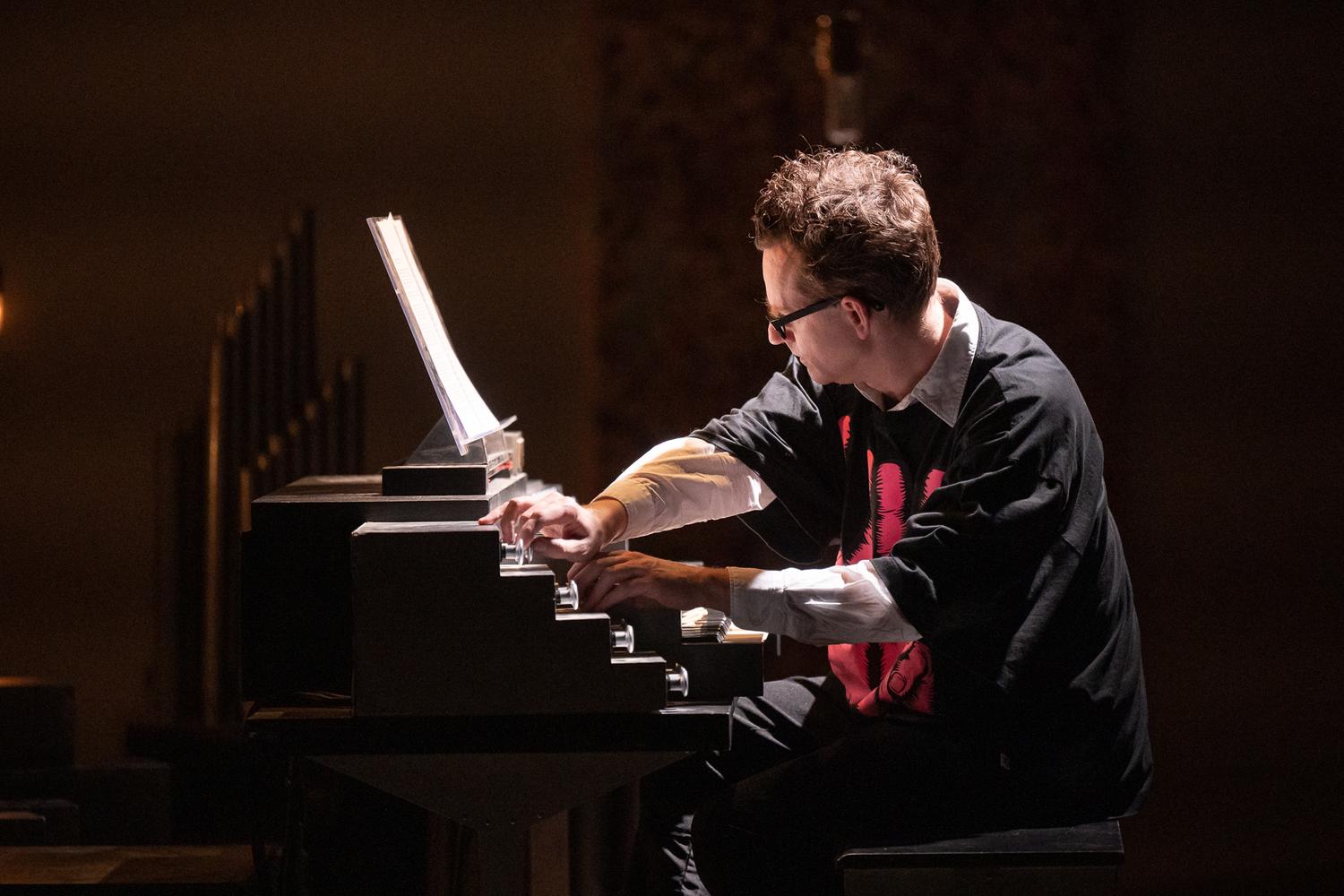
Published
Name: Hampus Lindwall
Nationality: Swedish
Occupation: Organist, composer, improviser
Current release: Hampus Lindwall's new album Brace for Impact is out June 20th 2025 via Ideologic Organ.
Recommendations for Paris, France: I would suggest you visit Seth Price’s solo exhibition ‘Free Fall’ at Chantal Crousel gallery. It runs through July 26. Seth is one of the most visionary artist of my generation, and has continuously created new and challenging works over a several decades long career.
I would also suggest you go to the mass in one of the big, well known churches, and listen to the organist improvising. There are so many great musicians out there, and experiencing it in the acoustics and the setting of the mass is the best.
Topic I am passionate about but rarely get to talk about: Check out Amina Hocine! She is creating (and performing on) fascinating instruments made out of things she buys from a hardware shop. She also has a super cool website.
If you enjoyed this Hampus Lindwall interview and would like to know more about his music, visit his official homepage. He is also on Instagram, and Bluesky.
The borders between producers, sound artists, and even songwriters are becoming increasingly blurry. What does being a composer mean today, would you say?
The blurrier the better! I like it when those fields are a bit more free flowing. People could slide in and out of categories and do different things, I think that’s great for everyone.
I myself have done a number of very different organ recordings of course, but also a solo album for the Roland TB-303 called ‘Lost & Found’. That’s a play on the notoriously bad memory chips that often gives you surprises.
Some of the best things on that album was actually “invented” by the machine itself when it was turned on and off. I chose to keep that and integrate it.
Many people perceive classical music and contemporary composition as having high barriers of entrance, both for listeners and musicians. What have your own experiences been in this regard?
I was always focused on doing new music, my own and others, and I was lucky to become friends with a group of incredible composers when I moved to Paris in the early 2000s (Mauro Lanza, Francesco Filidei & Noriko Baba and others). Already when they were young they had so much maturity and technical skills, and very distinctive styles.
I myself, had difficulties getting out of the academic composition style after the conservatory, and didn’t produce anything for years other than improvisation. I felt like all I was doing was inside the academic definition of “contemporary music”, and I didn’t like that.
At some point, I went through a phase similar to Baldessari’s ‘I will not make any more boring art’, which was a similar rebellion against academic art. This was possible through my friendships with some of the most free thinking artists like the Dutch art collective JODI (aka JODI.ORG, Joan Heemskerk & Dirk Paesmans) and Cory Arcangel, who has become a longtime collaborator with our series Hidden Noise.
He also designed the cover for our recent trio release with supergroup Lippard / Arkbro / Lindwall, ‘How do I know if my cat likes me?’.
[Read our Ellen Arkbro interview]
As of today, what kind of materials, ideas, and technologies are particularly stimulating for you?
The Internet was incredible until around maybe 2010, now it’s not working the same anymore, or maybe I got out of phase with it.
In organ building there are also many interesting inventions, like the computer driven control system which can be a great tool to construct new sonorities using complex and unusual combinations of pipes.
Where do most of your inspirations to create come from – rather from internal impulses or external ones? Which current social / political / ecological or other developments make you feel like you need to respond as an artist?
Almost always from external stimulation, mostly visual arts, film or literature. Art doesn’t have to be political, and purely political art is always lame.
But when it comes to organ building, I always tend to think in ecological terms. With only a very limited number of new organs constructed yearly, I don’t think it represents a big part of the problem, but sustainability must always be a concern.
Composing has always had an interesting relationship between honouring its roots and exploring the unknown. What does the balance between these two poles look like in your music?
This statement is valid for all kinds of art, and it’s a double-edged sword.
Tradition can be a prison, but without it you can’t do anything. I have struggled with this while teaching too, and I don’t think there is an answer that is valid for everyone. Many of the best visual artists I know studied other things, like psychology, musical composition or even farther away subjects like law. It always seems like it’s an advantage.
But I’m not in favor of any amateurism where the craft is neglected, which has also been a recent trend. Music is also very technical in the way you produce it, whether you play an instrument or you compose a score or instructions for someone.
It’s a great question, and I don’t have an answer.
How much potential for something “new” is there still in composition? What could this “new” look like?
A lot!! There are so many things to explore, and they lie in front of us, without anyone touching them.
What role do electronic tools and instruments play for your creative process? What does your creative space / studio look like and what tools does it contain?
I have used my iPad since about 15 years as a tool for live sound processing. The programs I use are easy enough to manipulate with one hand and I can play the organ with the other.
'Swerve’ from Brace for Impact is an example of that.
I also use MIDI controlled organs, and ‘À bruit secret’ is a good example of this; the first element which includes all the 56 notes on the keyboard would be impossible to perform with bare hands.
The different sequences were computer generated as well.
It is my impression that adding a conceptual, non-musical dimension to one's work is almost a prerequisite for commissions and grants. How do you view this tendency and how “conceptual” is your own approach to writing?
A lot I would say. In the trio I have together with Hanne Lippard & Ellen Arkbro we have a highly conceptual approach. I’m still waiting for someone to coin what musical genre we should be in [laughs].
On our recent release How do I know if my cat likes me?, the music is entirely fueled by the text. Oddly enough, we never discussed making a concept album beforehand, but afterwards it was striking that the recurrent themes were very much the same; mostly frustration over seemingly hopeless interactions with technology and alienating society.
I’m old enough to have grown up before the arrival of the Internet, and when I called somewhere, there was a person at the other end of the line. Today it’s almost impossible to reach beyond automated voices. Pieces like ‘Unavailable’ sounds comical at first, but ends up being agonizing and existential when the minutes pass, and you realize how short your life is.
It might be less visible in my solo work. ‘À bruit secret’ is a title borrowed from a Duchamp piece from 1916. His friend Walter Arensberg inserted a small object into the sculpture, and it makes a rattling sound when you shake it. He never told Duchamp what was inside. Similarly, during the development of material for my piece I use an algo that a friend developed, and he never explained how it worked.
Working with long forms, complex concepts or new vocabulary is potentially more challenging today because they require us to remember things that happened perhaps minutes ago – while most of us are finding it hard to focus even on what's happening right now. Both as a composer and as a listener yourself, how do you deal with this?
I really like to experience music in concerts. Same as going to the cinema, you have to endure it. And sometimes that has a positive outcome.
I often tell younger people that when I was a kid, if you wanted to see a film, you had to go to the movie store and rent a VHS cassette. If it felt like the movie sucked the first 10 minutes, there was no way you were going to put on your scarf and clothes again and walk 25 minutes to the video store to rent something else, so you dealt with it and finished the movie.
Now I think that was great! Something I wouldn't have finished if I could zap to the next channel often turned out to be a greater work, it just needed some more time to develop.
For many artists, life-changing musical experiences take place live. Few works these days, however, are performed beyond their premiere. What, do you feel, does this mean for composers, and the music they write, and how does this reality influence your own work?
Yes that is definitely a problem for large scale works like orchestral pieces or operas.
Since I’m both a performer and a composer, I don’t suffer from this. But it’s a question one has to consider for someone who’s asked to make a large scale piece.
How, would you say are live performances of your music and your recording projects connected at the moment? How do they mutually influence and feed off each other?
That’s funny because playing pieces live really gives you an idea about how the music is perceived by an audience, and that influences the recording. But when you record something, you have to spend so much time with the material that it also enhances the knowledge of the music and hence the performance.
I can definitely relate to the recording artists of the 20th century, that often recorded up to three versions of their repertoire throughout their lives.
To some, the advent of AI and 'intelligent' composing tools offers potential for machines to contribute to the creative process. What are your hopes, fears, expectations and possible concrete plans in this regard?
I have used AI a bit, but mostly for practical things like calculations of random series or generating chords. Pretty dumb stuff to be honest! I have hopes that it could be a great tool in the future when it becomes more integrated in the machines, and why not in organs?
I think that some of the most popular film scores today could probably already be done by AI. But I think it’s difficult to imagine AI becoming artistically independent and creative.
But maybe I’m underestimating things. I saw a meme that said something like “Can AI replace musicians? Let me know when it can get drunk and trash an hotel room”. There’s a certain truth to this, that the greatest creative minds that I know are not wired the same way as others.
Are there approaches, artists, festivals, labels, spaces or anyone/-thing else out there who you feel deserve a shout out for taking composition into the future?
Yes, we are actually doing one ourselves!
In 2022 Stephen O’Malley and I started a concert series in my church Saint-Esprit in Paris called Les Inspirations Visibles. It’s an attempt to give a scene to music that doesn’t fit neatly in a box. We immediately saw that there was a hole to fill, and our concerts are almost always completely sold out!
I have worked in this church since 2005 and the priests are very supportive of us.
The Montreux Festival intends to preserve its archive of recordings for future generations. Do you personally feels it's important that everything should remain available forever - or is there something to be said for letting beautiful moments pass and linger in the memories of those that experienced them?
Everything will eventually turn into dust! We got a strong reminder of that when Notre-Dame burnt. Some things are ephemeral by nature, and that’s fine too. You can’t save a great meal or glass of wine for eternity, and I guess some things will live only in our memories.
I like to think of it that way with all the improvisation I do during the masses in church. I play 4 services per weekend and there’s a lot of music in there. It lives in the parishioners’ minds for a while, and will hopefully help them to pray. But there will be no trace of it in the future.