Published
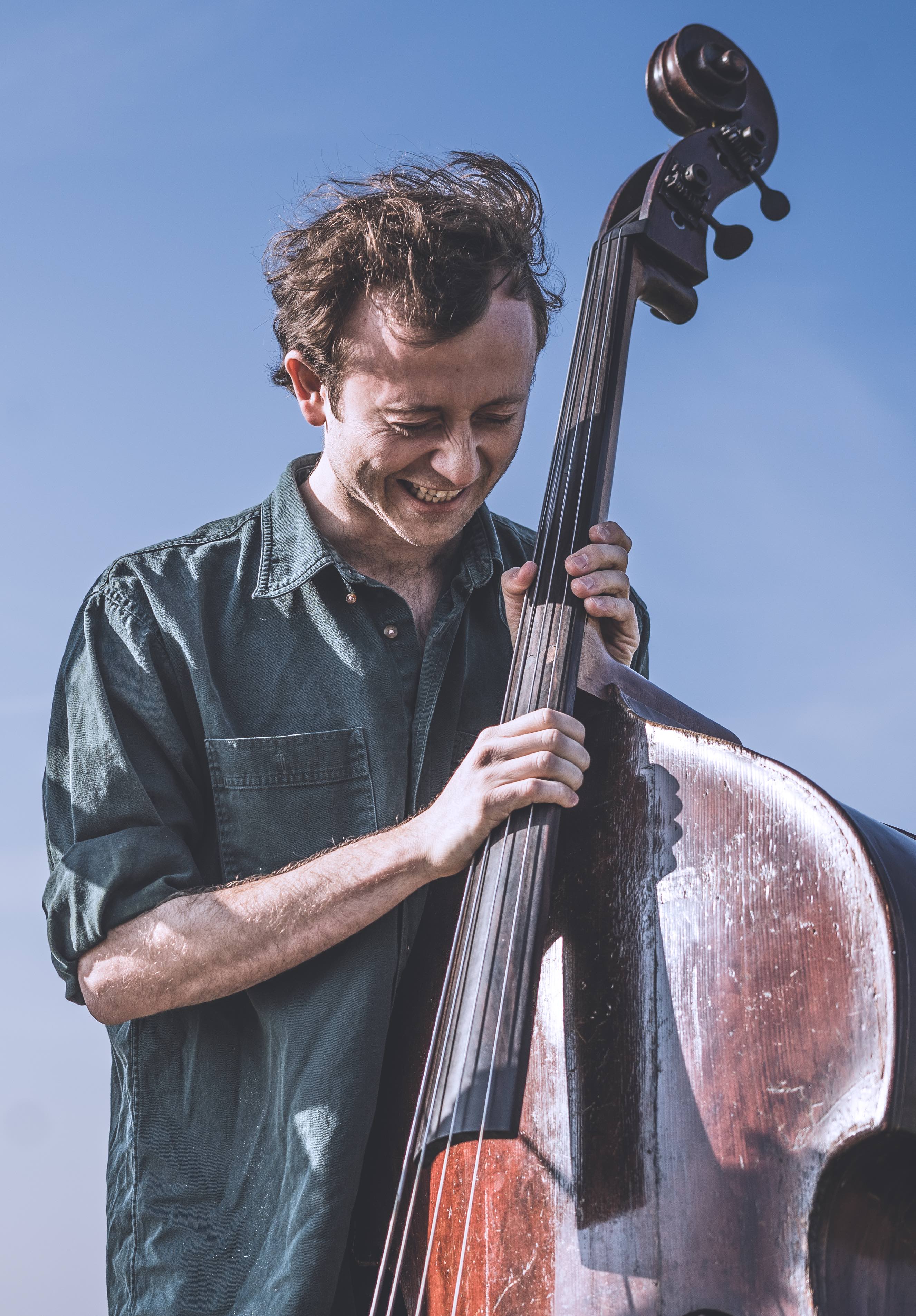
Name: Hans Bilger
Nationality: American, Berlin-based
Occupation: Musician, sound engineer, producer
Current release: Hans Bilger teams up with Eli Greenhoe for their new duo album Orchids, out via Adhyâropa.
Recommendations for Berlin, Germany: Check out the music club Donau115! It’s my creative home in Berlin, and just a wonderful place.
If you enjoyed this Hans Bilger interview and would like to find out more about his music, releases and upcoming live dates, visit his official homepage. He is also on Instagram.
Where does the impulse to create something come from for you? What role do often-quoted sources of inspiration like dreams, other forms of art, personal relationships, politics etc play?
For me, it’s something mysterious and constitutional.
It’s very rarely related to a specific happening, like a dream or political event. Making music just feels like something I have to do.
For you to get started, do there need to be concrete ideas – or what some have called a 'visualisation' of the finished work? What does the balance between planning and chance look like for you?
When I’m writing a song, it usually has to start with some kind of musical kernel or seed. Most often, it’s a figure on the guitar or double bass.
And much like the way in which a seed contains the genetic plan for a tree, I often feel like my musical “seeds” contain the basic instructions for the rest of the song. The mood, the length of subsequent phrases and sections, the development of the harmony—all of it is usually at least vaguely suggested by the core musical idea that I start with.
But the subsequent sections certainly don’t come to me fully formed at the beginning. I usually get the seed for free, as a gift, and then it’s mostly craft from there on out.
Is there a preparation phase for your process? Do you require your tools to be laid out in a particular way, for example, do you need to do 'research' or create 'early versions'?
Nothing set in stone. If I’m writing songs, I’m usually fleshing them out through sequentially numbered voice notes on my iPhone—whenever a new section or idea in the song feels like it’s taking shape, I’ll make a quick recording, and sometimes listen back to it a few times to see if it’s landing in the way I suspect.
Other types of composition require a different process. When I’m writing music for the dance company Cora Dance, for example, I’ll usually have several conversations with the choreographer, Shannon Hummel, to get a sense of the general sonic direction and dimensions for the piece.
And if there are any non-instrumental sound that I’ll need to include—like a field recording of a natural or urban environment, for example—I’ll try to source those first. They usually have a sonic texture that determines what other types of sounds can fit into the piece.
After those steps, I’ll often set up a good set of microphones and improvise something on the bass or guitar. Once I get a performance I’m happy with, I’ll use that as a kind of “skeleton” upon which I hang the rest of the sounds of the piece.
Some or all of the original improvisation might be deleted by the end, but I find that establishing it as a kind of reference point gives the pieces an organic structure that they wouldn’t have with a pre-planned rhythmic grid or sequence of concepts.
Do you have certain rituals to get you into the right mindset for creating? What role do certain foods or stimulants like coffee, lighting, scents, exercise or reading poetry play?
I need to be alone, and I need to have a sense of peace. I have a toddler, so at the moment, having much more ritual than that almost feels like an indulgence.
But it’s also been nice to have these small, intense windows for making things. In a weird way, it almost keeps me more connected to the stream of music that feels like it’s always surrounding me.
If you want to step into it quickly, you have to keep it close.
For your latest release Orchids, what did you start with? If there were conceptual considerations, what were they?
I made Orchids with my production partner Eli Greenhoe.
Eli and I have been friends since middle school and making music together about as long. Eli lives in Brooklyn, where we both grew up, and I live in Berlin. At the start of the pandemic, we decided that we wanted to try and make a “Postal Service”-style EP, where we’d each recorded tracks remotely and then eventually pair them with a couple of sessions where we recorded things together.
It grew from there and became much bigger than either of us expected. We added more songs, and more and more musicians, until at a certain point we realized that we weren’t creating a Covid EP—we were slowly building a musical world. The songs were going to have to sonically and emotionally connect to each other in several dimensions, not all of them conscious or intentional.
Conceptually, we became preoccupied with the idea of coherence—how could we make this group of stylistically varied music seem like an inevitable grouping, somehow foregone?
Tell me a bit about the way the new material developed and gradually took its final form, please.
For most of the tracks, we started with a basic version that featured both of us performing together live. We recorded some of these at Old First Reformed Church in Brooklyn, NY, some at Eli’s family’s cabin in Vermont, and some in our respective homes.
We then did several overdub sessions for each song where we added things like string orchestras, percussion, electric guitars, synths, and bass clarinet. Getting the acoustics of the different recording spaces to blend was one thing we were particularly concerned with. We wanted many of the spaces to feel big and airy, even though the music was often intimate.
That was a tricky ask when tracks featured recordings done in both churches and spare bedrooms.
What makes lyrics good in your opinion? What are your own ambitions and challenges in this regard?
I suppose what makes a good lyric kind of depends on the song for me.
But some things I often look for are rhythmic, phonetically tailored lines that fit their melodies well; a lack of cliché; a sense of honesty (honesty in intent; not diary honesty); a sense of generous mystery; an activating effect on the imagination. Also, they shouldn’t kill the momentum of the music—they should either be transparent and almost disappear into it or they should give it a kick in the pants.
My ambition is to write lyrics with the above qualities, I guess. As far as my own challenges: I can sometimes be too concrete and logical, and at other times too abstract and associative. Sometimes I’m too sincere; at other times I’m too coy. Finding the right balance with these things is difficult.
What are areas/themes/topics that you keep returning to in your lyrics?
Dreams, love, tenderness, violence, menace, care.
Many writers have claimed that as soon as they enter into the process, certain aspects of the narrative are out of their hands. Do you like to keep strict control or is there a sense of following things where they lead you?
In the broad sense—not all of my music has a strict narrative—I like to follow things where they lead me. But as I mentioned above: the “seed” material I’m working with usually only suggests a few viable paths forward. And that’s a productive constraint for me.
I think it’d be harder for me if I felt like I could travel in any direction at any time.
There are many descriptions of the creative state. How would you describe it for you personally? Is there an element of spirituality to what you do?
The creative state—whether writing, playing talking, etc.—is one of the most beautiful states of mind and forms of attention that I know. It gives me the feeling that someone has taken the roof off my psyche, and fresh air is rushing in.
And yes, there is definitely something spiritual or faith-based in this for me. I believe that that the universe is not indifferent; that at the center of everything is something loving and good that we might call God. And I think that the creative process continually tests that aspect of faith.
Over and over again, we have to stare down something that looks superficially empty—the blank page, the waiting instrument—and trust that something lovely is waiting to appear.
Once a piece is finished, how important is it for you to let it lie and evaluate it later on? How much improvement and refinement do you personally allow until you're satisfied with a piece?
It’s very important. Certain qualities you can only see with time.
But also, I don’t usually scrap entire sections after I think something is more or less finished. Once I’m at the end of a piece, the “curing time” is mostly useful for small refinements.
How do you think the meaning, or effect of an individual piece is enhanced, clarified or possibly contrasted by the EPs, or albums it is part of? Does each piece, for example, need to be consistent with the larger whole?
I think that individual pieces certainly take on resonances from the other pieces on the EP/album they’re a part of. They take on a different, and hopefully deeper meaning, in context.
But I don’t think their meaning is fully determined by that context. I love it when a song from Abbey Road comes on the radio, even when it’s bookended by Marvin Gaye and Charli xcx.
In terms of what they contribute to a song, what is the balance between the composition and the arrangement (including production, mixing and mastering)?
If a recorded song were a movie, then the composition would be the script, the performance would be the acting, the production would be the directing, the recording would be the cinematography, and the mixing/mastering would be the color grading/quality control. They’re all necessary steps in making a recording, but none of them alone is sufficient.
That said, there’s a hierarchy of importance. The composition and basic performance come first; all the rest is crucial but secondary.
Music and the accompanying artwork are often closely related. Can you talk about this a little bit for your current project and the relationship that images and sounds have for you in general?
The pianist Simone Dinnerstein has a beautiful album of Bach and Schubert called Something almost being said, whose title she took from Philip Larkin’s poem The Trees.
Well, for me, music is something almost seen.
The act of making music, mixing, writing, fills my head with visual impressions—but they’re more like gestures of light rather than specific images. So therefore, album artwork has always had a special importance for me.
As far as the process of making/commissioning it goes, though—I’m not too prescriptive. I prefer to work with visual artists with a strong style and allow them to respond to the music, while giving them some guidelines to work within.
The cover of our current album is a photograph of a little owl named Greta that came to roost in the tree outside Eli’s parents’ house during the making of the album. There was something about this picture of Greta that just felt like Orchids to us—dense, detailed, organic, lovely but a bit foreboding.
We tried out a few different images as well, but we just kept coming back to this one.
After finishing a piece or album and releasing something into the world, there can be a sense of emptiness. Can you relate to this – and how do you return to the state of creativity after experiencing it?
I can definitely relate to it—but these days, I’ve got so many projects running simultaneously that I’m usually in several creative stages at once.
I feel this kind of creative emptiness more acutely after performing. If it has been a meaningful performance, where we’re really on a wavelength with the audience—or one where I feel like I haven’t risen to the occasion—I can feel pretty hollowed out afterwards.
The solution is basically always to just make more music—especially with others. That always fills me back up.
Creativity can reach many different corners of our lives. Do you personally feel as though writing a piece of music is inherently different from something like making a great cup of coffee? What do you express through music that you couldn't or wouldn't in more 'mundane' tasks?
I just read this great article in The Strad from 2001 about the German violin maker Martin Schleske. He’s done a lot of formal study in physics and creatively incorporates those insights into his violin making. But he also says there’s a point in his process when artistry becomes its own, unalloyed thing:
Schleske believes that 'aesthetics is not a subsidiary branch of physics, and great instruments will never be made by analysis alone. There comes a point when we have to jump in and become violin makers. As soon as we do this we are too close for understanding. When we listen to great music we don't understand the music, just as when we pray we don't understand God. Instead we feel understood.'
I feel a very similar way. Making music makes me feel understood in a way that literally nothing else in my life can. That’s why I keep making it.