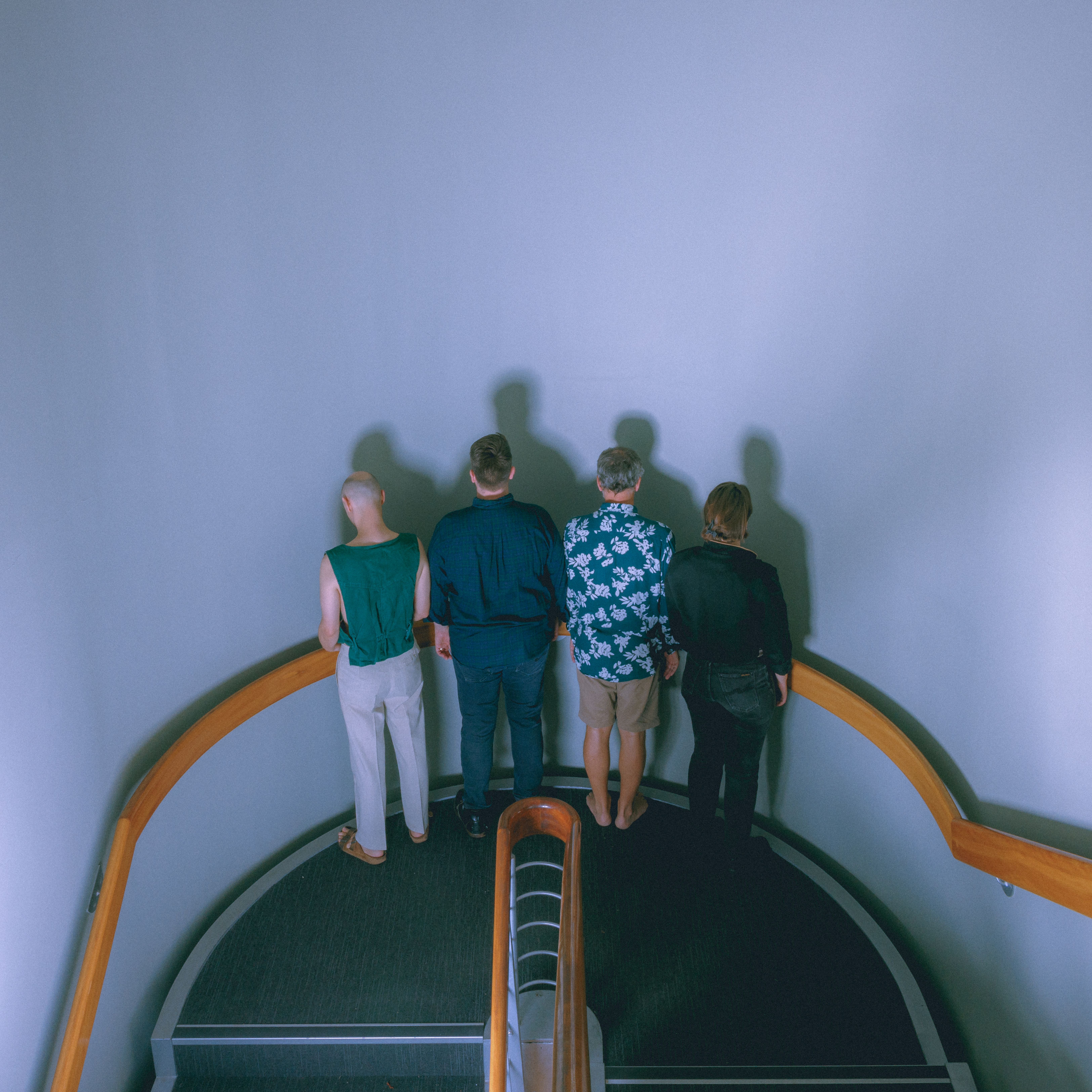
Published
Name: I Hold the Lion's Paw
Members: Reuben Lewis (trumpet, synthesisers, pedals), Emily Bennett (voice, synthesisers, lyrics, vocal compositions), Adam Halliwell (bass guitar, guitar, double neck guitar, 12-string guitar, flute, voice), Ronny Ferella (drums, voice)
Interviewee: Reuben Lewis
Current release: I Hold the Lion's Paw's new album Potentially Interesting Jazz Music is out September 26th 2025 via Earshift.
Shoutouts: A shout out to Koi Kingdom, another Naarm-based trio of musicians who have forged their own path and made their own version of jazz.
Recommendations for Brunswick, Auastralia: The Brunswick Green is a great little bar on Sydney Road. Every Thursday for the last 18 years, Michelle Nicole (a guest on Potentially Interesting Jazz Music) has performed with her trio. She takes song requests and finishes every night with a sing along of “You are my Sunshine”. It’s still the best jazz in town to me.
Topic I'm passionate about but rarely get to talk about: I love effects pedals. Chase Bliss changes the creative game for me pretty much every time they announce new gear. I think we’re in a really exciting period where technology is getting more accessible/portable/powerful, which is in turn feeding the appetites of designers and artists who want to explore new possibilities.
If you enjoyed this I Hold the Lion's Paw interview and would like to stay up to date with them and their music, visit their band page on Reuben Lewis's official website. They are also on Facebook, and bandcamp.
What were some of the musical experiences which planted a seed for your interest in jazz?
I was fortunate to have Miroslav Bukovsky as a creative mentor from a very young age.
Miro is one of those unsung heroes who has had an incredibly important influence on generations of jazz artists in Australia, and I count myself lucky to have had some of my earliest experiences of making my own jazz music under his care and guidance.
What does the term jazz mean today, would you say?
To be honest, I’m not sure if we’re the right people to be asking! Lion’s Paw called our newest record Potentially Interesting Jazz Music as a humble provocation for the audience to ponder this question, not because we had the answer.
There is something to be said about convention and/or conservatism in terminology, however. Jazz often seems to be described as an add-on to a hip sub-genre or a nostalgia trip.
We’re not interested in that. We improvise together and draw influence from things that interest us without much thought on the style or genre.
As of today, what kind of materials, ideas, and technologies are particularly stimulating for you?
The record making process has become such an important part of how Lion’s Paw continues to refresh itself.
This album’s nine collaborative tracks emerged from a seven-hour marathon improv session. The material was then manipulated, collaged and massaged in post-production; broken into parts, and then carefully reassembled.
This time around, there was a newfound delight in brevity and subtle song structures that really shines through on the record.
Where do most of your inspirations to create come from – rather from internal impulses or external ones? Which current social / political / ecological or other developments make you feel like you need to respond as an artist?
A big part of the yearly Lion’s Paw tour schedule at the moment involves performing our music for children in Imagination Exploration for the Musica Viva Australia in Schools Program. We get to connect with kids from all walks of life across Australia and share how improvisation can be a powerful tool for making something magical with whatever materials are at hand.
It’s really special to be regularly performing as an ensemble in a context with such a direct impact on the future (our kids). It keeps the music sharp and our artistic intentions accountable.
Tell me a bit about the sounds & creative directions, artists & communities, as well as the colleagues & creative hotspots of your current hometown, please. How do they influence your music?
Naarm/Melbourne is a really interesting creative hub for all sorts of artforms. In addition to all sorts of music, there is a vibrant independent dance scene here that I’ve come to know and love (check out Dancehouse if you are in town and want to see some interesting dance work).
I Hold the Lion’s Paw have had the good fortune of connecting to that scene, in particular through our durational jams with Tony Yap Company.
What role do electronic tools and instruments play for your creative process?
For Lion’s Paw, electronic tools are heavily embedded into our sound and creative processes, especially when making records.
There’s no aversions or grand intentions, it’s simply that we enjoy the possibilities afforded by using those tools and feel very comfortable using them to experiment together.
Thanks to technological advances, collaboration has become a lot easier. What have been some of the most fruitful collaborations for you recently and what approaches to and modes of collaboration currently seem best to you?
Making Potentially Interesting Jazz Music stands out as a special collaborative moment.
We spent a lot of time editing, overdubbing and distilling every offering so that they could be as potent as possible.
I also made a point to mix every track separately from the ground up, which was an incredible chance for us all to reflect on how we work as a unit.
Jazz has always had an interesting relationship between honouring its roots and exploring the unknown. What does the balance between these two poles look like in your music?
I’m not sure if Lion’s Paw is interested in setting up that dichotomy within our music.
I think we’re more interested in the journey, honouring the moment, and creating a permeability within our creative materials that lets new possibilities redirect the flow.
How much potential for something “new” is there still in jazz? What could this “new” look like?
I think jazz naturally leans towards the “new” if it’s taken as a guiding philosophy for assembling and experimenting with varied materials and influences.
I think where it gets stuck is when fixations on genre, nostalgia, classicism and fashion start to limit the scope.
For many artists, life-changing musical experiences take place live. How do you see that yourself?
For sure. Lion’s Paw had the unique experience of performing Lost in Place 14 times in 10 days in 2024.
I don’t think anyone in the project was the same person after almost 50 hours of live durational improvisation at that intensity!
How, would you say are your live performances and your recording projects connected at the moment? How do they mutually influence and feed off each other?
Potentially Interesting Jazz Music feels like a new era within the context of Lion’s Paw.
For years now we have almost exclusively performed long-form free improvisations when playing live. We took that process into the studio and came out the other end with what feels like extremely compact offerings of eclectic musical universes.
Now that the record is out, we’ll go through an extended process of fleshing out those universes within a live context, until we reach a point where they have evolved into something else entirely that deserves investigating further within a studio context. And on it goes …
Ímprovisation is obviously an essential element of jazz, but I would assume that just like composition, it is transforming. How do you feel has the role of improvisation changed in jazz?
I think genre and stylistic conventions have become more and more dominant when considering improvisation in jazz. When everyone is trying to work with the same materials there is a risk of the beautiful mico-cosims of local scenes becoming bland.
That being said, there is a new wave of incredible improvisers across Australia that are actively bucking that trend in my opinion.
What, would you say, are the key ideas behind your approach to improvisation?
I wrote a Masters Thesis on this topic within the context of Lion’s Paw if you really want to go there ;-)
In a nutshell, I started the band to freely collaborate with the places, people and creative contexts that inform my identity as an artist.
My role as bandleader is to keep the door open to possibility when we improvise. It’s about the journey and the mapping of a shared vision.
The Montreux Festival intends to preserve its archive of recordings for future generations. Do you personally feels it's important that everything should remain available forever - or is there something to be said for letting beautiful moments pass and linger in the memories of those that experienced them?
I’m not sure that archives and recordings CAN fully capture those moments ...
Recordings tend to make memories of their own in my experience, which is why I love making records as much as performing live.