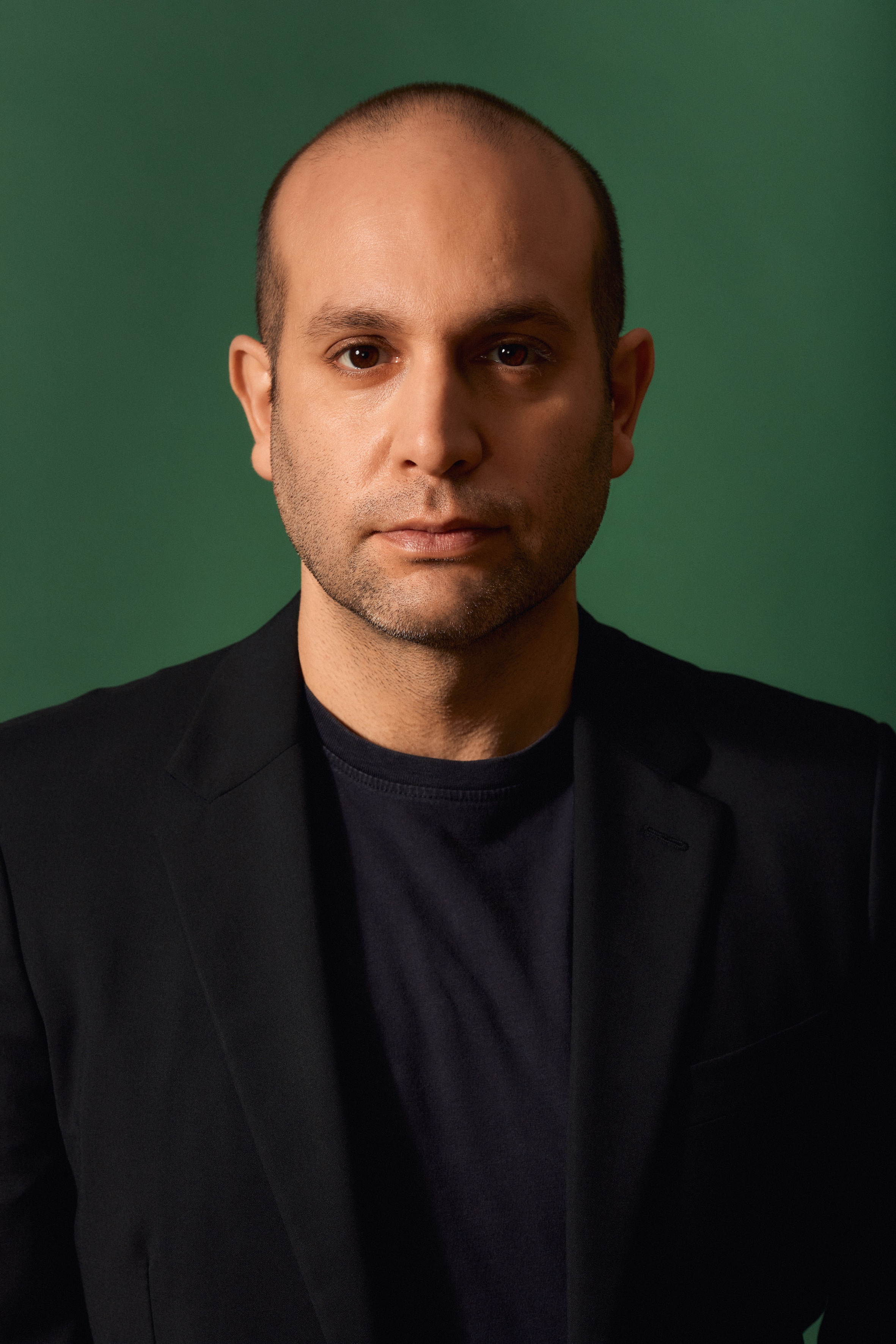
Published
Name: Ilan Eshkeri
Nationality: British
Occupation: Composer
Current release: Ilan Eshkeri Space Station Earth is out via Masterworks.
Current event: Over the course of 2026, Ilan Eshkeri will tour Space Station Earth, a music-led, multi-media experience that allows the audience to see through the eyes of astronauts and to contemplate our planet, the stars, and the exploration of the universe. Get tickets and find out more here and see the performance at one of the following venues and dates:
MAY
28th - Glasgow, Royal Concert Hall
31st - London, Royal Festival Hall
JUNE
5th - Birmingham, Town Hall
6th - Manchester, AVIVA Studios
Recommendation for London, UK: London has a lot to offer right now. There are several exhibitions worth spending time with, Tracey Emin at Tate Modern, Turner and Constable at Tate Britain, and David Hockney at the Serpentine. Each offers a distinct way of seeing and feeling, and that range of perspectives is what matters most to me.
If you enjoyed this Ilan Eshkeri interview and would like to stay up to date with his music, visit his official homepage. He is also on Instagram, and Facebook.
Where does the impulse to create something come from for you? What role do often quoted sources of inspiration like dreams, other forms of art, personal relationships, politics etc play?
It usually begins with something that shifts how I see the world.
With Space Station Earth it was a conversation with astronaut Tim Peake about what it feels like to see Earth from orbit, not the data, but the emotional experience.
Known as the Overview Effect, it is frequently described technically or with images but rarely described poetically. How could I translate something almost impossible to describe into music?
For you to get started, do there need to be concrete ideas or what some have called a visualisation of the finished work? What does the balance between planning and chance look like for you?
I begin with research and immersion rather than a clear picture of the finished work, spending time with scientific thinking, at places like the Royal Astronomical Society, and reading texts that explore humanity’s place in the cosmos. I also had direct experiences, including a zero gravity flight and being present at a rocket launch, which were mind bending and informed the physical impact of the work.
From there, I start playing with notes and sounds, and when they stop being random and begin to mean something, they form the core fragments of the composition. I don’t know if that comes from intention or discovery, so it sits somewhere between planning and chance.
Some ideas are defined early. Here, it was the blending of electronic and organic elements, reflecting both humanity and the machines that allow us to travel into space. From orbit, daylight shows only the natural world, while at night artificial light reveals human presence. That idea of nature and machine sits at the core of the work, which is why the audience sees synthesisers next to strings, and guitars next to horns on stage
Is there a preparation phase for your process? Do you require your tools to be laid out in a particular way, for example, do you need to do research or create early versions?
I like to evolve my creative environment and tools for each new work. Working in unfamiliar ways inspires creativity, so I change instruments and environments.
At an early stage I like to have instruments at my fingertips. With Space Station Earth, it was about how an arpeggio feels on a violin versus a Juno synth, the imperfect expression of the string in contrast with the repeated precision of the synth.
Preparation for performance is more structured. Once the framework is established, there is space within it to play, allowing each performance to shift in response to the space and audience. Being in the moment on stage has such energy, I love the flying V guitar and the keytar moment during Moon, or the huge build in Launch and the release as you enter space.
The work creates a sense of scale that can feel overwhelming, whilst dropping into moments that are very quiet and intimate.
Do you have certain rituals to get you into the right mindset for creating? What role do certain foods or stimulants like coffee, lighting, scents, exercise or reading poetry play?
For me it’s about discipline. When I am in a creative cycle, I try to write something every day. It doesn’t have to be good, it just has to be there. I can always improve it tomorrow.
I like changing my environment, walking from my studio in the garden to the piano in my living room, so I’m working with the same idea in a different space. That shift changes how the material develops. The change of environment is also why the performance changes in different venues.
For Space Station Earth, what did you start with? If there were conceptual considerations, what were they?
It was the idea of shifting perspectives, with multiple ideas unfolding together. The structure emerges through repetition and layering, meaning gradually coming into focus. The individual pieces function like this.
Composing began with two days of working with analogue synthesisers, recording fragments that were the seeds of the work. From there, I developed it through layering and orchestration
In ‘Day’, the electric piano figure was the starting point. That initial fragment becomes the anchor for the piece.
It’s joined by acoustic guitar and voice which ground it in something intimate and human. Gradually, synths gather and expand, building in scale and intensity before being overtaken by sustained string lines, rising brass and drums, pulling everything toward the Earth. The sound reaches a peak, then suddenly falls away into silence, with the planet suspended across the screens.
What remains is the quiet electric piano from the beginning, now carrying the weight of everything that came before.
Tell me a bit about the way the new material developed and gradually took its final form, please.
The music came first, shaping the emotional narrative. Through this, the layers and overall form emerge as a continuous, unfolding experience.
From there, the visual language emerged. It became clear that the work should unfold as a triptych, three ultra wide screens showing Earth. This allows a single or up to three different perspectives to exist at the same time, in dialogue with the layers of music.
Synths, strings, brass and choir build a sense of scale in the room, while the images show weather systems, land and oceans connected without borders, and the atmosphere as a thin, fragile line around the planet. It’s the music that opens the emotional path that allows you to engage with the images.
Night Parts 1 and 2 tend to leave audiences with the most varied interpretations.
The work moves into the Earth from slowly floating above the globe, drawing closer to city lights, then dividing the screens to compare distant galaxies with those same lights. Rapid staccato notes contrast with long legato lines, and the macro and micro begin to blur.
You are placed inside the work, surrounded by music and image, creating a visceral experience. It is in performance that the work fully exists.
Many writers have claimed that as soon as they enter into the process, certain aspects of the narrative are out of their hands. Do you like to keep strict control or is there a sense of following things where they lead you?
It’s a mixture of these ideas.
As you create the framework and core ideas, it can demand things from you. Sometimes it’s about melody leading or implied harmony, sometimes the sound of an instrument, a Moog synth, or a brass section dictates the flow, and sometimes you have to deliberately get in the way of it. I am always pushing against the edges of the medium. That’s where the most interesting and unexpected ideas happen.
Occasionally I grow attached to an idea that I should leave behind. It can be helpful to reframe yourself as the listener, not the composer. Moving between the two roles can be a powerful tool.
This idea of following where things lead extends beyond the studio. It was because of my early career work on Layer Cake that Tim Peake contacted me. My music has taken me on journeys I could have never imagined.
There are many descriptions of the creative state. How would you describe it for you personally? Is there an element of spirituality to what you do?
It’s the moment when the notes stop being random and start to mean something. When they become greater than the sum of their parts. That’s the moment that is impossible to explain. Meaning appears, and then the question becomes whether it was discovered or created.
I find it hard to recall the moment of pure creativity. Once all the research was done and initial musical ideas came into being on Space Station earth the album formed very quickly.
Once a piece is finished, how important is it for you to let it lie and evaluate it later on? How much improvement and refinement do you personally allow until you're satisfied with a piece? What does this process look like in practise?
Refinement never really ends. The end product is not the part I’m most drawn to, it’s the process of creating that I love.
Nonetheless, at some point you have to let it go, and the recorded work defines it. But performance opens it up again. I start to focus on the details that shift within that structure, the pacing, the balance, how far something is pushed.
Aurora is a really special moment in the show for this, it’s never exactly the same. That’s what makes it work live. The work continues to evolve every time it’s performed.
How do you think the meaning, or effect, of an individual piece is enhanced, clarified, or possibly contrasted by the EPs or albums it is part of? Does each piece, for example, need to be consistent with the larger whole?
With Space Station Earth, the individual pieces have meaning in their own right, They describe specific moments, ‘Maps’, ‘Sun’, ‘Day’, ‘Rocket’, ‘Launch’ etc.
But the cumulative effect of the complete work has layers of meaning. There is the journey to the International Space Station and on to the stars. There is the journey from day to night, past to future, innocence to experience, natural world to machine world.
The full meaning only emerges across the whole journey, and even more so when accompanied by the images in a live setting.
What’s your take on the role and importance of production, including mixing and mastering, for you personally? In terms of what they contribute to a song, what is the balance between the composition and the arrangement performance?
I don’t separate composition, arrangement, and production, they’re the same process. The sound is part of the composition. The way something is performed, recorded, layered, and shaped over time is the work.
Sometimes a sound leads to a set of notes, and sometimes the other way around. Sometimes what you create doesn’t work until an effect is applied to it.
Melody and arrangement are interchangeable, and mixing isn’t a final stage, it’s part of the creative process, shaping perspective and narrative through sound. This is particularly clear in the interplay of electronic and organic elements, where one begins and the other ends is often unclear.
In Rocket, balancing these layered textures is what makes the piece work. Production is the space in which the music comes into being.
Music and the accompanying artwork are often closely related. Can you talk about this a little bit for your current project and the relationship that images and sounds have for you in general?
In Space Station Earth, the music shapes how the work unfolds over time and the images fill that space.
Musical layers across instrument groups and visual elements across the three screens allow multiple perspectives to exist at once. It’s a dialogue between forms, not a translation from one to the other, which allows the audience to find their own meaning in the work.
Because of my synaesthesia, music and colour are closely linked, so directing the film felt like a natural extension of my practice.
After finishing a piece or album and releasing something into the world, there can be a sense of emptiness. Can you relate to this and how do you return to the state of creativity after experiencing it?
Stars is the last piece on the album and was the last piece I finished writing. Creativity moves in a continuous cycle of input and output. There are periods of absorbing work, and periods where that material turns into new work, so I don’t feel emptiness.
Typically those states don’t overlap for me, but if I get stuck during a period of output, I move sideways. If I’m making music, I won’t listen to music, I’ll go to a gallery instead.
So I don’t think in terms of leaving or returning to creativity with emptiness between; I’m always moving within a cycle.
I would love to know a little about the feedback you've received from listeners or critics about what they thought some of your songs are about or the impact it had on them, have there been misunderstandings or did you perhaps even gain new insights?
Once a piece is released, it exists within the audience’s context, not just mine anymore, so meaning shifts. Because the work is asking questions. I welcome this, but mostly I hope that the work remains relevant, even as its meaning changes over time.
So far it seems like the scale, the immersion, and the shared moment creates a profound experience for the audience. Astronauts have said it successfully expresses the experience of looking at Earth from space very closely, and audiences have said that it’s as close as they could imagine to being in space.
Creativity can reach many different corners of our lives. Do you personally feel as though writing a piece of music is inherently different from something like making a great cup of coffee? What do you express through music that you couldn't or wouldn't in more mundane tasks?
The difference is in how you approach it.
Making a cup of coffee can be pure craft, done with care, precision, and consistency. But if a visionary chef pushes the boundaries of what a coffee can be, it becomes something else, an expression.
So the difference isn’t between food and music, but between craft and art. Craft fulfils a function. Art pushes beyond it, asking questions and finding something new.
It comes down to whether you’re fulfilling expectations or redefining them. Art is not defined by the form, but by the intention.