

Name: India Gailey
Nationality: American-Canadian
Occupation: Cellist, improviser, composer, multidisciplinary artist
Current release: India Gailey's new album Butterfly Lightning Shakes the Earth is out via redshift.
Shout-outs to those taking composition into the future: Most of the artists on my mind have already received many a shout out, but I have I have so much admiration for artists who merge different realms:
Björk for taking complexity into the pop universe; Nicole Lizée with her vintage machine classical psychedelia; Kronos Quartet and their creative commissioning– like working with Tanya Tagaq to arrange her throat singing compositions for string quartet; Tanya herself;
Caroline Shaw and her expansive practice that weaves between songwriting, production, and composition; Julia Holter; Mary Lattimore; Holly Herndon;
Sō Percussion; Architek Percussion (PERCUSSSION!).
And so many more. Much gratitude to the many inspiring artists out there who are pushing frontiers.
[Read our Julia Holter interview]
[Read our Mary Lattimore interview]
[Read our Jeffrey Zeigler, formerly of Kronos Quartet interview]
If you enjoyed this India Gailey interview and would like to know more about her music, visit her official homepage. She is also on Instagram, and Facebook.
What were some of the musical experiences which planted a seed for your interest in composition?
I was always an improviser.
When I first got a violin at seven years old, I didn’t quite know how to play Vivaldi’s Four Seasons, so I made up my own version using mostly open strings. Later, in high school, I was given an assignment for English literature with several options to report on Shakespeare, and composing some pieces of music to represent the characters of Hamlet and Ophelia seemed like the easiest route ...
I no longer think composing music is easy … but when I was young, playing with indie bands, dabbling in all sorts of instruments, playing along with recordings of the Silk Road Ensemble, it seemed natural to just make up the music as I went along.
I also loved the strange, and my fascination with the avant-garde grew as I learned of artists who really shook up expectations and social constructs. Like there was this obscure album that my dad’s friend sent us called Tubas From Hell—I thought that was the most delightful thing.
After I read somewhere that Oscar Wilde used to keep a pet lobster and take it for walks, I told all my friends at school.
Composition was about a lot more than just music for many decades. For you personally, is music still a way of life or a way of seeing life – and if so, in which way?
Very much both. My entire life is arranged around making music. I work way harder than I would like, but I’ve gotten used to this sporadic lifestyle.
And in the everyday, each aspect could be framed as somewhere on the spectrum between improvisation and composition. All of life is listening, responding, and creating a reality in cooperation or discord with the elements, resources, and beings who are around.
I try to use music as a practice that can both ground and uplift myself and others.
Many people perceive classical music and contemporary composition as having high barriers of entrance, both for listeners and musicians. What have your own experiences been in this regard?
Oh for sure. When I first got to McGill, playing on a cheap cello from Ebay and not having attended Juilliard pre-college, I felt like a complete imposter.
I did most of my real practicing at a later age than most, and there were people who told me that at age 20, it might already be too late for me to be the musician I wanted to be. A distinction that could mean drowning outside the barrier vs slipping through the door was often very subtle. My rejection-to-success ratio for auditions took a long time to improve.
And then for the audience–yeah, expensive tickets to get into this place where there are all sorts of unfamiliar words, forms, and intellectual jargon that we’re supposed to know and it’s really easy to clap at the wrong time?
But then there’s a whole generation trying to avoid the elitism of classical music, trying to cultivate a vibe that feels accessible. I think there are some people out there doing really interesting work in this regard, but it can also hard to measure the success of certain efforts.
What, would you say, are the key ideas behind your approach to composition?
Environmental degradation is very sonically alive for me. I am inspired by the stories in the weeping Earth, exploring a space between the real and the fantastical.
What would a musical illustration of a gnarled 5000 year-old tree sound like? The song of a mountain, the spirit of the wind? If the ocean were translated through radio transducers, what would it say? Composing Butterfly Lightning Shakes the Earth was a rich experience because I felt room to explore much more than a single organism, creating a whole poetic world.
In terms of sound, I like to combine some kind of old-world sound with acoustic imitations of electronic effects. That’s probably the core of my style. I love an early music vibe– no vibrato, diatonic modes, fourths and fifths. I love evolution purely within colour and texture. I love a good simple melody. I love taking a piece of material and exploring the different ways it could be painted so it’s a little fancier.
For many artists, life-changing musical experiences take place live. How do you see that yourself?
My most vivid musical memories are of being at a concert, being in a place and experiencing something. The rawness of the performers living and breathing, untouched by pro-tools, an improvisation spontaneously in conversation with the space, an unrecorded composition uniquely unfolding in time, a room full of people sharing this, each having their unique experience. It’s basically my religion.
I remember when I was a lot younger, sitting in the front row as a cellist I still very much admire, Denise Djokic, began the first chord of Britten’s first cello suite. I was so struck by the passion and fullness of that first chord that it gave me full body chills.
How, would you say are live performances of your music and your recording projects connected at the moment? How do they mutually influence and feed off each other?
As a performer, I have worked with many other composers, and many of my performances lately have been of specially commissioned works as part of a project/album called Problematica, which mixes cello, electronics, voice, and composers from various musical communities I’ve been a part of.
Lately I have also been performing a lot more of my own compositions, and the premiere of my cello concerto Butterfly Lightning seems to have been a transition point in that zone for me. I’m really enjoying working with ensembles on my music, performing it with them, and sometimes going totally free rogue solo set. Performing is how I get to know music and musicians deeply, and playing other people’s music expands my own voice and technical capacity.
Cello is my primary writing tool, so playing a wide variety of music programs all sorts of different ideas into my body where they swim around and mingle with my memories to re-emerge somehow transformed in my own writing.
There are various models to support composers, from financial help to mentorships/masterclasses. Which of these feel like the best way forward to you?
I would like to have my own Esterhazy, but only the good parts. If you know them, send 'em my way.

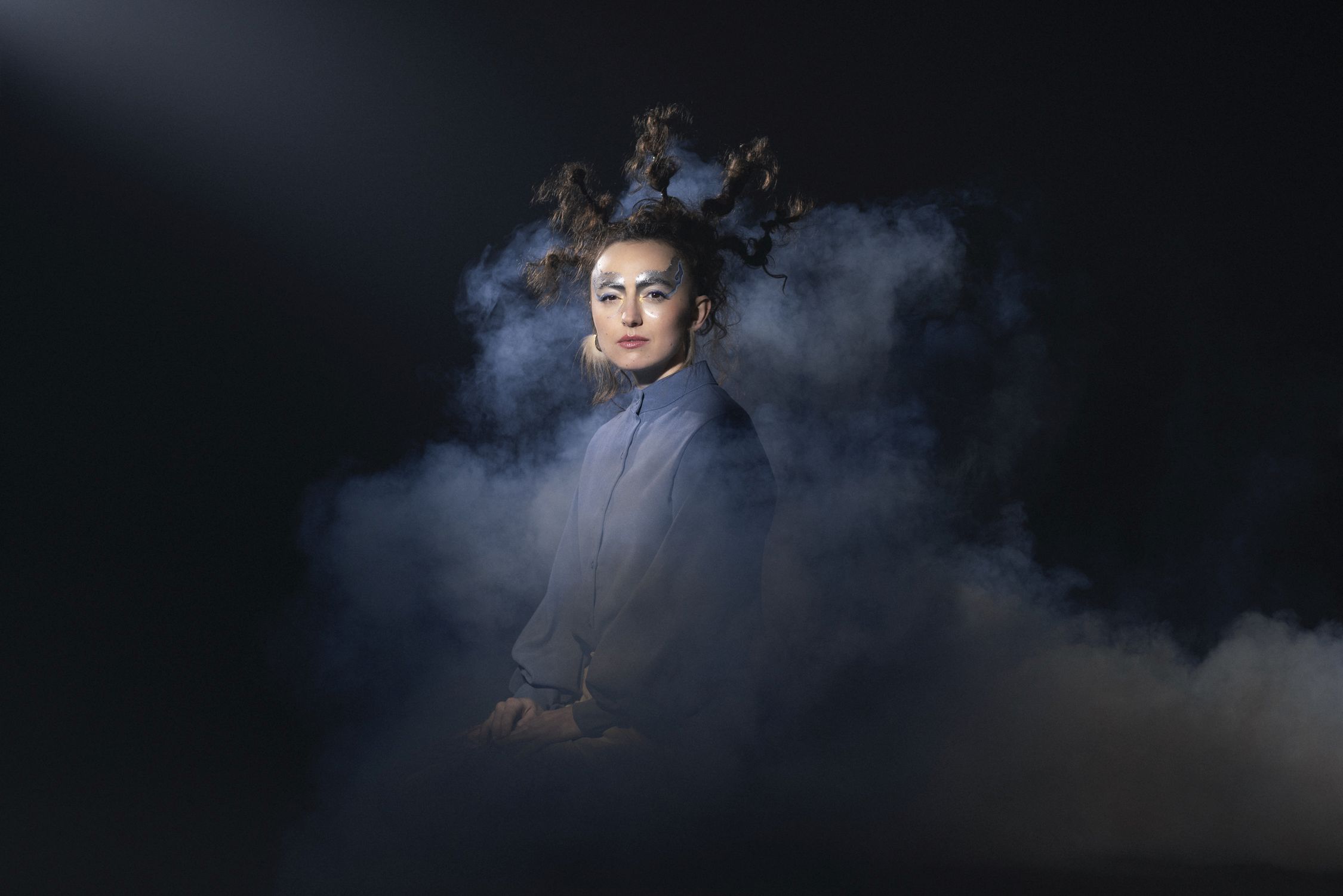 India Gailey Interview Image by Meghan Tansey Whitton
“I like to combine old-world sound with acoustic imitations of electronic effects.“
Video
