Published
Band Name: Ciao Kennedy
Members: Samuel du Fontbaré (guitar), Leopold de San (guitar), Simon Boonen (drums), Geronimo de Halleux (keys), Gaspard de Bellefroid (bass)
Nationality: Belgian
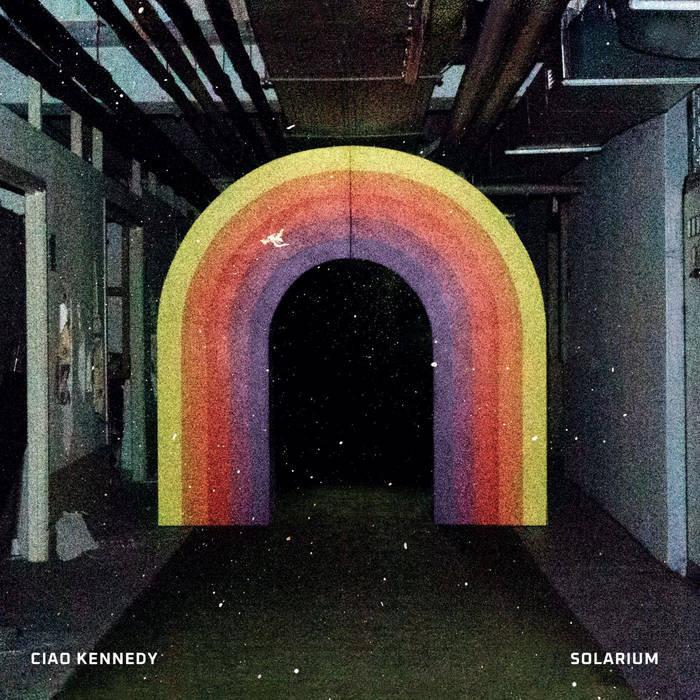
Release: Ciao Kennedy's new album Solarium is out via Sdban.
Review by: Tobias Fischer interviewing himself
This interview review is part of 15 Questions's project of finding new, more engaging formats for the review format.
For a deeper dive, read our Ciao Kennedy interview.
There was a time when this band would have been called “the future of rock.”
I remember it well. Some of my most memorable musical discoveries took place in that time.
Ciao Kennedy, as a very basic stylistic description, are fusing the worlds of rock music and electronica and that's a combination which, almost throughout the entire 90s, seemed like it would become the dominant force for the entire industry.
The movement extended from the experimental post-rock scene, almost single-handedly engineered by John Mcintire out of Chicago, up to the industrial metal perfected by Fear Factory and the block rocking beats of the Chemical Brothers until the concept eventually found its commercial peak in the release of Linkin Park's debut album.
If anything, Ciao Kennedy are closer to the early phase of this period, when the sheer determination to break borders and the joy of exploring the potentials of new and cheap technology were overwhelming.
So, in a sense, they're a tribute band?
That's the thing: on paper, everything points in this direction. But they're really not.
Do you remember that moment in Trans Am's “Rough Justice,” off their seminal Surrender to the Night allbum?
You mean when they band are riding this big, hypnotic riff and you're waiting for some sort of release … and then suddenly, there's a huge blast of noise and it shreds their performance and rips the entire song apart?
To this day, I remember reading about that passage in the German edition of Rolling Stone magazine as something deep and important.
It sums up the entire fascination of rock musicians with electronic music back then: That it was a force of nature, which would, like a tidal wave, sandblast the old and rusty structures of the genre to make way for something fresh.
For the Chemical Brothers, or Underworld, on the other hand, rock was both an approach to music – immediate, no thinking and all feeling – and a set of tools that seemed to congenially complement their dancefloor productions.
Coming home late at night from a party, putting on MTV and seeing Karl Hyde holding a guitar and running around a stage to that mesmerising, 12-and-a-half-minute-long dreamstate of “Juanita/Kiteless” felt entirely natural to me.
Ciao Kennedy, however, don't fit into this discussion.
When I spoke to their bassist Gaspard de Bellefroid, the artists he specifically mentioned as personal favourites were Mark Giuliana and King Gizzard & the Lizard Wizard …
… from the corner of jazz and psychedelic rock respectively …
… and then, of course, they released their previous EP on Layva which also features outfits like Tukan, who, coincidentally, just released a new mini-album which is quite similar to Solarium in many respects.
So, really, although Ciao Kennedy are ostensibly an instrumental electronic rock band, their sphere of inspirations doesn't overlap with rock and dance, but rather with experimental fusion, hip-hop, and the most leftfield part of the EDM spectrum.
It's not a continuation of a lineage, it's really an entirely new branch and, frankly, it's extremely exciting to me right now.
I really don't see this as jazz, though.
Not if you're applying the corsetted dictionary definition to it, no. But in that same interview, Gaspard mentioned something that was extremely revealing and quite astute.
Speaking about Giuliana, he said that what attracted him to his music was how he and his band members brought groove and melodies so tightly together that they could no longer be separated. I never thought of it that way, but this really is something quite unique to jazz even today, when it has changed considerably – a key part of an improviser's chops is to play with and against the pulse, to bend the metrum to your will or use it as a grid with hidden pockets.
It is also exactly what sets Solarium apart: It is so rich in melodies that their keyboard player almost takes on the same role as a lead vocalists.
There are some passages here, where I all but expected a rapper or vocalist to come in. A slower track like “sloot,” for example, almost has this trap-like head-nodding beat which would lend itself really well to a few bars or a spoken word contribution.
I am thankful that they never actually go there, though. Because these themes build their magnetism by remaining wordless and in a slightly mysterious place. And the absence of the human voice makes them even more emotionally intense.
Take “Nothing,” for example, which is one of the stand-out pieces for me.
Its chord pattern, combined with the bittersweet lead, conjurs up the same deep feeling I had as a boy listening to Joël Fajerman's L'Aventure Des Plantes. It's absolutely magical.
What's so intriguing, however, is that within this blend of influences, it is surprisingly the electronic parts which will often provide nostalgia, technology acting as a time machine.
So is that time machine going forward or backwards?
It's doing both and all at once. All the bands I mentioned at the beginning, were envisioning the future. They had a certain expectation, perhaps also a hope, of how things would become.
Ciao Kennedy sound as though one of those futures had actually come to pass and we're already living in it. The percussions switch seamlessly from an acoustic, but highly processed kit to a drum machine played with human swing. The synths fly a garishly tinted flag, but they have all the beautiful tiny inconsistencies of being played by hand. The arrangements have the energy and rawness of five instrumentalists standing in the same room, but they were probably laid out perfectly linear in a standard DAW.
You can no longer tell where virtual and physical reality end and begin. In a sense, they're one here – which is a reflection of the exact moment in time we're living in.
I do sometimes wish that we'd get a few more “visions,” you know, ideas that really mark a departure.
In that case, you should listen to “Flub.”
If there's one piece on Solarium that has this a utopian glow to it, it's this one.
The beats lumber along with a happy-robot-like playfulness, the chords describe the kind of sunrise in an distant galaxy that would have painted a smile on Ziggy Stardust's face, the bass suggests a jazzy walking bass played by an alien gym instructor – and at the end, they even add dreamy lapsteel-chords and a catchy melody.
That sounds quite confused to me.
It's endearing and moving, actually.
But either way, it's the future – just like a good science fiction story, if it doesn't confuse you just a little bit, why even bother taking the trip?