Published
Band Name: Imperial Triumphant
Members: Zachary Ezrin (vocals, guitar), Steve Blanco (bass), Kenny Grohowski (drums)
Nationality: American
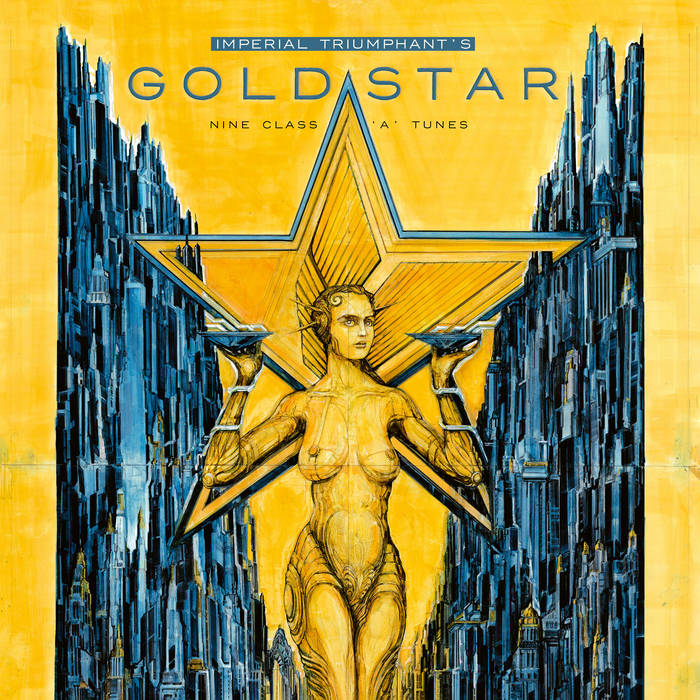
Release: Imperial Triumphant's new album Goldstar is out via Century Media. It features guest contributions by Tomas Haake, Yoshiko Ohara, and Dave Lombardo.
Review by: Tobias Fischer interviewing himself
This interview review is part of 15 Questions's project of finding new, more engaging formats for the review format.
I read a comment about Imperial Triumphant recently, not specifically about this album, which claimed that there were two types of responders to the band: Those who thought the music was extreme, ugly, unlistenable and, thus, terrible. And those who thought it was extreme, ugly, unlistenable and, thus, incredible. The difference was merely that the former group was being honest and the latter wasn't.
I don't think this is an unreasonable criticism, although it's weird it should be held against Imperial Triumphant precisely at the moment their music may well be at its most digestable. History is littered with examples of art praised to high heavens by people who didn't “get it” at all.
Take the atonal/polytonal/serialist movements which dominated contemporary composition for decades. For many, a suitable response to something they don't understand is to worship it – if it's so difficult that you can't penetrate it, it has to be high art.
I do take issue with one thing, though. That comment you mentioned seems to suggest that this kind of response is dishonest. But that doesn't necessarily have to be true. Think of all the albums which fascinated you precisely because they felt alien at first.
Sometimes, you instinctively recognise the presence of greatness although your mind can not yet access or accept it. Something like Coltrane's Interstellar Space, for example.
The band would surely be elated to be associated with an album like that, considering how much they have talked about the influence of jazz. But it doesn't really disprove the basic premise of the argument: That Imperial Triumphant get a lot of love for creating something firmly unlovable.
I guess that's true. On Goldstar, Imperial Triumphant are playing technically ambitious death metal with contagious, chunky riffs, hypercomplex yet remarkably groovy drumming, and many changes in tempo, mood, and material within each single song. Clearly, that's not the kind of material that will endear them to everyone
But at the same time, these arguments don't really hold once you start talking about the actual music. It's an unsettling experience for sure. But there is plenty to instantly latch on to as well.
Like what?
Take the anthemic, classic black-metal tremolos on the chorus of “Hotel Sphinx,” which take turns with future-funk verses pierced by garish post-punk chords.
Something like “Gomorrah Nouveaux” may initially appear to be pure sonic mayhem. But after a while, you realise that its main riff has a trance-like quality to it, something you can simply let yourself be carried away by.
And that Latin-flavoured drum solo in the middle of “Pleasuredome” where Kenny Grohowsky explodes his drum kit into a playful polyrhythmic jam – to me, this just puts a smile to my face.
I know it's not for everyone. But to not see the musical and creative appeal of this is bewildering to me.
So how do you explain that so many are trying to like this and fail miserably?
Something I noticed with regards to Goldstar in particular is that the feedback seems to, again, be divided into two camps:
On the one hand, those who feel like the band are pandering to the masses here by making their songs shorter and their material more accessible. And, on the other hand, those who feel that this is still a muddy mess without recognisable shape or form.
I would argue that in this particular case, both can be true at the same time. By gently opening up their galaxy, many of Imperial Triumphant's most hardcore followers may feel like they're getting cheated. Ironically, it may do nothing to sway the opinion of its detractors either.
Before, they would listen to albums like Vile Luxury, and fail to even see them as music – it was mere “noise” to many. Now, they can see the music for what it really is – and finally put their finger on why, exactly, they hate it so much.
But this can work the other way around, too. I found the following remark in an online discussion. “At first I disliked them because of how unsettling their sound is. But after seeing them live and understanding that it's their goal to unsettle you, I started loving them.”
Sure, and ultimately it doesn't matter what attracts you to something as unconventional as Imperial Triumphant. Discovery, at least that's how I feel about it, should always be part of music.
Although I would like to add: neither do I think Goldstar is particularly unsettling nor do I think that the band's goals should matter for your enjoyment in this regard. Embrace the unsettling, I say, don't wait for permission.
Can you explain what draws you in, specifically?
As a whole, the album has a radio-play-like immersiveness to it. I have always preferred albums which create a journey over those which are a collection of great songs. Goldstar covers both of these requirements, but if I compare it to something like Vile Luxury, where the tone was so dark and the pieces blurred so much into each other, that it felt disorienting at times, there is far more of a narrative here.
One of the greatest moments occurs when the trance finale of “Rot Moderne” fades out and gives way to a cityscape of police sirens, traffic noises and the ringing of a bell which, in turn, gets submerged by another equally brutal and hypnotic instrumental section. That's classic storytelling made even more intense by the sheer rawness of the performances.
Some of it is ugly, but that doesn't deter from but adds to the experience. I see it as an experience similar to a horror movie: The more haunting it is, the more of a relief the deliverance at the end.