Published
Artist Name: Steve Okonski
Nationality: American
Occupation: Pianist, composer, improviser
Release: Steve Okonski teams up with Aaron Frazer (drums) Michael Montgomery (bass) for Entrance Music, out via Colemine.
Review by: Tobias Fischer interviewing himself
This interview review is part of 15 Questions's project of finding new, more engaging formats for the review format.
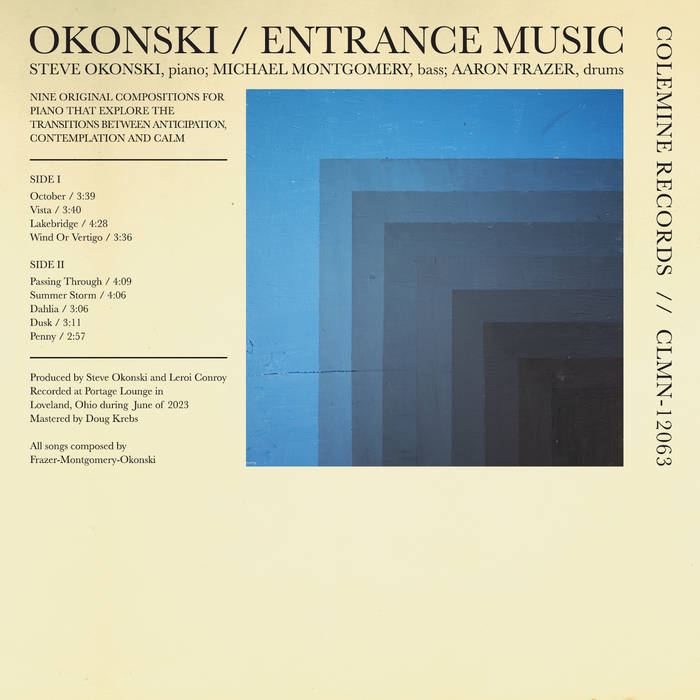
This one has a really nice cover.
Actually I bought it based purely on the cover.
I walked into the “Saturn” on Berlin Alexanderplatz – a large department-type store and not the kind of place you'd expect to carry independent jazz – and was already on my way out when the artwork grabbed my attention.
I saw it and instantly felt a connection.
It's an interesting design. The blue square leads the eye into a mysterious world, almost like the opening of a cave. It would have worked great using up the entire available space. Instead, they cropped it considerably. It's almost like someone cut off the lower half of the cover.
I agree, it's very unusual. In a way, that's precisely what drew me in. The back cover, by the way, is composed in a similar fashion, it's just a small black and white photo of the trio on the left side.
There may be conceptual considerations involved, but really, it spoke to me more on an emotional than an intellectual or even aesthetic level.
It's like this album does not want to make itself bigger than it was. It does not force itself on you, it wants to be found.
I was thinking there might be a connection to the subtitle of the album.
You're referring to the description of the compositions as “exploring the transitions between anticipation, contemplation and calm?” I'm sure there is a connection there and yes, this, too, is an intriguing thought to consider.
After all, it's obvious to see how contemplation can lead into “calm.” But how does anticipation fit into this? Entrance Music doesn't so much give us any clear-cut answers, it simply takes us on this journey.
Most of the pieces follow the classic A-B-A form: A short introduction of a melodic idea, an extended improvisation and, finally, a reprise of the opening theme. It could easily be argued that these three stages represent the transitions: The gentle sensation of excitement at the outset, the reflection of the material and then the pervasive and powerful inner silence upon returning to the source.
It's a really interesting way to think about improvisation in general.
I agree – but if you listen to Steve Okonski's trio play and how different they sound from anything else I know, you realise that not a lot of bands actually do. To achieve this very particular experience, you can't just treat it as a simple variation of the classic jazz template. You have to fill this form with new meaning.
This becomes most apparent in the middle section of the pieces, where the actual improvisation takes place. These are not classic re-arrangements of the melody.
Rather, I experience them similar to “fantasies” from the Romantic period, something Chopin or Liszt could have written: You carve out a path in real-time, you compose the piece as you play, and you allow yourself to stray and surrender control.
One could say: You empty out your mind …
… and then you enter into that state of stillness at the end, absolutely. Now, you can play the same theme again, only this time it is the destination, not the point of departure. The notes are the same, but how we hear them could not be any different.
What I like about this approach is that the materials can be very simple and immediate, yet the potential and the possibilities are almost endless. It also allows the musicians to activate parts of the music which might otherwise remain secondary.
Such as?
Take sound and space – I really don't know a single record which sounds the way Entrance Music does. It's like you're in the room with the musicians, the light of late afternoon on a warm Summer day trickling in, filtered through the leaves of gently swaying trees moved by a breeze. And always, plenty analog hiss, so comforting and blissful.
Coincidentally, Steve has described the music as more “nature-based … a little more ethereal.” That seems apt.
It felt pretty grounded to me.
That's because there's so much personality in these performances.
You have the hip-hop casualness of Aaron Frazer on drums set against the soft rocking pulse of bassist Michael Montgomery, set against the tender touch of Okonski. Each track has at least one special moment: Frazer's almost humorous intro to “Vista,” …
… or the lyrical bass solo in the first bars of “Passing Through” before Steve Okonski enters with these infinitely dreamy and tender chords.
And through it all, the band plays to the pulse of their own metronome, deliberately defying a world obsessed with quantising, correcting, and removing every tiny imperfection.
I think this is what people mean when they talk about music as a form of utopia: This is an album that makes you experience and long for a better world.
That's deep. And, you know, the cover of that first album looks pretty nice, too.
I noticed. Excuse me while I place my order.