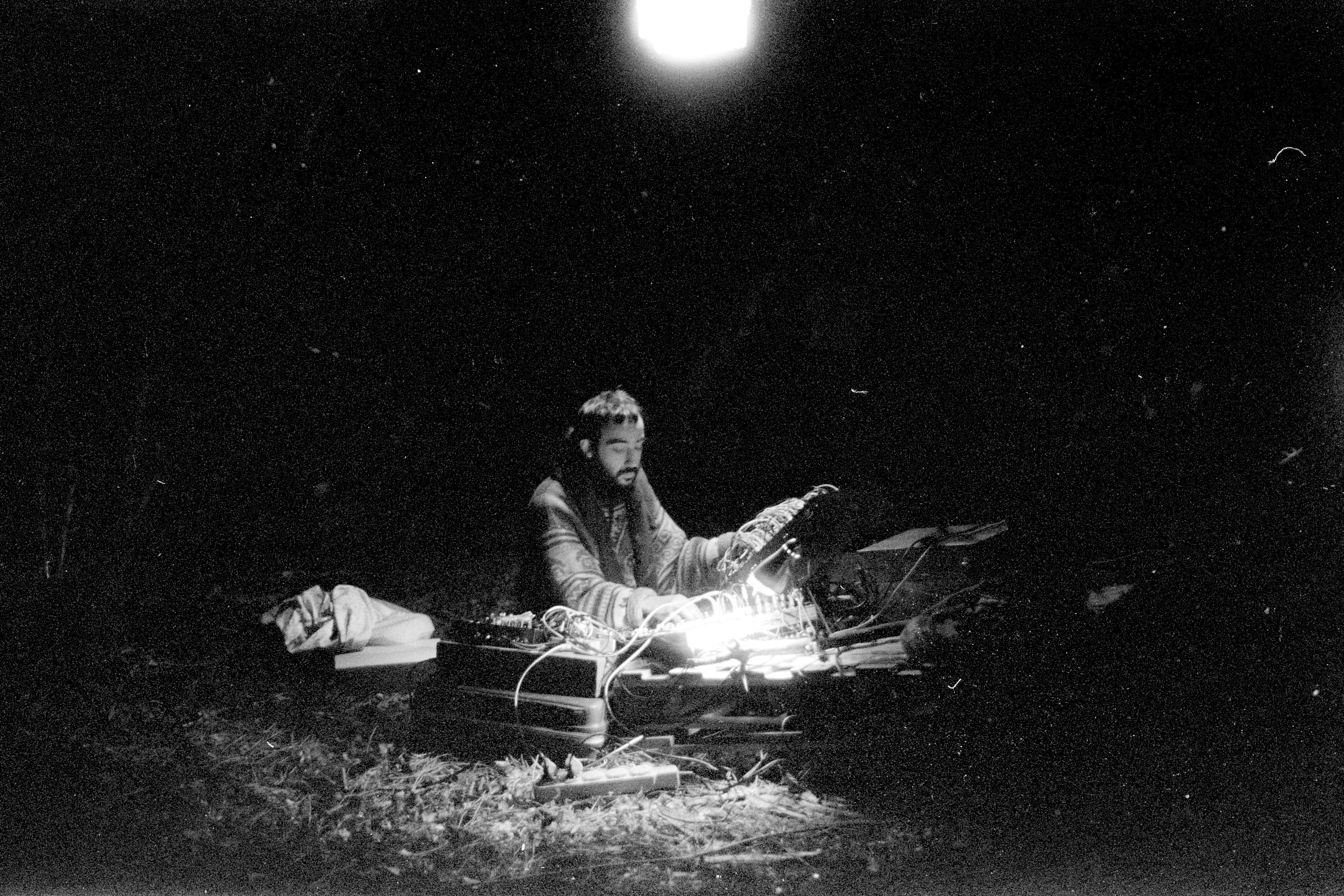
Published
Name: Ioa Beduneau
Nationality: French
Occupation: Composer, producer, sound artist, multidisciplinary artist
Current release: Ioa Beduneau's new album Mélodies pour Clairons is out via Marionette.
Shoutouts: Emilie Gillet, Andrew Pekler, Whimsicalraps, Matthias Puech, Peter Blasser, Dj Phazerville, ...
[Read our Andrew Pekler interview]
If you enjoyed this Ioa Beduneau interview and would like to stay up to date with his music, visit his official homepage. He is also on Soundcloud, and bandcamp.
Many artists have told me that they're in discovery mode when working with the modular. What are some of the things you recently discovered while working with your own set-up?
Very rich sounds by creating feedback, fm, cross modulation and self patching with mannequins' "three sisters" and "just friends" modules.
There are artists who can realise their ideas best with a traditional – or modified – piano interface, others with a keyboard and a mouse, yet others by turning knobs or touching screens. What's your preferred and most intuitive/natural way of making music and why?
Yes, everyone is comfortable with one tool or the other. I prefer modular but also love a DAW for different reasons.
Modular synths are very versatile, they can be intuitive and programmable at the same time. Patching can also be a way to accidentally arrive at interesting sounds. On the other hand, a DAW helps me to compose in a more precise way - especially when it comes to mixing or sound editing details or a even constructing a whole composition using raw recordings.
So I would say that I do like to use both as they complement one another, and I would not call myself a modular purist.
What did your first modular look like? Tell me about the first pieces you produced and performed on it, please.
My first modular was a DIY one that I made with the goal for CV to control an automatised kinetical sound art installation during my art studies. It was, at its core, mostly composed of a "baby 8 step sequencer" and an LFO circuitry inspired by the book handmade electronic music by Nicolas Collins.
After graduating, I no longer had space to work with such bulky, fragile, and temperamental equipment. So, little by little, I decided to use manufactured modules only.
There is a worldwide community around modular synthesizers. How would you describe your involvement with it and its role for your creative development especially in the early days of your modular journey?
The internet community is a precious resource for inspiration, technical advice or sharing ideas. It helped and continues to guide me in the process of creation.
Modular synthesizers allow for the most diverse and personal set-ups. What were some of the most surprising/inspiring configurations or ways of playing the modular that you've seen?
Concerts by Rashad Becker, Thomas Ankersmit and Bertrand Frayssewere are amongst the 3 most surprising/inspiring modular performances I have seen live.
[Read our Thomas Ankersmit interview]
Can you take me through the evolution of your modular system up to your current set-up? What are aspects you consider when buying a new module?
I’ve moved on from big and kind of old school fully analog ones to smaller yet powerful digital ones.
I first consider versatility and the ability for CV to control all parameters. Also looking if it is possible to switch between several modes and functionalities.
Which modules incisively changed your way of making music – and why?
Mutable plaits and elements clones for the ability to make a wide variety of synthesis methods in small hp space, for selfpatching …
Intellijel quadrax as it can provide envelopes, LFO, oscillators and its internal CV matrix. And its unique "burst LFO" mode.
Portability has been one of the main drivers for music production over the past years. What importance does mobility have for you when it comes to production – and what strategies for making the modular portable have you developed?
Portability is a key point for me in the way that it enables me to be autonomous in my music as a wheelchair user.
I use a 2 raw cases with a lid (that allows me to move with the synth patched). That way I can carry it by myself in my wheelchair.
With a keyboard and a traditional synth, I would instantly know what something would sound like if I pressed down the keys a certain way. Would you say the same is true for the modular and certain patches and modules? How does working with wires, cables, and plugs change your perspective on music?
I would say that it is very different as there could be a gap between physical movements and the sounds generated with electronic instruments. Those tools summon acousmatic situations and generative music.
For me, working with cables and plugs is abstract, mental and empirical.
Modulars suggest a more immediate relationship with sound. In how far does this hold true from your point of view and what has working with them taught you about sound in general?
Yes, we can choose every aspect and characteristic of sound creation with those tools and it can help grasp the structure of sounds that surrounds our environments.
In which way does the modular influence musical results and what kind of compositions does it encourage / foster?
It fosters experimentation.
Describe the creative process for Mélodies pour Clairons, please.
I developed the album both as a sound diary and as a compilation of studies.
Ideas began on paper notes which developed into modular compositions and improvisations. Most of those materials were multitrack recordings which were then edited on a DAW to cut/loop and mix down the recordings.
Many modular set-ups still do not support saving patches or quickly switching between them. What possible benefits or inspiring consequences does this quite severe limitation have for your own music and creative practise?
Yes, it encourages me to record long patches and their developments as they are unique and unlikely to sound the same each time. For example, the album's first two tracks shared the same patch at their core but sounded very different between two sessions.
That being said, we can overcome this with digital modules that provide internal memory.
I am under the impression that choosing the modular is not just a musical decision, but somehow extends into other parts of one's life as well. Can you reflect on this a little bit?
I think it varies from one person to another. It can be a way to go deep into sound research or it can be somewhat of a fashion statement.
All I can say it is that it is certainly not the simplest and cheapest way to make music.
For you personally, is the goal to become as proficient and fluent on the modular as others might get at the piano – or to keep discovery mode on forever?
Clearly to keep discovery mode on, forever and ever.