Published
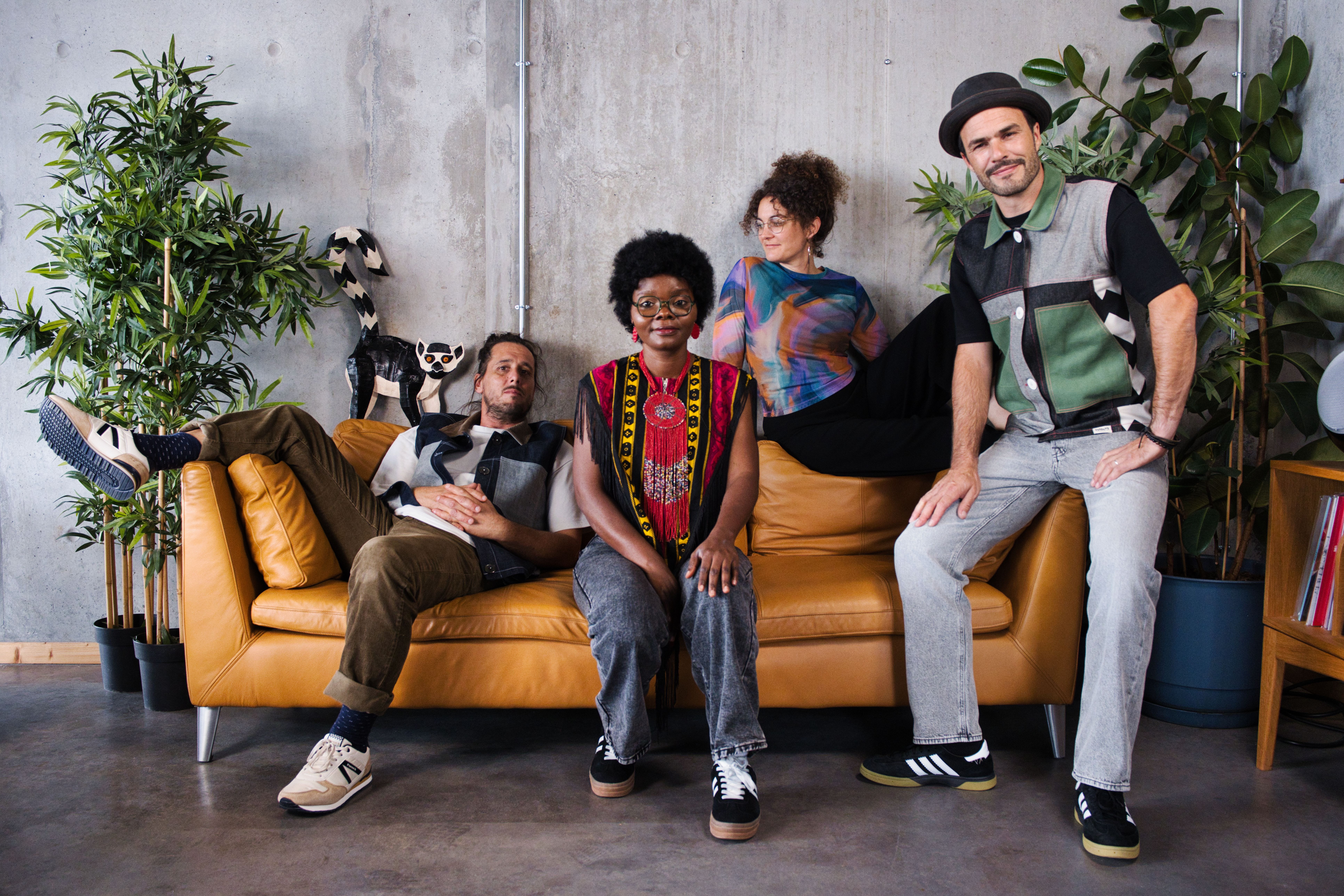
Name: Ireke
Members: Julien Gervaix, Damien Tesson
Occupation: Producers, multi-instrumentalists
Nationality: French
Current release: Ireke's new album Ayo Dele is out via Underdog.
Recommendation for Talmont-Saint-Hilaire, France: We are lucky enough to live close to the Atlantic Ocean. The Veillon site in Talmont-Saint-Hilaire is a wild natural gem where the Payré estuary meets the ocean. Nestled between dunes, holm oak forests, and a turquoise lagoon, it is a landscape in perpetual motion. If you happen to be in La Roche-sur-Yon, we also want to take this opportunity to recommend a stop at the excellent independent record shop, 'Comme à la radio'.
If you enjoyed this Ireke interview and would like to know more about the project, their music and current tour dates, visit the band on Instagram, bandcamp, and Facebook.
Tell me about one or two of your early pieces that you're still proud of (or satisfied with) in terms of production – and why you're content with them.
'Electro Highlife' is one of our first pieces, and we still enjoy playing it live as much as ever. It perfectly symbolizes our universe and our workflow—somewhere halfway between beatmaking and the organic. By 'organic,' we mean our actual instruments; we are, first and foremost, live musicians.
In fact, when we're on stage, we place a high priority on blending machines with our instruments.
To compose this track, we started with a guitar sample as a foundation for the drum rhythm. Then, we just started jamming over it—one on guitar, the other on bass—until we found the ideal groove.
There is also the track 'Petit à petit,' which was composed with the same spirit but stands out due to Agnès Helène joining us with her vocals and flugelhorn. It marks an evolution in our project, which until then had been 100% instrumental.
Her contribution to the composition was incredibly enriching; it convinced us and gave us the desire to collaborate with more singers.
In how far, would you say, was your evolution as an artist connected to the evolution of your music set-up and studio? Were there shared stepping stones?
Since the beginning of the Ireke project, our studio setup has indeed evolved.
At the start, we were primarily using hardware. However, this created constraints from a live performance perspective: we had to transport a lot of gear, and the settings were complex to manage if we wanted to stay faithful to the sound crafted in the studio.
We eventually moved toward using VSTs (both existing ones and some we created ourselves), which allowed us to find the right balance between the studio and the stage.
There are artists who can realise their ideas best with a traditional – or modified – piano interface, others with a keyboard and a mouse, yet others by turning knobs or touching screens. What's your preferred and most intuitive/ natural way of making music and why?
We see all these options as a vast toolbox at the service of creativity. It’s then a matter of choosing the right tool based on the inspiration of the moment.
For instance: should we go with an organic bass or one played via a VST? It all depends on the 'color' we’re looking for. Composing a bassline on a fretboard, using pads, a keyboard, or a mouse doesn't spark the same ideas, but each method can prove to be relevant.
On a side note, the best way to optimize a studio—as a devoted family man—is to set it up as far away as possible from the kids' bedrooms! :)
From the earliest sketches to the finished piece, tell me about the production process for Ayo Dele, please.
The first stage happens individually in our respective studios. We then share our initial sketches with each other, allowing the other person to add their own ideas and sensibilities. This is followed by a collaborative phase where we fine-tune the arrangements, the groove, and so on.
Next, we present the track to our vocalists, who develop their own melodies and lyrics. This kicks off a new studio phase where we refine the track as a team, deciding what to keep and what to evolve. We make structural choices and search for themes and arrangements that complement the vocals.
Finally, we reach the highly enjoyable stage of choosing effects, cuts, and final touches—diving deep into the last details. Once this process is complete, we head over to our friend Grud at Caracal Studio for the mixing and mastering phase.
Tell me about your aesthetic preferences for picking effects like reverb, delay, compression, chorus etc … - what was the role of these effects in the production of your current release?
We have several ways of approaching and utilizing effects. First, there’s the 'texture effect' used to highlight certain instruments—things like chorus, subtle echoes, and compression. These blend into the production; they might seem imperceptible, but as soon as you take them away, you immediately realize something is missing.
Then, there’s the arrangement side, where effects are used as instruments in their own right—think spring reverbs, analog delays, and filters—much like the Jamaican dub pioneers. These are deliberate and far more noticeable. In fact, when we play live, we use these dub techniques with our gear to create improvised moments on the fly.
AI is already capable of making something most people would recognise as music. I am curious, though, and will keep this question somewhat broad on purpose: What do you think that means?
AI is not capable of creating; it merely reproduces what it has already integrated. It requires a 'prompt' from a human. It cannot imagine.
It’s true that some AI-generated productions can seem impressive, especially given how disconcertingly fast they are made, but they will always be something 'already heard.' The creative process takes time, and that time is essential. In fact, it’s a source of pleasure and learning. It is also often a collective process where the human element is central.
Furthermore, AI tends toward statistical perfection, whereas music—especially in the Dub tradition we love—thrives on imperfections and 'happy accidents' that only a human hand can provoke. We must not forget the essence of music: the musician and their instrument. Nothing will ever replace the expressivity and the emotions a musician conveys, nor the physical vibration of an instrument.
Music is, above all, an exchange—a communion between an artist and their audience. Perhaps AI will actually push live music back to the center of attention, precisely because it is rarer and less accessible.
Creativity can reach many different corners of our lives. Do you personally feel as though producing a piece of music is inherently different from something like making a great cup of coffee?
The creative process in music can absolutely be compared to crafting a fine dish.
There is a recipe and there are ingredients. It’s all about getting the proportions right, finding the best pairings, adding the right spices (effects, textures...), and leaving room for a bit of chance—much like the 'happy accident' that gave birth to the famous Tarte Tatin.