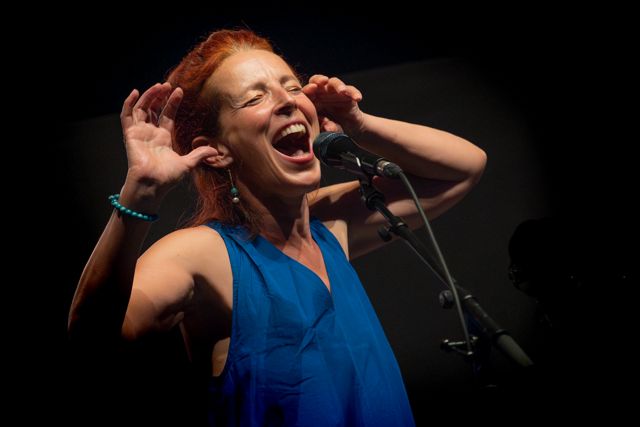
Published
Name: IKI (France, there is also a Danish ensemble by the same name)
Members: Isabelle Duthoit (Vocals), Anthony Laguerre (drums)
Interviewee: Isabelle Duthoit
Nationalities: French
Current release: IKI's self-titled debut album is out via Serotonin.
Global Recommendations: I live in the countryside, in the Morvan region of France, which is a nature park. It's very beautiful, a balm for the eyes. The fall season that will soon be upon us is magical. The colors of the leaves, the floating mists ... it's as if fairies are about to appear in the air ...
Topic I am passionate about but rarely get to talk about: I am fascinated by the moon.
[Read our Anthony Laguerre interview]
If you enjoyed this Isabelle Duthoit interview and would like to stay up to date with her music, visit her on Facebook.
When did you first consciously start getting interested in singing? What was your first performance as a singer on stage or in the studio and what was the experience like?
I became interested in singing when I was 15 years old. I was studying the clarinet and my teacher loved opera. We constantly played transcriptions of Mozart and Verdi operas. And I listened to Maria Callas ... that's how my interest began.
Then I wanted to learn to sing alongside my clarinet studies at the conservatory, but I was always rejected from voice classes and choirs ... so I never learned to sing, but I learned to be a musician.
During a festival called “Fruits de Mhère” that I organized with Jacque Di Donato in my village, we invited Phil Minton, and as I listened to him, I thought to myself, he's so unique, what he does is unlike anything else. Why not give it a try? The next day, I started, and I haven't stopped singing since.
My first experience on stage was in 1998, at the Musique-Action festival at the CCAM in Vandœuvres les Nancy, organized by Dominique Répécaud. I was playing in a duo with Jacques Di Donato, in the middle of pieces for clarinets, and I took vocal sound ideas from the Greek composer Georges Aperghis, who has written many performative pieces for voice and with whom I had done a workshop a few years earlier. I improvised with these to sing.
But the real first time I sang with my voice and my music was in my village in 2010, where we organized concerts. It was a duet with double bassist Frédéric Stochl. At one point, the village priest said, “Well, I've heard enough for today, I'm leaving ...” and he left. I carried on, I had to stay on stage, but it was a strange start.
If you're also playing other instruments, how does the expressive potential of these compare to your own voice?
I am a clarinetist. Yes, it is very different from playing an instrument or singing. For oneself, but also for the way the audience perceives it.
For me, the clarinet is an ocean in which I can navigate between different types of music. My voice is my island in the middle of this ocean. It is very small, but it is my creative space. The possibilities for playing are more limited, but I know that I never cheat.
The relationship with the voice is very different. It is completely exposing, with no safety net. Like a tightrope walker, we draw sounds on a tightrope that is nothing more than our breath. Personally, it is much more fragile, more uncertain, more “dangerous,” and at the same time totally enjoyable.
My singing is a song of the body. The body must be free, available, otherwise nothing real can come out. The boundaries are even more precise and powerful than those with an instrument. You have to let your whole body act and let it sound, it's an incredible emotion, almost addictive.
Sometimes I don't know if my voice will last until the end of a performance. Last spring, in a project called Portraits Chantés, I was singing 52 times for 25 minutes over 4 days. It was huge, but my body and voice held up. It was like a sporting feat, climbing a mountain: you have to go all the way, without turning back. It's about surpassing yourself. .
On the other side, that of the listeners, another connection is also established. When a listener hears a singer, they may think to themselves, “I could be doing that.” There are no instruments, no prosthetics. Just a body and a voice, and that can be captivating for some and frightening for others.
I feel that the bond of admiration or rejection is more intense, certainly because of this more immediate back-and-forth between the performer and the listener.
Singing is an integral part of all cultures, and traditions. Which of these do you draw from – and why?
I am very inspired by songs and music from outside Europe, particularly those from Japanese traditions such as Bunraku theater and Noh theater. I love the relationship they have with the voice.
These voices are well trained, of course, as the songs are passed down from generation to generation from a very young age. But the voices are raw, gravelly, scratchy, smooth; they age with the body. They are natural. They seek truth in the depths of breath and cry.
This is what I seek in my music, what exists in the breath, right up to the cry, which is often hidden, invisible.
I am also attracted and inspired by the voices of the far North, especially katajjaq, which is throat singing, a female Inuit vocal contest. Two women face each other, holding hands, responding to each other, imitating each other sound by sound. The imitation is very fast. It is a very exhausting song, based essentially on breath.
As you can see, breath is an exploration that I never cease to deepen and that fascinates me completely.
What were some of the main challenges in your development as a singer/vocalist? Which practices, exercises, or teachers were most helpful in reaching your goals – were there also “harmful” ones?
The first challenge was to chart my own course and continue to believe in myself, to trust myself, and to persevere on this path, even though very few friends and colleagues supported me. It was more like, “Stop messing around.” I threw myself straight into performing on stage. I played the clarinet well, but my voice was very raw and quite aggressive at first.
Ten years later, I was awarded a residency at Villa Kujoyama, an artist residency in Kyoto, Japan. My project was the scream in Noh theater. There, I met some exceptional masters, and that was the only training I received in my career as a vocalist. When I came back nine months later, my voice was very different. It was no longer aggressive. The scream was still there, but it was a vocal material like timbre, like breath, like melody.
I didn't meet anyone harmful in my entire career as a musician when I was a student. I studied with wonderful clarinet teachers. I can say that Phil Minton was a guide for me, in his own way, without really knowing it, I think, but he is a man and a singer who is very important to me. I still have a lot of admiration for him as a human being and as a musician.
Sainkho Namtchylak also inspired me a lot.
[Read our Sainkho Namtchylak interview]
What are the things you hear in a voice when listening to a vocalist? What moves you in the voices of other singers?
I love voices that are very scratchy, very powerful, hoarse, that don't cheat and that seek the truth in the depths of the voice. But I also love very pure voices, such as baroque voices.
A voice touch me when it explores the depths of the body and soul. When it is full, when it is fragile, when it does not hide. I don't like voices that remain on the surface.
I love voices that engage the full body.
How would you describe the physical sensation of singing? [Where do you feel the voice, do you have a visual sensation/representation, is there a sense of release or tension etc …]
Singing is first and foremost an immense pleasure, a great source of enjoyment, a way of letting go. I love to make my breath, my throat, my screams resonate, to make heard what is usually invisible: accidents, saliva, the throat, groans ...
There is a lot of tension inside me when I sing, but I control it and at the same time it brings me immense well-being, a sense of liberation. I know that my singing is universal, anyone can sing like I do because it is a way of rediscovering the original voice, the one we used to express ourselves before language arrived, a language before language ...
So I make my voice sound as every human being did at the beginning of their life. And it is an immense joy. Singing is sublimating these pains and offering one's joys.
For me, my singing comes from my belly, my lower abdomen, my throat, my mouth, and through my hands.
We have a speaking voice and a singing voice. Do these feel like they are natural extensions of each other, ends on a spectrum or different in kind?
I think that first we have a very free singing voice, beautiful because it is true. When language arrives, this voice falls silent, but it does not disappear; it falls asleep. So we have to wake it up, this voice that expresses itself with emotions. Then we use words to express our emotions.
I think that language and society have severely castrated the archaic voice. And what interests me is rediscovering this archaic voice.
So I don't know if spoken and singing voices are linked. In any case, today both are far too standardised, stereotyped, locked into overly restrictive and inflexible aesthetics. We must escape the dictate of civilisation and give ourselves the right and dare to develop our archaic voice, the voice of our origins.
How do you see the relationship between harmony, rhythm and melody? Do you feel that honing your sense of rhythm and groove has an effect on your singing skills?
Everything is connected; music exists when these three paradigms are conceived, whether the musician chose to have them present or not.
I am singing without melody, without rhythm, without harmony. My work is an abstract work of sound.
What are the potentials and limits of your voice? How much of your vocal performance can and do you want to control?
I can scream very loudly and for a long time, I can use my breath in many different ways.
I lose my voice when I try to reproduce a melody. When I'm improvising, in my music I feel like I have no limits, or that they are infinite.
When I have to sing something specific at a specific moment, I lose that freedom, that power, the horizon narrows.
As a singer, it is possible to whisper at the audience, scream at the audience, reveal deep secrets or confront them with uncomfortable truths. Tell me about the sense of freedom that singing allows you to express yourself and how you perceive and build the relation with the audience.
I have always felt a great deal of respect from the audience when I sing, especially when I sing solo. Whether they like what I am producing or not, I have rarely seen anyone leave the room. But people often come to talk to me after the concert, whether they loved it or hated it.
I feel like I'm exposing myself so much, it's so fragile, and at the same time I'm giving everything I know about myself, that everyone respects that fragility. I think a relationship develops. Beyond aesthetics.
I'd love to know more about the vocal performances for your latest release, please, and the qualities of your voice that you wanted to bring to the fore.
In the album IKI with Anthony Laguerre, it is a work on extremes, on screaming, on power, on exhaustion, on breathlessness, on how to push ourselves to the limit, together.
When you're writing song lyrics, do you sense or see a connection between your voice and the text? Does it need to feel and sound “good” or “right” to sing certain words? What's your perspective in this regard of singing someone else's songs versus your own?
There are never any words in my singing.
Strain is a particularly serious issue for many vocalists. How do you take care of your voice? Are the recipes or techniques to get a damaged voice back in shape?
I do a lot of Feildenkrais exercises and bodywork to reduce tension and free up my body for singing.
What tires my voice is speaking in a noisy environment after a concert. When you have to push your voice, that's usually when I hurt myself. So when I have several concerts, I leave even if the party is great.
Otherwise, of course, hot water, thyme, honey, lemon and ginger are all simply miraculous remedies
How has technology, such as autotune or effect processing, impacted singing? Has it been a concrete influence on your own approach?
My vocal world, my quest is to make heard everything that normally we don't want to highlight: scratchy breathing, squeaking, grunting, groaning, accidents ...
So of course I don't use any effects and obviously no autotune, since I don't sing melodies.
For recording engineers, the human voice remains a tricky element to capture. What are some of the favourite recordings of your own voice so far and what makes voices sound great on record and in a live setting?
My favourite recording? I don't have one.
And what makes a voice beautiful? The relationship that the artist and the sound engineer develop together, hand in hand, ear to ear, listening to each other, and above all with a great deal of modesty, so that the singing can sound right.
It's a team effort, and that's what's beautiful and powerful. The singing, my music, will sound good if everyone searches deep within themselves for depth, truth and essence with their own tools and knowledge.
Motherese may have been the origin of music, and singing is possibly the earliest form of musical expression, and culture in general. How connected is the human voice to your own sense of wellbeing, your creativity, and society as a whole?
If music, whether sung or instrumental, wasn't in my life, I think I would find it difficult to live.
Music makes me live, music makes me move, makes me believe, hope, dream, cry, vibrate, love. Music simply makes me live.
I need it to exist.