Published
Name: Ishmael Ali
Occupations: Composer, improviser, cellist, guitarist
Nationality: Filipino-Arab-American
Current Release: Ishmael Ali's new album Burn The Plastic, Sell The Copper is out February 13th 2026 via Amalgam. Alongside Ishmael on cello, voice, and electronics, compositions, it features Ed Wilkerson Jr. (tenor saxophone, alto clarinet), Corey Wilkes (trumpet), Jim Baker (piano, ARP), Brianna Tong (voice), Bill Harris (drum set, percussion).
Recommendations for Chicago, USA: Garfield Park Conservatory.
Topic I am passionate about but rarely get to talk about: Too embarrassing, you have to butter me up first.
If you enjoyed this Ishmael Ali interview and would like to stay up to date with his music, visit his official homepage. He is also on Instagram, and bandcamp.
When did you first consciously start getting interested in musical improvisation? What was your first improvisation on stage or in the studio and what was the experience like?
Improvisation within forms/grooves through pretty traditional routes: Blues and rock. Hendrix. A lot of funk music: Funkadelic, James Brown, Sly, later on jazz.
The first unique thing that comes to mind is that I had a friend named Diepiriye who’s father was a pastor. We used to play at his Pentecostal church. We would do a mix of gospel tunes but improvise during sermons, etc. Sometimes the audience would go off into trances and start speaking in tongues and the music would follow that and get quite visceral.
Later on, I got into playing free primarily from branches of the AACM as well as a big Derek Bailey influence. Some parameter-based modes of improvisation through composition as well.
I didn’t have a huge musical background in more niche worlds and there was this friend in college who is still one of my closest friends named Aaron Quinn who was an absolute encyclopedia of knowledge and was sweet enough to share that with me.
Tell me about your instrument and/or tools, please. What made you seek it out, what makes it “your” instrument, and what are some of the most important aspects of playing it?
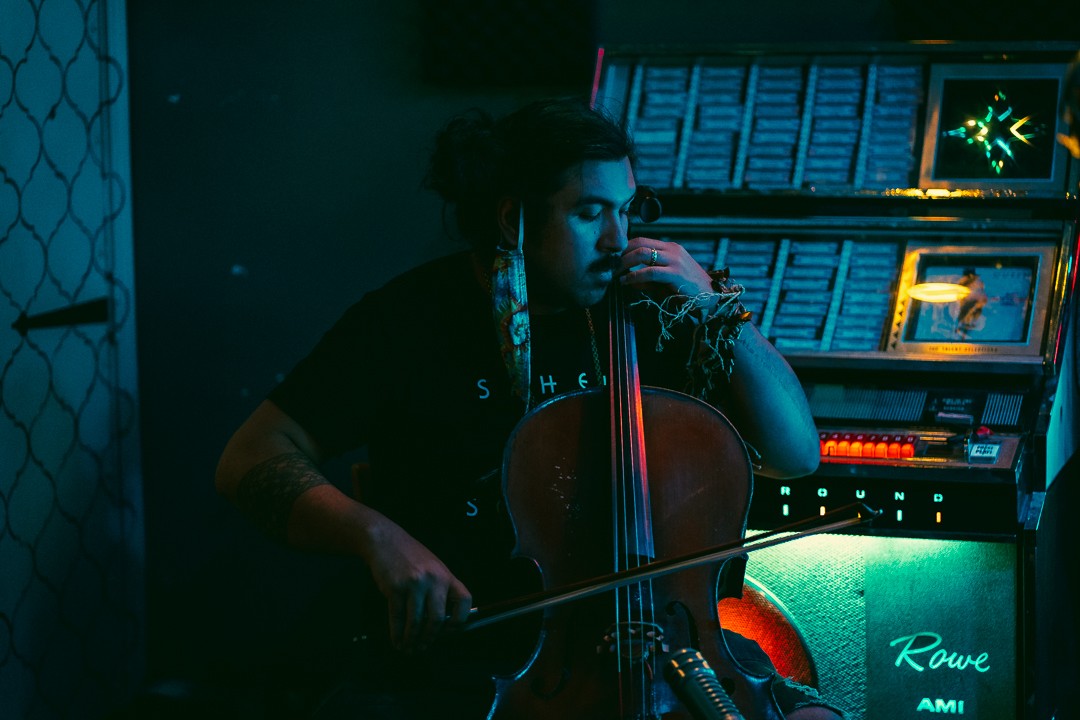
I actually switched over from guitar to cello fairly recently —a year or so before pandemic. I wasn’t completely satisfied with all the sounds I could get from the guitar. I appreciated the way the cello could fill multiple roles: playing legato melodies arco, pizz bass-type functions, choppy atonal motifs, so many textural possibilities.
I was lucky to be in a city so rich in cellists: Fred Lonberg-Holm, Katinka Kleijn, Tomeika Reid. Coming out of college I was also a big Okkyung Lee fan so it just kind of made sense to pick it up. It was an experiment at first. I was gigging a bit just in improvising contexts then pandemic happened and I had all the time world to really dive in.
There are so many sonic possibilities on cello. It became a thing of “imagine the sound” then just invent/practice those techniques in addition to more traditional approaches. Having the theory background as well as finger dexterity/fingerboard concept down helped a ton.
I started by just tuning an electric bass in 5ths then learning the fingerboard, then I started just working on long tones/bowing/intonation obsessively. Maybe one day I’ll get there.
[Read our Clarice Jensen feature about the cello]
[Read our Theresa Wong feature about the cello]
How would you describe your own relationship with your instrument – is it an extension of your self/body, a partner and companion, a creative catalyst, a challenge to be overcome, something else entirely?
For me extension of self 9000% percent.
It’s quite the opposite of guitar personally. I like how it’s hard to play things on the instrument if you can’t hear it first and vice versa. Guitar you can certainly do that, but it also lends itself to finding new harmonic approaches without hearing them first and just general scalar fuckery.
The cello also fits perfectly in my vocal range which I found out later. As a whole the instrument just resonates with my body.
Derek Bailey defined improvising as the search for material which is endlessly transformable. What kind of materials have turned to be particularly transformable and stimulating for you?
It’s funny that you mention Derek Bailey because I got deep into his work being a guitar player.
I printed out this pdf where he talks about some of the things he practiced and I would work on (still do) this one particular exercise where you would play some sort of melodic line, whether it be a scale or melody or whatever, and each note would alternate between either a fretted/fingered note, open string, and harmonic.
It was really ear opening just finding all the harmonics on both cello and guitar, finding different places/ways to play them, hearing how flat or sharp they are depending on what partial of what fundamental they are, etc.
That’s definitely something I took with me to cello, both as a technique but also hearing the fundamentals playing arco as you get closer to the bridge. I was always jealous of horn players how they could get that gnarly overblown sound and I try to emulate that on cello quite a bit.
Do you feel as though there are at least elements of composition and improvisation which are entirely unique to each? Based on your own work or maybe performances or recordings by other artists, do you feel that there are results which could only have happened through one of them?
To me I feel like this is a bit of a complicated question as it’s not necessarily about being unique to each but each lending itself to arriving at certain musical ideas more.
For me, they feed into and enrich each other.
When you're improvising, does it actually feel like you're inventing something on the spot – or are you inventively re-arranging patterns from preparations, practise or previous performances? What balance is there between forgetting and remembering in your work?
Definitely both, though not necessarily patterns. I think it’s dependent on individuals and even instruments but there’s a vocabulary that stays with you for sure.
When playing free I tend to think of things in musical modalities / mindsets / aesthetics more than patterns if that makes sense.
The rhythm certainly is always underlying, even when playing out of time.
Artists from all corner of the musical spectrum, not just “free jazz” have emphasised the importance of freedom in their creativity. What defines freedom for your improvisations?
In a general sense I think minimizing what’s lost between what you’re hearing and what you’re playing, between thought and sound defines “freedom” to me. I think this means different things for different people.
I tend to hear things more gesturally than specifically so this often translates to being able to emulate the essence of what I experience a thing as rather than the thing itself.
Off the top there’s this bass line thing I play on Fred Jackson’s Double Helix Quartet that’s a sort of mimics that infinite staircase / shepard’s tone idea.
For me catching them in the moment and having the ability to recognize and expand on little ideas like that when you play is everything.
Taking your recent projects, releases, and performances as examples, what, would you say, are the key ideas behind your approach to improvisation?
Recently I’ve been aiming more to blend together abstraction and the concrete in a more meaningful way and find a balance of the two that I’m happy with. It’s something I feel Kahil does really well and I don’t think I’ve ever reconciled those two worlds fully.
I used to compose a lot and would merge the two approaches mainly through composition like in Je’raf or older projects then I started playing pretty much exclusively free for many years.
Free improvisation is such a unique world in that you stumble upon language thats hard to find through other means. A couple projects come to mind like Hearsay and the trio I had with Jeff Kimmel and Bill Harris.
Part of this solo work is me working through finding cohesion in all of it.
In your best improvisations, do you feel a strong sense of personal presence or do you (or your ego) “disappear”?
I’ve been finding more and more that it’s important to be able to operate from different perspectives and states of mind. Ideally you’re operating within that Mihaly Csikszentmihalyi thing, but if you shift out of it what do you do?
Also, what context are we talking about: solo, duo, trio, large ensemble? I certainly function differently in different environments (and can think of people who don’t lol and it’s not always great haha).
Even when I’m in a self-aware sort of thing, though, I try my best to really focus on the sound and the music and try and get lost in it.
What are some of your favourite collaborators and how do they enrich your improvisations?
Oh man I don’t even know where to start.
First person to come to mind is drummer Bill Harris. We worked together on so many different projects and different types of music and was one of the first folks that I developed a shared vocabulary with.
We have this way of playing out of time that I absolutely love where it’s still so rhythmic. Instead of bpm it’s like “what density are we at?” The counterpoint is there too and so fun to play with and feel in and out of sync.
Brianna Tong, too. I love working with text and voice and she’s been so amazing and kind letting me pull her into so many different things not knowing what I had in store for her.
A lot of the older Chicago generation also come to mind: Avreeayl Ra, Ed Wilkerson, Jim Baker, Fred Jackson, Kahil too obviously. They’re so unabashedly and unmistakably themselves and I think that’s very important to be able to do that.
In a live situation, decisions between creatives often work without words. From your experience and current projects, what does this process feel like and how does it work?
I have no idea how it works ahaha.
I can tell you that it works more often when people have shared aesthetics/sensibilities. My old music professor, amazing teacher, shout out Stan Smith, would have a thing where you shouldn’t look at someone in the eyes while you’re playing generally. Like, if you make eye contact in generally means something important: something’s wrong, something needs to happen, etc, so it kind of tales you out of the thing if you’re not careful.
Me and Bill have talked about this a bunch before but to me the most important communications are endings. You shouldn’t miss a good ending (RIP one short one).
Stewart Copeland said: “Listening is where the cool stuff comes from. And that listening thing, magically, turns all of your chops into gold.” What do you listen for?
Besides all the ‘normal’ stuff, intention.
There can be surprising moments during improvisations – from one of the performers not playing a single note to another shaking up a quiet section with an outburst of noise. Can you tell me about such situations from your own performances and how they impacted the performance?
I really enjoy when sounds made from non-participants, e.g. audience members, bartenders, etc, affect the music and musicians just run with it.
Vague examples include sirens, chair shifting squeaks, audience walking to bathroom cadenzas off the top.
As a listener, do you also have a preference for improvised music? If so, what is it about this music that you appreciate as part of the audience? I go in and out of it as a listener.
I always come back but I find myself having phases where I get obsessed with certain genres or albums outside of a lot of the music I play and I think it’s super important to hear different approaches to music that aren’t your own.
In a way, we improvise all the time. In which way is your creative work feeding back and possibly supporting other areas of your life?
Being a father certainly.