Published
Name: Izabela Dłużyk
Nationality: Polish
Occupation: Sound artist, field recorder
Current release: Izabela Dłużyk's new full-length album The Amazon — Where the moon wept is out via LOM. She is also one of the artists contributing to harkening critters, an epochal, 33-track-encompassing compilation which "tunes in to the plethora of vocalizations, mechanical emanations, and any other acoustics phenomenon produced by animals." The album is available from forms of minutiae.
If you enjoyed this Izabela Dłużyk interview and would like to know more about her music, visit her on Facebook.
What sparked your interest in animal sounds? Are there any memories or experiences with these sounds that you can share?
The first thing that inspired me to become interested in bird sounds was a number of very short, low quality, several seconds long bird recordings I heard while browsing through a computer encyclopedia on a CD-rom. I was about ten years old then. I started to memorize those bird songs, and soon I wanted to find more. After some time I bought my first cassettes with Polish bird voices. At that time I also received a cassette with amphibian sounds as a gift, and it fascinated me as well.
Then I decided I would like to capture some of the sounds I can hear in the field, and this is how I started to make my first recordings. I had a low quality, noisy and hissy tape recorder, and I considered it as a success if I could hear the bird at all …
The biggest challenge was to approach birds as closely as possible without startling them. It was difficult, because the recorded subject had to be really very close to be audible. While walking e.g. through a forest, I always had to leave the main paths to record anything, which of course meant a lot of noise, e.g. because of leaves rustling under my feet. I still remember one instance when I decided to climb a certain hill to record a singing wood warbler …
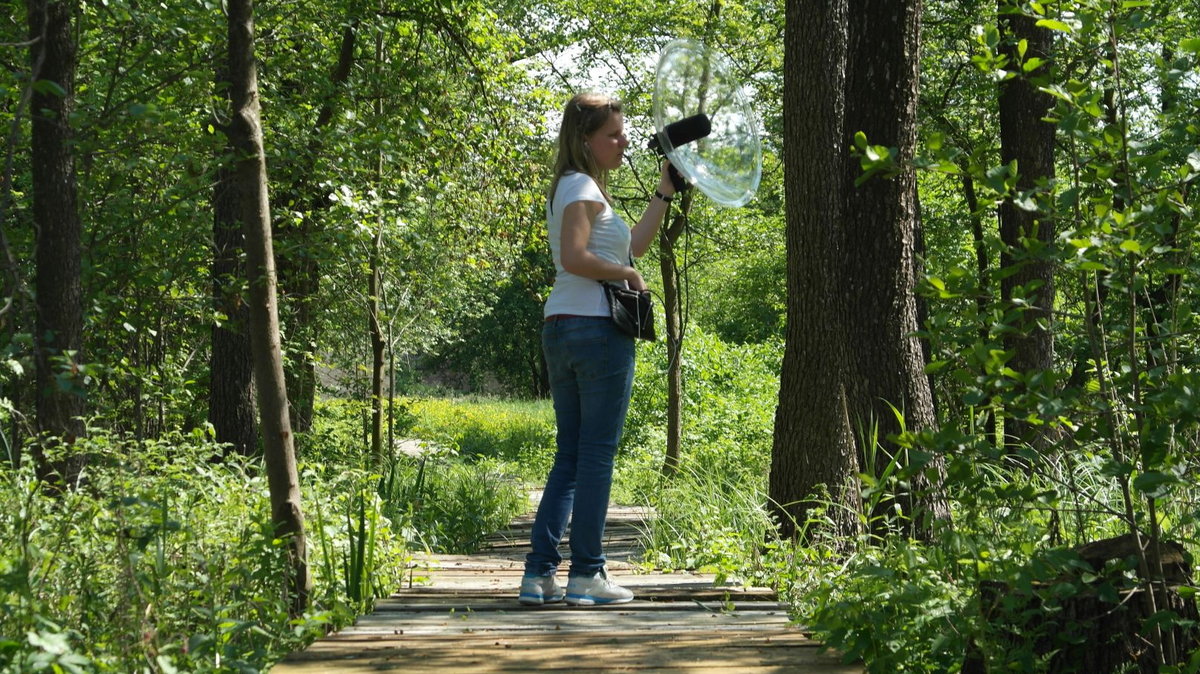
Now, when I use a parabolic dish, I do not need to venture deeper into the forest – I can record animals directly from the path where I stand. This makes the entire process much more quiet and unobtrusive to animals. However, those first challenges taught me to stand absolutely still while recording, not to make any movements at all, and to walk as quietly as possible.
They also taught me to approach birds very slowly, preferably while they are occupied with singing, and to wait through the pauses between song phrases. These habits proved very useful later as well.
What makes animal sounds interesting, inspiring, or just plain beautiful to you? Is there anything that continues to impress you about them?
For me, listening to animal sounds, or nature sounds in general, and, as a consequence, capturing their sounds through recording, is like delving into a new, mysterious world. As Simona Kossak, a Polish writer and nature researcher said: “Seven seals guard the secrets of nature from us.”
I want to discover and share glimpses of lives of animals, including their interactions and coexistence. This also means biological knowledge, which I am broadening constantly, because it is essential to understand as much as possible from what is happening.
But it is not only about education. Exploring nature is about enjoying the smallest things, about contemplating beauty, experiencing and feeling, this is about expanding our hearts. We will remain human as long as we will cherish our ability to become amazed, delighted, moved. Paraphrasing William Butler Yeats, who wrote that the world is “more full of weeping than we can understand”, I feel that the more worn out the world becomes, the more it needs such valuable qualities.
Throughout the years, I have come to perceive the natural world as an autograph of God, wisdom beyond words, music beyond language, message beyond speech. Whispering of trees, chants of streams, touches of wind, majesty of thunder, and all of our patient music teachers – birds, frogs, insects … And we still think we know better …
Trees are too humble to defy us when we cut them down, although they may live so much longer …
Did or do you do any research on animal sounds? If so, what were some interesting findings?
I have written a doctoral thesis regarding bird voices, but the thesis mainly explores how these voices are perceived by people and translated into human speech through phenomena such as sound symbolism and onomatopoeia.
These relations are fascinating, although they do not analyze animal sounds directly, for their own sake.
Tell me a bit about your first animal recordings, please.
At the beginning, I used to record everything I could. One of the first recordings I remember was a flock of house sparrows high up in a tree. I remember that I climbed on a low fence next to the tree to get at least slightly higher, and I was holding a branch for balance while recording … There is nothing like creative ideas from childhood …
My first absolutely favourite professional recording was a thrush nightingale from the Białowieża primeval forest. Thrush nightingales are my favourite songsters and I always wanted to record one. But it was not until I visited Białowieża in 2015 that I finally managed to achieve this goal for the first time.
It was my first evening there. It was May, the height of European spring. I was standing on an observation tower next to Narewka river, listening through the headphones to the voice of the nightingale, resounding with an evocative echo, and beautifully enhanced by the parabolic dish. The weather was calm, trees were humming in a gentle breeze around me, and the air smelt with due and aquatic plants.
I had been waiting for such a chance for so long, and finally, when I pressed the Record button, my first thought was: “And what if my recorder breaks down just now, just to deprive me of this special moment?...” Luckily, nothing undesirable happened, and the delightful voice became preserved forever.
What did your first field recording set-up look like – and how has it changed over time?
I started my professional field recording in 2014, with an Olympus LS3 sound recorder (I chose this particular model as it had voice guidance) and a Telinga MK2 stereophonic microphone, which I mainly used and continue to use with a parabolic dish.
Currently, I have three Olympus recorders (LS3, LS-P2 and LS-P5), Zoom H1 Essential recorder and three Telinga microphones (MK2, SSM for soundscape recording and MK3).
Perhaps it may not be the most sophisticated setup, but I am very pleased with it and nobody has ever had any remarks regarding the quality of recordings I achieve with it.
Do you have an archive of animal sounds? If so, what's in it and how do you use it?
I do have an archive of my recordings, which I use for various purposes – for publishing albums, preparing performances, delivering educational presentations, but also simply I keep it for my own enjoyment.
Have animal sounds been a direct inspiration on some of your other creative projects – if so, in which way?
I am currently planning to release my first album containing nature sounds gently blended with some subtle, specially selected musical instruments, such as Indian male tanpura, Andean quena flute, African sansula, orchestral bells and Koshi chimes.
However, I find it very important to make sure that the instruments will not dominate the sounds of nature. It also requires careful consideration, which nature sounds harmonize best with which instruments.
Tell me about your contribution to harkening critters, please. What were your considerations going in? When, where and how was it recorded?
My vision for “Harkening critters” was to choose recordings which would depict some interesting or unusual scenes from the lives of animals.
Two particular recordings, “First flight of a young white stork” and “great snipe lek”, were deemed by the publisher as the most captivating, although they were not the only ones I suggested.
The recording of the stork was taken in a white stork colony in the Żywkowo village in Poland in mid July.
I was truly fortunate to experience this special moment of a young stork leaving its nest for the first time while just standing there with a parabolic dish. The recording of great snipes was taken in mid May on a marshy meadow not far from the Narew river just after sunset, with the equipment left unattended.
Now you've had some time to hear the other pieces on the release, what are some of your favourite recordings by the other participants – and why?
It is hard for me to choose a favourite recording, because each of them is evocative in its own way … I like to perceive publications with nature sounds in their entirety.
The press releases to harkening critters uses the word “signals” to classify the sounds on the CDs. Undeniably, there are many “musical” moments on harkening critters, but how do you feel about the using the term “music” for them? What sets “signals” apart from “music”?
If we look at the diversity of nature sounds as a harmony in itself, without classifying sounds into those which are pleasant or unpleasant from our human perspective, we may come to perceive this diversity as a kind of music, a kind of orchestra as a whole.
From such a viewpoint, it is not that relevant if we categorise them as songs or signals, because both of these communication types still belong to this natural music.
Do you think that true creative collaboration between animals and humans, as has been attempted for example by artists like David Rothenberg, is possible? Are there any such collaborations you've engaged in or would like to try?
It is definitely interesting to research how birds and other animals respond to our human music, although there is a fundamental question that we need to ask ourselves – what we mean by “true collaboration”, i.e. what level of reciprocal understanding?
This is an area into which I choose not to venture too deeply, as this is a unique, separate field of exploration, different from my main recording interests.
Based on your thoughts, experiences, examples, or intuitions, do you think it is possible that examining animal signals will at some point lead to understanding and, eventually, communication? What is your personal threshold for considering interspecies communication as successful?
We try to communicate with some animal species, especially those domestic ones, just as they try to communicate with us. However, I think this is just barely touching the surface.
I am certain that in the future we will understand animals much better than we do now, but when it comes to our ability to achieve truly successful interspecies communication, I have my doubts. Our perspective and perspectives of diverse animal species may be so different and so incompatible that we may never be able to overcome these limitations, regardless of our technological advancements.
Some have argued that recording animals is a form of appropriation and that they should be compensated in some form. Do you have any thoughts on this?
The fact that nature needs care and protection is indisputable. However, I find the stance which perceives specifically recording animals as an appropriation extremely radical, therefore I strongly disagree with that, as generally I tend not to identify with radical viewpoints in most areas of life.
Recording is one of the most unobtrusive activities one can imagine, so as long as we do it with common sense, our encroachment into the animal world is minimal, so there is no need to feel guilty about that, let alone instil the sense of guilt in others.
I think that currently many activists who fight for protection of natural environment try to push forward their demands from the point of the sense of guilt, which, in my personal opinion, is counter-productive and even harmful. We will never be able to create anything permanent and long-lasting out of the sense of guilt. The only driving force which has a true potential to change us for the better is love and only love, because only things which are loved will be cared for and protected in the long run.
Being exposed to the richness of the world of animal sounds can be an intense experience. How has listening to animals changed your views on various topics? (ecology comes to mind, but there may be more).
As I became interested in animal sounds in early childhood, I cannot say they changed me – I would rather say they shaped me.
Now, after many years of enthusiasm and awe, I feel that the battle is for retaining this childlike enthusiasm and freshness of experiencing the world. I believe I need to strive for not falling into a trap of routine or a trap of twitching, ticking off subsequent species as if they were only trophies for my ego.
If somewhere on my way I find myself no longer capable of cherishing the beauty of even the simplest moments from the natural world, this will be the beginning of my downfall as a human.