Published
Name: Jambal
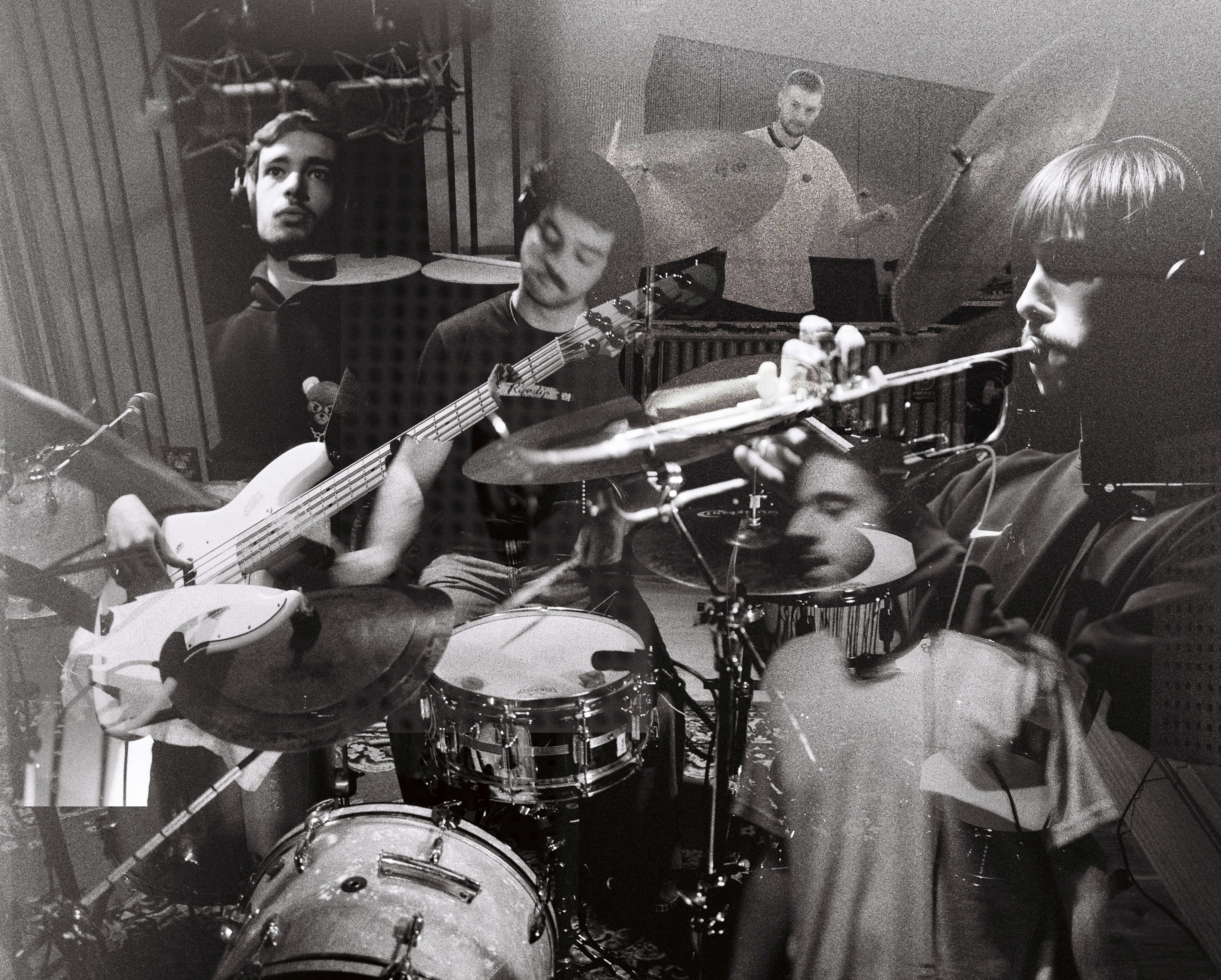
Members: Matteo Griz Wolff (vocals, lyrics), Ben Bley (trumpet, synth), Arthur Clees (vibraphone, piano, add. percussion), Mateus Wojda (electric guitar), Rolan Eberhardt (electric bass), Luca Garofalo (drums, add. percussion)
Nationality: Luxembourg
Current release: Jambal and Kenai Shogun's new album Men of Average Nature is out November 21st 2025. Catch their release concert at Rotondes in Luxembourg.
Hometown Recommendations: Ben (trumpet, synthesizer), Luca (drums), and Rolan (bass) have been living in Amsterdam for over four years now. While ‘Concerto’ - a vinyl shop with a superbly curated selection of music - and ‘Bimhuis’ - one of Europe’s most prestigious jazz venues -, ‘Mezrab’ is also a cool place in Amsterdam; a space where storytelling, music, poetry and theatre are combined and is getting you to know a very cool side of alternative Amsterdamers.
Arthur (vibraphone, keys) is currently continuing his studies in Oslo after spending four years in Dresden. He highly recommends exploring the nature around the city - especially the small islands in the fjord right in front of the city centre. You can simply take one of the public transport ferries and hop off wherever you feel like it.
Matteo (aka Kenai Shogun, vocals) and Maddy (aka Mateus, guitar) have recently made London their new home. ‘Colour Factory’ is one of the venues with the best lineups they’ve experienced in London. They showcase so many diverse acts from all over the world and from various fascinating scenes. It’s a safe space for expression, a melting pot of identities and cultures. It’s a place where partying has meaning and reflects important values of inclusion, resistance and free expression.
Erik (visuals) has spent the last few years in Antwerp. One of his favourite places there is ‘Het Bos’ - an artistic house and creative breeding ground where art, social engagement, and human connection are central. It’s a living space, filled and propelled by all kinds of makers and visitors who often leave their mark. They have a super diverse program and lots of refreshing events, ranging from concerts and raves to weekly dinners, writing nights, theatre, expos etc. A classic, but still worth mentioning, since they want to demolish it, is the M HKA - Museum of Contemporary Art.
And since we’re all originally from Luxembourg, where we still come together to work on our music, we have to mention our home favourite: there are plenty of great cultural hotspots - De Gudde Wellen, Rotondes, Kulturfabrik, Neimënster, to name a few - where we love to hang out and perform. But most recently, we had a songwriting camp in the north of Luxembourg, in the region called Éisleck near the town of Woltz. It’s full of beautiful landscapes, picturesque medieval towns, and a peaceful atmosphere - highly recommended.
If you enjoyed this Jambal interview and would like to stay up to date with the band and their music, visit them on Instagram, Facebook, and bandcamp.
What does the term jazz mean today, would you say?
Today, the term jazz has become a very broad umbrella. It often refers to improvisation-based music or compositions that draw on traditional jazz elements - components like rich harmony, rhythmic complexity, and a sense of spontaneity.
But beyond the theoretical, jazz has always been about giving voice to the individual - allowing every musician’s sonic identity and ideas to be heard. It’s rooted in trust, real-time interaction, and collective creativity; a musical conversation where everyone contributes and responds.
Though jazz emerged from a specific culture, time, and political context that we may only understand from a distance, it paved the way for countless genres, sounds, and artistic movements around the world. And somewhere within that global melting pot of roots and inspirations, we try to navigate and showcase our own experiences.
Maybe jazz, for us, refers to a sonic identity that’s closely connected to subculture - music that uses elements of the traditional jazz language but is also undeniably tied to the contemporary, to the Zeitgeist.
As of today, what kind of materials, ideas, and technologies are particularly stimulating for you?
Since we’re spread across Europe - with some of us based in Amsterdam, others in London or Oslo - everyone is immersed in different musical scenes and influences.
Because we only get a few chances a year to come together, our approach hasn’t changed much: we just jam, have fun, and keep our expectations light. Each of us brings ideas and sounds we’ve been exploring individually, and when we meet, we try to capture that moment of exchange through improvisation - sometimes it becomes a song, sometimes it just stays a moment.
Working with Matteo (Kenai Shogun) on this project (Men of Average Nature) added a new dimension to our music. The songwriting process became more intertwined with the lyrics, and we found ourselves shaping the music around the words, and vice versa. So when it comes to materials and ideas, improvisation and live interaction remain our core tools - they keep the creative process honest and spontaneous.
As for technology, we’ve recently started integrating more synthesizers into our live setup (recently heard on synthesizer-heavy tracks such as “Grantelbart” from our 2025 EP *ASTERISK) . That’s opened up an entirely new sonic landscape for us, and it’s exciting to see how that continues to influence our sound and direction.
We feel that a strong collaborative and collective spirit is what continually drives us to create new projects.
Even though Jambal was born from a musical idea, it has never been purely about sound. We’ve always worked closely with our long-time friend and visual artist Erik Mathias, who designs our covers, takes our photos, and shapes our entire visual identity. He also plays a big organisational role in the band and is part of every concert - he’s truly our fifth member.
Working with Matteo (Kenai Shogun) and Mateus Wojda (guitar) on this project isn’t just another collaboration either; it’s the result of years of friendship, shared work within the same musical scene, and a collective desire to revive and contribute to the Grand Duchy’s youth culture with new energy and ideas.
Where do most of your inspirations to create come from – rather from internal impulses or external ones? Which current social / political / ecological or other developments make you feel like you need to respond as an artist?
We think inspiration is never purely external or internal. Inspiration is a back and forth exchange between internal and external factors. Sometimes external factors will highlight internal turmoil which push you to start writing/ composing, sometimes internal processes push you toward commenting external events.
We think music and art in general is inseparable from the context they exist in. To believe music exists and evolves in a vacuum is absurd - and that’s particularly true for jazz and rap. Although they’ve now found a much broader audience these two genres have always served as a tool of expression for marginalised communities to express their identities. The spirit of block parties and jazz joints should be upheld in whatever form - making music that is simply fun is just as important as sending a message.
The current decline in people’s capacity for empathy and general desensitisation of the masses is something we want to push back against. We want people to rediscover appreciation for the people behind the art they enjoy and raise their standards for any kind of consumption of media which also includes news and politics.
Tell me a bit about the sounds & creative directions, artists & communities, as well as the colleagues & creative hotspots of your current hometown, please. How do they influence your music?
Luxembourg has a surprisingly rich creative scene, with great artists across many genres. Because the community is relatively small and close-knit, we’ve had the pleasure of getting to know - and sometimes collaborating with - quite a few of them.
Many of the country’s leading musicians also teach at local conservatories and music schools, which we all attended growing up. The jazz teachers in particular, some of whom we still meet up with for a beer now and then, have had a lasting influence on our musical taste and our overall approach to playing and composing.
Of course, the size of the country has its downsides. Many young people leave Luxembourg to study abroad, and while some return later, there’s a noticeable demographic gap among younger residents - ourselves included. That sometimes makes it challenging for youth and underground culture to fully develop and sustain itself. But there’s a strong sense of determination in the scene, and we’re working on it.
On the other hand, Luxembourg offers great opportunities for young artists to grow. There are plenty of showcases, cultural institutions, and professional structures that provide support, along with affordable access to concerts and events. The scene may be small, but it’s full of incredibly talented and internationally recognised artists.
Still, once you step outside the country, you quickly notice that most European jazz hotspots operate in completely different ways - which makes Luxembourg feel like its own little bubble again.
What role do electronic tools and instruments play for your creative process?
(I think I speak for everyone here when I say) We completely reject the notion of purism in jazz especially. Institutionalising music like jazz goes against what it stands for originally. Any tool that can add texture, richness or flavour to a song is fair to use for us. Electronic tools have made so many of our songs possible in the first place.
If we’re speaking of AI in this case we believe it’s always to be regarded as a tool rather than a co-creator. When AI helps you structure and idea and work out any quirks it’s actually doing it’s jobs. We’ve created these things so they can do the heavy lifting while we paint pictures and write songs, not the other way around.
Thanks to technological advances, collaboration has become a lot easier. What have been some of the most fruitful collaborations for you recently and what approaches to and modes of collaboration currently seem best to you?
Since we’ve all studied - or are still studying - jazz at music universities, we share a strong foundation in the theory, history, and language of the genre.
Of course, learning jazz in an academic setting isn’t always the most authentic way to experience it, but it’s given us a deep understanding of its harmonic and rhythmic concepts. That knowledge inevitably shapes our work, even though ‘Men of Average Nature’ leans strongly into pop and hip-hop aesthetics.
In many ways, jazz influences how we think about music rather than how it sounds on the surface. Our approach to composition, sound selection, and song structure often departs from what’s typical in rap or pop, leaning instead toward the openness and unpredictability found in jazz-related music.
We also include improvised solos and instrumental interludes (tracks like ‘moan’ and a long guitar solo on ‘Fair & Well), which bring all the musicians - including the lyricist - onto the same wavelength.
So, the balance between honouring jazz’s roots and exploring the unknown comes quite naturally for us. We’re grounded in the tradition through our studies and influences, but we’re equally drawn to pushing those ideas into new contexts and genres - letting the spirit of improvisation guide us wherever it wants to go.
How much potential for something “new” is there still in jazz? What could this “new” look like?
We think there’s still an infinite amount of unexplored territory within jazz and jazz-related music. The potential for something “new” is always there - not necessarily in reinventing the genre from scratch, but in how we reinterpret its spirit of innovation and improvisation in today’s context. Ultimately, it’s up to our and future generations to shape how this next wave of music will sound, depending on the social and political realities they face.
Jazz has always been closely tied to underground culture and political expression - much like hip-hop - and those two worlds have been influencing each other for quite some time now. So why not continue blending jazz with any genre that carries personal or societal urgency?
It’s nearly impossible to separate modern music from jazz’s legacy. The drive to express individuality, to create collectively through improvisation, and to challenge musical boundaries will always remain at the heart of what we do. In that sense, the “new” is a continuous rediscovery put into a contemporary setting.
For many artists, life-changing musical experiences take place live. How do you see that yourself?
We’d probably all agree. While studio work is great fun too, they’re two very different experiences - in terms of preparation, musicianship, and how the music is perceived from the outside.
The beauty of live music, for us, lies in sharing a space with people and creating that direct interaction between musicians and audience. Most of our concerts aren’t recorded or documented, which gives them a unique sense of magic and transiency - they exist only in that moment.
Studio work, on the other hand, is much more deliberate and detail-oriented. That’s why we consciously make our albums sound different from our live shows, so listeners can experience two distinct musical worlds from the same band.
Kenai Shogun: Some of my most treasured memories took place in the company of Jambal. Making music by yourself and together are two very different things and both have their distinct benefits. But nothing can quite emulate the feeling of belonging and connection in the synergy of a live band performance.
The palpable electricity between all of us during a life performance feels like it’s prolonging my life expectancy! I feel like that’s where many of the sporadic screams and other ridiculous sounds I make live and in the studio come from. Nothing can replicate that elation in any way. It’s a cheesy way to put it but it’s genuinely a drug.
We’ll play our release show on November 21st at Rotondes in Luxembourg. There are few things more exciting than playing a home concert in front of friends, family, and new faces - it’s always a special kind of energy and creates beautiful memories for us to think back to.
Improvisation is obviously an essential element of jazz, but I would assume that just like composition, it is transforming. How do you feel has the role of improvisation changed in jazz?
We don’t think the core idea of improvisation - especially the improvised solo has fundamentally changed. The motivation remains the same: to create something spontaneous, personal, and in the moment. What has evolved is the approach.
Today, musicians might think and play differently - melodically, harmonically, or aesthetically - than a few decades ago, and the proportion of improvisation within a composition can vary widely.
Over the years, we’ve heard countless great soloists who have completely reimagined musical norms and listening habits. That history has become an immense source of inspiration to draw from. So while solos today might sound radically different from one another, they’re still rooted in the same desire to capture that fleeting sense of magic in the moment.
In that sense, the role of improvisation hasn’t changed - but the ways it’s expressed have become incredibly diverse.
The Montreux Festival intends to preserve its archive of recordings for future generations. Do you personally feels it's important that everything should remain available forever - or is there something to be said for letting beautiful moments pass and linger in the memories of those that experienced them?
The value of memory is often underestimated, that’s becoming quite blatant in how we’re electing our leaders and facing the daily injustices we’re confronted with. Why should it be any different with art?
It’s important to know how we got to where we are now. Jazz and rap being the ever-evolving genres they are, being able to leave a trace that future artists can draw inspiration from is almost a duty, something you owe the people that’ve inspired you.