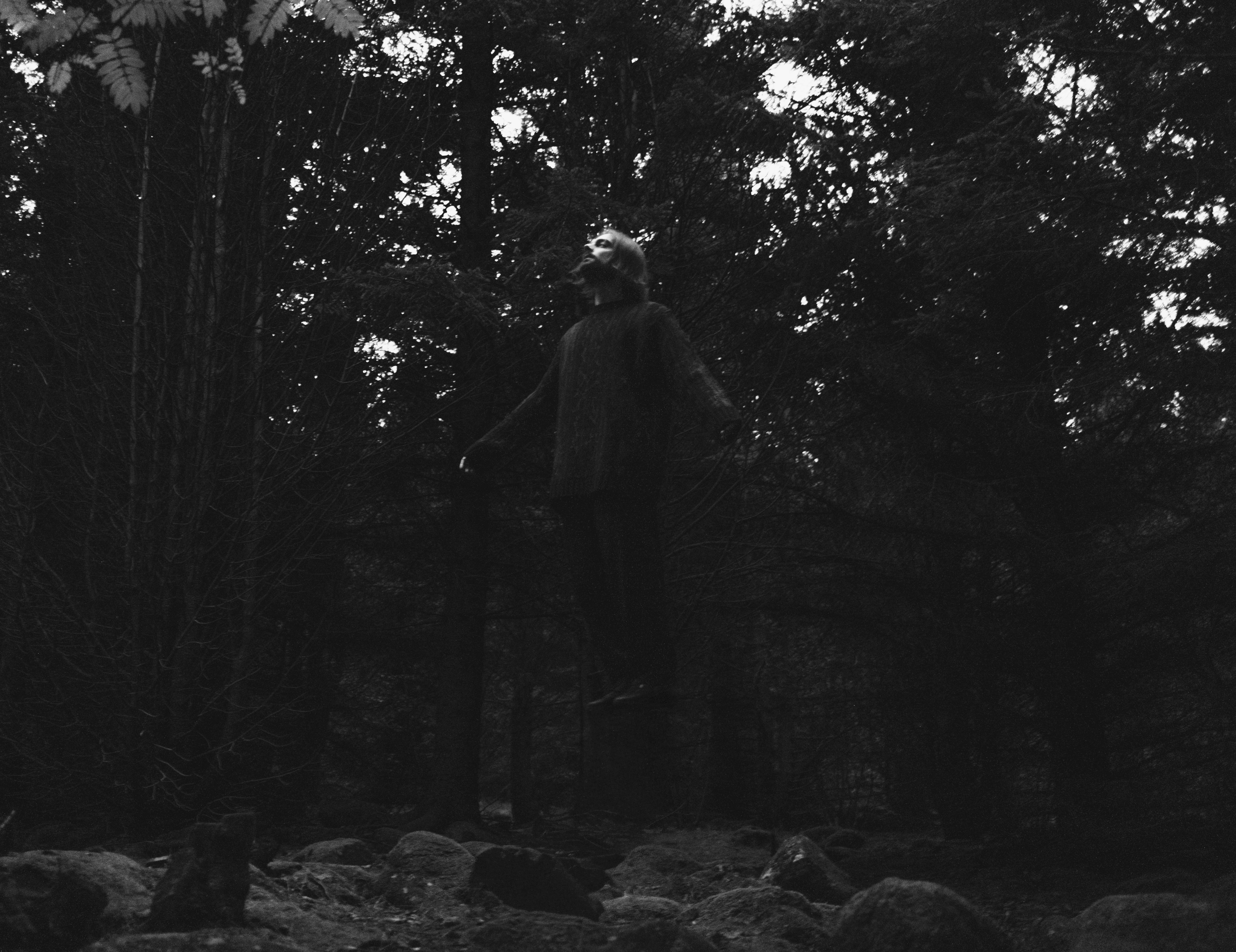
Published
Name: Janus Rasmussen
Nationality: Danish, Faroese, Reykjavik-based
Occupation: Producer, composer, vocalist
Current Release: Janus Rasmussen's new album Inert is out June 19th 2026 via Embassy One.
Recommendations for Reykjavik, Iceland: There's a cafe and bakery called Hygge in Reykjavik, which I really like to visit on weekends. Their pastries are delicious, and it's a cosy place to hang out and meet friends for a while. If you’re looking for good coffee, you should visit Kaffi Ó-le.
Topic I am passionate about but rarely get to talk about: I’m very interested in the history of computer games, almost more than actually playing them, since I rarely have time these days. But I’m currently playing a Baldur’s Gate 3 campaign with three friends, and we've been trying to finish it for nearly two years. It’s a huge game, but it’s good fun if you like that kind of thing.
If you enjoyed this Janus Rasmussen interview and would like to know more about his music and upcoming live dates, visit his official homepage. He is also on Instagram, Facebook, and Soundcloud.
For a deeper dive, read our earlier Janus Rasmussen interview.
What were some of the musical experiences which planted a seed for your interest in electronic music?
Some of my earliest experiences with electronic music came from watching a lot of MTV when I was growing up.
They broadcast it in the capital area of Tórshavn, and often late at night, they’d show programs featuring exclusively electronic music. It was there that I discovered artists like Aphex Twin, Björk, and early Daft Punk.
Those artists really helped shape my interest in electronic music.
Most genres of music make use of electronic production means. What does the term “electronic music” mean today, would you say?
It’s an interesting question, as most recorded and produced music today could be considered electronic in some sense.
Take, for example, metal music. It is mostly written on a computer these days, with programmed drums and even programmed riffs, and then it is taken to a band and performed that way. So, in a sense, everything, pop, rock, and most genres, could be considered electronic.
But today, we still tend to think of music that primarily uses synths and programmed drums as the pure form of electronic music.
Disco, house, techno, drum n bass, IDM and many other genres were about a lot more than just music. For you personally, is electronic music (still) a way of life – and if so, in which way?
If you’re at a place in your life when you’re out a lot at clubs, and so on, these genres can be a big part of your life.
But for me, as an electronic music producer, it doesn’t really make much difference anymore, since I produce a lot of other genres as well. I think that, with these genres, you tend to be a bit more into the technical, nerdy aspects of music production, but for me, it’s not about much more than that.
Honestly, on most weekends, I just sit at home early in the morning, have a coffee, and make beats. That’s about as crazy as it gets for me these days.
Debates around electronic music tend to focus on technology. What, though, were some of the things you learned by talking to colleagues or through performing and/or recording with other musicians? What role does community play for your interest in production and getting better as a producer?
Community and a sense of belonging in music mean a lot to me, actually, because I come from a rock and roll band background. I’ve always wanted to make music with other people, and it’s a bit of a shame that, in electronic music, you’re often just sitting alone.
So whenever I can, I try to do joint sessions or collaborate, making beats and just jamming out. That’s probably where you learn and grow the most as an artist, and I really wish we did more of that these days, instead of just being a bunch of emo loners on our computers all the time.
What are examples for artists, performances, and releases that really inspired you recently and possibly gave you the feeling of having experienced something fresh and new?
I get really excited about artists and performances that think outside the box in how they present their music. For example, I see many artists now relying on visuals in their shows, even calling them audiovisual shows.
I also really enjoy artists such as Clark, who are starting to use microtonal scales in their music. That is really inspiring to me. And I’m really wondering if I should try it out myself as well.
What kind of musical/sonic materials, and ideas are particularly stimulating for your own work right now?
These days, I’m really into music that draws inspiration from all kinds of places and moves freely across genres, tempos, and BPMs. I’m drawn to things that feel very open-minded. I’ve also been getting more into the IDM scene again, which was a huge influence on me during my adolescence.
Right now, I’m really interested in seeing where electronic music can go and in testing different boundaries. I also want to see what I’m capable of producing now that I feel a bit more confident in myself as a producer.
Where do most of your inspirations to create come from – rather from internal impulses or external ones? Which current social / political / ecological or other developments make you feel like you need to respond as an artist?
The answer to this is actually quite simple for me. Inspiration comes from being in a flow, a rhythm. The more music I write, and the more consistently I do it, the more inspired I become.
And to be honest, whenever I feel stuck and can’t seem to write, it’s because I haven’t been finishing any music. Once I start doing that again, momentum builds and inspiration returns.
Tell me a bit about the sounds & creative directions, artists & communities, as well as the colleagues & creative hotspots of your current hometown, please. How do they influence your music?
Living in Reykjavík is hugely inspiring for me creatively. It’s obviously a small city, but the music community here is incredibly strong and tight-knit. It’s easy to get in contact with people you admire or want to work with, and collaborations happen very naturally.
The studio space where my studio is located has around 20-30 studios in the same building, so there’s always something going on. You walk through the hallways or into the alley outside, and suddenly you’re deep in conversations about music production, songwriting, plugins, synths, or whatever people are working on.
Everyone is constantly sharing new music, which creates a really inspiring atmosphere. There’s also a healthy sense of competition in hearing how good everybody’s music is getting, which pushes you to improve yourself as well.
So, for me, living in a city like Reykjavík adds a lot to how I write and approach music in general. It’s a very creative environment to be part of.
Today, electronic music has an interesting relationship between honouring its roots and exploring the unknown. What does the balance between these two poles look like in your music?
This is one of the reasons I love making electronic music, because I feel that the lines between what you can and cannot do no longer really matter.
For example, take my song ‘Drain’ from my upcoming album Inert. At its core, it’s a singer-songwriter track, but it has a strong electronica feel running throughout it, and it could probably have worked as an instrumental track as well.
I find it really exciting to make music that way, where genres blend naturally, and you are not too concerned with fitting into one specific category.
What were some of the recent tools you bought, used, or saw/read about which changed your perspective about production, performing, and making music?
One of my recent purchases is a subscription to Minimal Audio.
I really love their synth, Current, and with the subscription, you get a new bank of presets roughly every month. I’ve found the quality of these presets to be incredibly high, and almost every time I open the synth and browse through them, I end up writing a new song.
So even though I’m very tired of subscription models, I have to admit that this one has genuinely been worth it for me, simply because it’s led to so much new music.
How do you see the role of sampling in electronic music today?
I think it’s more important than ever, especially in this age of generative AI music. There’s something ironic about saying this, as it’s all been trained on our music. That’s what these models are built on after all.
But to me, there’s a completely different feeling when an actual person takes a sample and shapes it by hand, cutting it up, rearranging it, and manipulating it with intention. There’s so much artistry in that process. It becomes a reflection of someone’s taste and emotions. That feels very different from a black box simply generating something for you, where you have no control or human connection to the process.
I’ve become really interested in exploring sampling more deeply in my own work, even using longer, more recognisable samples. I’ve always loved the idea of working with samples, but for a long time, I was hesitant due to copyright concerns. Lately, though, I’ve had a real urge to dive fully into sample-based music, partly because so much of the electronic music I grew up with was built around sampling.
I’m thinking of artists, for example, like Daft Punk, The Chemical Brothers, and Fatboy Slim.
What are some of the most recent innovations in sound design for you - and what are currently personal limits to realising the sounds you have in your mind?
I think one of the most important recent innovations in music production in general have been the new CPUs, especially Apple's M-series processors, running on ARM architecture.
Ever since I got a computer with one of those chips, everything really changed for me. Suddenly, I could run incredibly heavy projects on a laptop while travelling, and the computer barely breaks a sweat. I’m still using the first M1 model, and it still feels really powerful.
One of the personal limitations I still struggle with, though, has less to do with sound design and more to do with arranging ideas quickly. I often get stuck in the loop stage for too long. I’d love to develop a workflow that lets me turn sketches into full arrangements much faster, because that’s really where you hear if an idea is actually strong or just an interesting loop.
In as far as it is applicable to your work, how would you describe the interaction between your music and DJing/DJ culture and clubs?
Before this album, DJing was a key way I discovered new music and kept up with what was happening in electronic music. Playing at clubs regularly motivated me to find fresh tracks, and seeing people react in real time to what I was playing was always eye-opening. It helped me sense the direction of the scene and what resonated with people.
However, with this new album, which is less club-oriented than my other work, I probably won’t be DJing as much for the time being.
Even if AI will not entirely replace human composition, it looks set to have a significant impact on it. What does the terms composing/producing mean in the era of AI, do you feel?
I have to be completely honest and say that I haven’t given it much thought yet, in terms of what it means to compose and produce with AI, mainly because I haven’t really tried it in any serious sense.
It’s strange, because I’ve always been very interested in technology when it comes to music. I’m constantly excited about new plugins, new techniques, and new ways of working, but something about AI in music production feels a bit different to me.
For now, I’m kinda just putting my head in the sand when it comes to the subject. I know I’ll eventually have to form a stronger opinion on it, probably sooner rather than later, but at the moment I’m not hugely interested in it creatively.
The only AI-related tool I’ve really used so far is a plugin from Datamind, which takes any incoming audio you feed into it and applies models created by different artists. What I like about it is that the artists behind the models are actually compensated and receive royalties for their work. That side of it feels much more human and collaborative to me.
I’ve had a lot of fun experimenting with it, but it still feels very rudimentary compared to all the generative AI stuff that’s happening right now.