Published
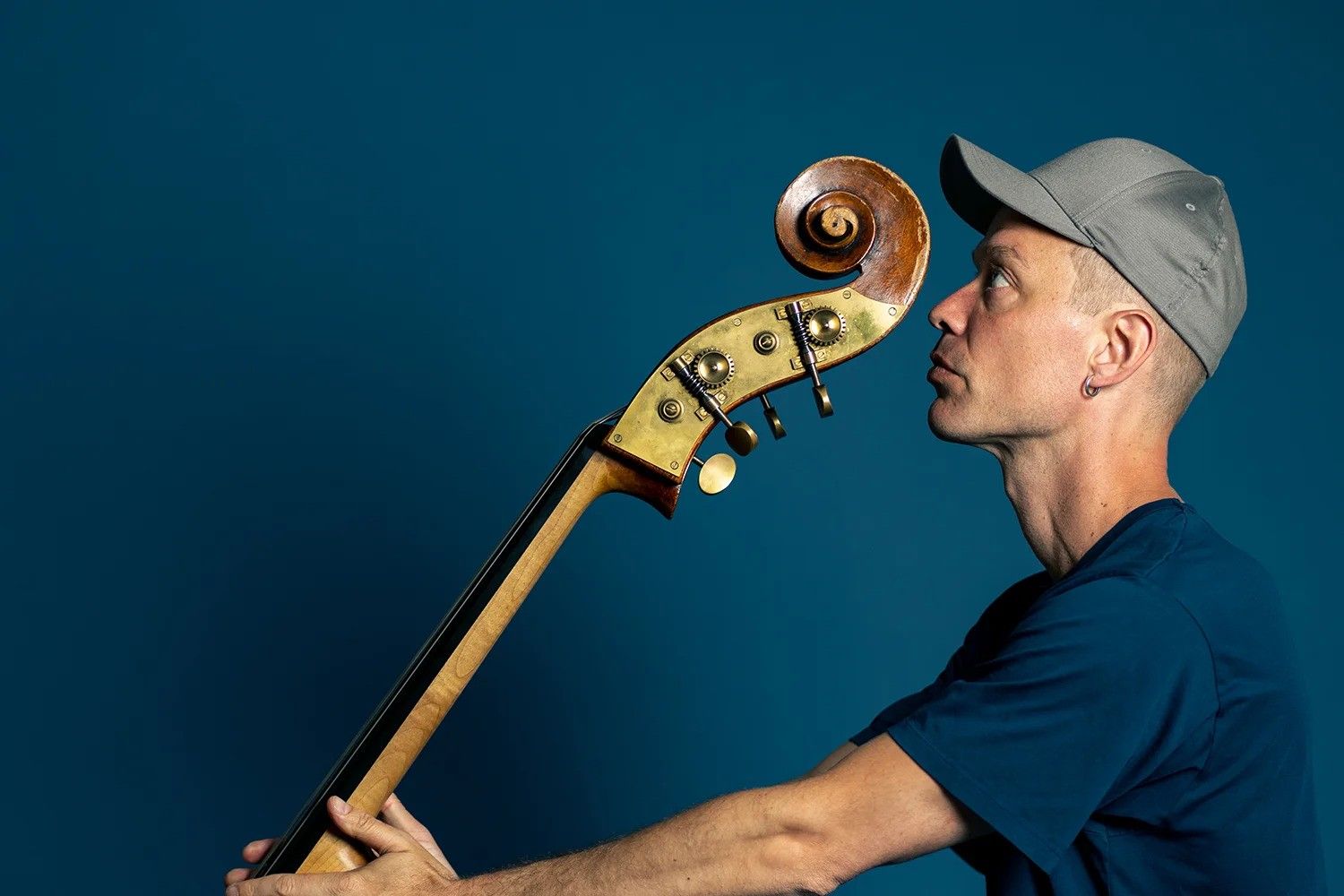
Name: Jasper Hoiby
Occupation: Bassist, composer, improviser
Nationality: Danish
Current release: Jasper Hoiby's new album Fellow Creatures: We Must Fight is out via Edition.
Current event: Jasper Hoiby is among the artists featured at Sounds of Denmark, a celebration of Danish jazz that takes place in London and Southampton on September 25th and 26th 2025. For more information and tickets, go here.
Recommendations for Copenhagen, Denmark: I would recommend buying some cheap drinks and finding a spot next to the harbour with your friends. The water is clean and on a clear summer night you can go swimming until the early morning and watch the sunrise. Thank me later.
If you enjoyed this Jasper Hoiby interview and would like to stay up to date with his music, and live dates, visit his official homepage. He is also on Instagram, Facebook, Soundcloud, and bandcamp.
What were some of the musical experiences which planted a seed for your interest in jazz?
I grew up listening to hip hop and that eventually led me to picking up the electric bass.
As my ears expanded (not literally) I was inevitably led to Jazz and discovered some of my first heroes like Jaco Pastorius and Marcus Miller etc.
What does the term jazz mean today, would you say?
For me Jazz is the one pioneering music style and most of the written music is derived from or directly related to improvising. If there’s no interaction or improvisation then it’s generally not jazz to me.
Jazz is also a music with roots in the Black American resistance from where the Blues was born and Jazz is a continuation of that struggle.
It’s a political music born out of resistance and personally I feel the responsibility to honour that history.
As of today, what kind of materials, ideas, and technologies are particularly stimulating for you?
Stimulating ideas for me are those of the philosophical ilk that try and imagine a different society that respects our planet, it’s resources and our fellow creatures and human beings.
Where do most of your inspirations to create come from – rather from internal impulses or external ones? Which current social / political / ecological or other developments make you feel like you need to respond as an artist?
The music I create is a result of my lived experience as a human.
I’m drawn towards justice and I feel inclined to use my music to seek justice where I can and I’m aware that one of musics biggest qualities is bring people together despite class or colour.
Tell me a bit about the sounds & creative directions, artists & communities, as well as the colleagues & creative hotspots of your current hometown, please. How do they influence your music?
London is the place that I call my home these days and I have a huge network of inspiring people around me in that city.
I feel that I was lucky to be there in the vibrant time of the mid 2000s, just out of college and the scene was buzzing with creativity. I was inspired by my peers starting the Loop Collective, which came of of the F-IRE collective and Tomorrow’s Warriors which came out of Loose Tubes which came from people like Norma Winston, John Taylor, Kenny Wheeler, Dave Holland, and later people like Julian Joseph and the Mondesir brothers etc.
At least that was my small glimpse into the UK scene at the time and it was immensely inspiring.
What role do electronic tools and instruments play for your creative process?
In my project Planet B I explore the use of electronics and artificial sounds ...
... but currently I’m more interested in the immediacy of the acoustic world. There’s a directness and originality there that I have not yet found when applying electronics.
Jazz has always had an interesting relationship between honouring its roots and exploring the unknown. What does the balance between these two poles look like in your music?
When I write or play I’m not concerned with honouring anything at all. I create from a point of where I am in that moment and try to think as little as possible.
How much potential for something “new” is there still in jazz? What could this “new” look like?
How much potential is there for new inventions in any field?
In some ways I see the universe we live in as a kind of endless fabric of combinations and only our imagination limit the possibilities.
For many artists, life-changing musical experiences take place live. How do you see that yourself?
I have had many life changing musical experiences both as a performer but also from the audience side.
Those experiences often make me think of creativity itself and the way that you can never quite know when the circumstances are ripe for such an occurrence.
In some ways, that’s the beauty of it all.
How, would you say are your live performances and your recording projects connected at the moment? How do they mutually influence and feed off each other?
I generally find inspiration for my recorded projects through my live experiences, whether as a sideman or leader.
The two things are spiritually linked and for me one doesn’t exist without the other.
Ímprovisation is obviously an essential element of jazz, but I would assume that just like composition, it is transforming. How do you feel has the role of improvisation changed in jazz?
If you zoom out on the genre as a whole I feel like it hasn’t changed at all.
Perhaps the exploration has gone deeper in all of jazz’ specific sub genres but the exploration is part of us understanding ourselves - and when do we ever fully understand ourselves?
What, would you say, are the key ideas behind your approach to improvisation?
Listen, listen, and listen some more.
Then speak but only if necessary.
Are there approaches, artists, festivals, labels, spaces or anyone/-thing else out there who you feel deserve a shout out for taking jazz into the future?
There are many but I feel like people are too concerned with the future. We are conditioned to think that new is better than old which is complete nonsense.
I personally try and think of Miles and his approach to try and constantly reach for something new when making music. That I feel is a lesson for us all and many upcoming musicians and labels seem motivated by that too, but without the old nothing new can exist.
They are both part of the same journey through time.
The Montreux Festival intends to preserve its archive of recordings for future generations. Do you personally feels it's important that everything should remain available forever - or is there something to be said for letting beautiful moments pass and linger in the memories of those that experienced them?
Some of the most magic musical experiences I have ever had are not filmed or recorded and they exist purely in my mind.
There’s almost a melancholy relief in knowing that for me and I don’t think any video or audio recording would do those memories justice.