Published
Name: Jean-Philippe Dary
Nationality: French
Occupation: Pianist, Keyboarder, Improviser
Current release: I:Cube's remix of Jean-Phi Dary's "For Peace" (released under his MIND alias) is out via COMET.
Recommendations:
Sculptures: from Ousmane Sow; Paintings byTam Joseph, k-litystreet;
Books: En attendant le vote des bêtes sauvages (Hamadou Kourouma); Fragments d’un enseignement inconnu (Ouspensky); Le guerrier pacifique (Dan Millman)
Music: DP Express (David); Weather Report (all the albums)
If you enjoyed this interview with Jean-Phi Dary, visit him on Facebook, Youtube or Spotify. For a deeper dive, we recommend our earlier Jean-Phi Dary interview.
What was the first time you were consciously impressed by technology – in and outside of music?
In the 60s, my father was working for the French phone network as a technician. He always explained to me what his job was. I was impressed because at that time not everybody had a telephone at home … For me, as a kid, he was the guy who made this magic happen.
Then I discovered synthesizers with Jean Michel Jarre.The first album I bought was Oxygene by mister Jarre. I was ten years old.
[Read our Jean-Michel Jarre interview]
[Read our Jean-Michel Jarre interview about the originators of electronic music and his time at the GRM]
[Read our Jean-Michel Jarre interview about Sound, Abstract Painting and Synaesthesia]
Tell me about one or two of your early pieces that you're still proud of (or satisfied with) in terms of production – and why you're content with them.
Oh, there are many pieces I’m still proud of! But it’s gonna be more in term of co-writing.
The Tomorrow Comes The Harvest album Evolution with Jeff Mills and Prabhu Edouard is the latest of these which was released.
[Read our Jeff Mills interview]
[Read our Jeff Mills interview about Metropolis and Scoring for Film]
[Read our Prabhu Edouard interview]
Then my collaboration in the duo project Tony Allen and Jeff Mills’s album (also) named Tomorrow Comes The Harvest, on which I played all the keyboards and also played on the world tour we did.
And of course The Paradox, live and studio album I did with Jeff Mills.
When it comes to arranging, sound design, performing, composing, etc – what are currently concrete topics and aspects that interest you and where you want to improve or simply challenge yourself?
The topic is the main world, the centerpiece of what we are talking about, what emotions, what feelings, what can I do with the images this topic brings to me. How to create a story from all these emotions.
All will be translateted into sounds, in musical ideas, phrases, chords, rhythmic patterns, etc …
Do you keep up with recent developments in terms of gear and software? If not, why not? If so, what are you looking for?
I have always loved technology. Analogue and digital gear are working together.
To me there’s no split between modern and old gear, even if I prefer using my old synths. Most of the time I record them in my computer and even if I use old preamps, I need a modern sound card. And I will also use some pluggins as effects.
How and for what reasons has your music set- up evolved over the years and what are currently some of the most important pieces of gear and software for you?
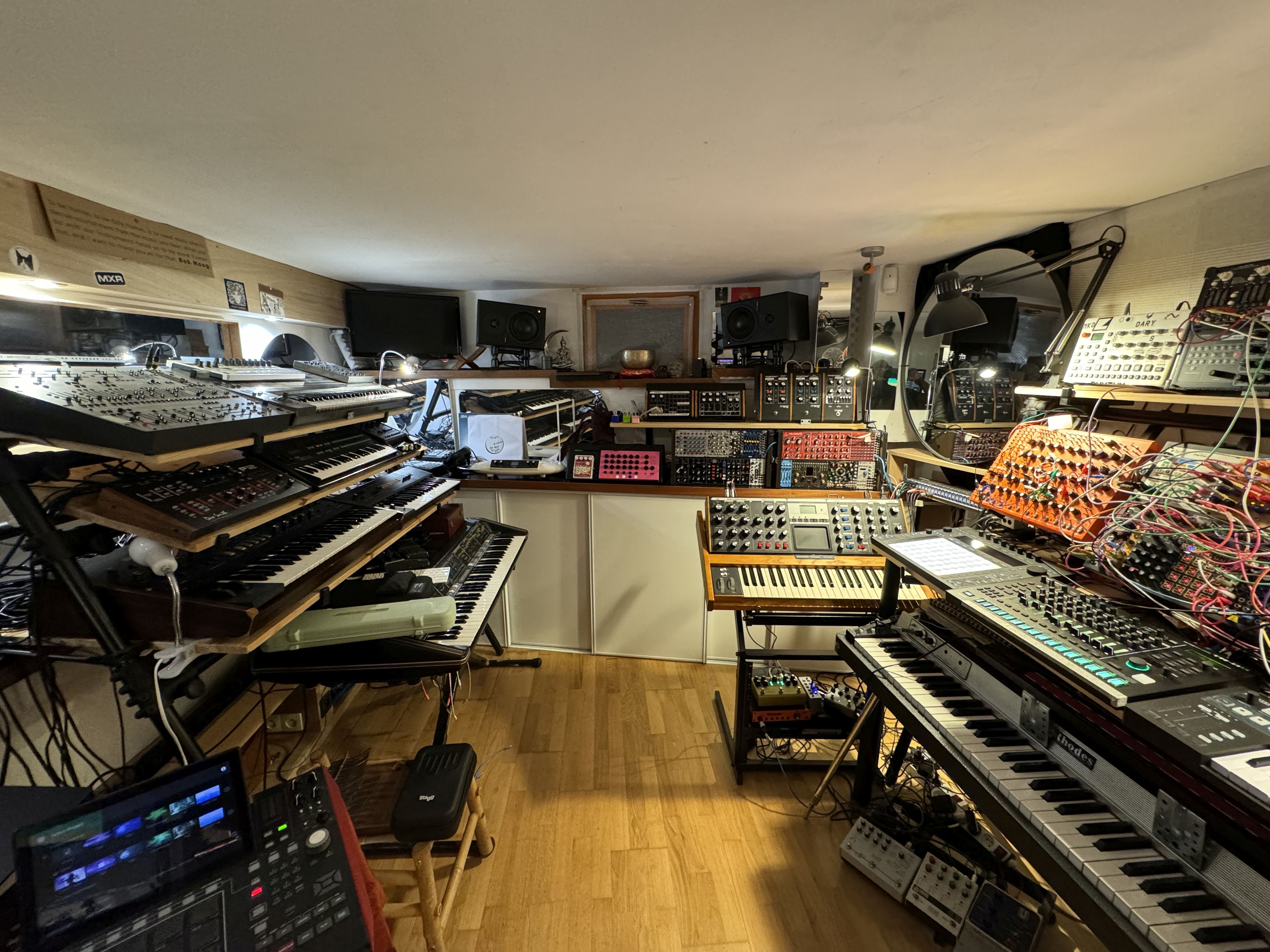
As I said I always loved technology. Even if I use more analogue gear than plugins. In my recent set up I add an MPC X AKAÏ and a Roland TR8S, which are two drum machines that work together perfectly.
[Read our Yamil interview about Production, Technology, and the Roland TR-8]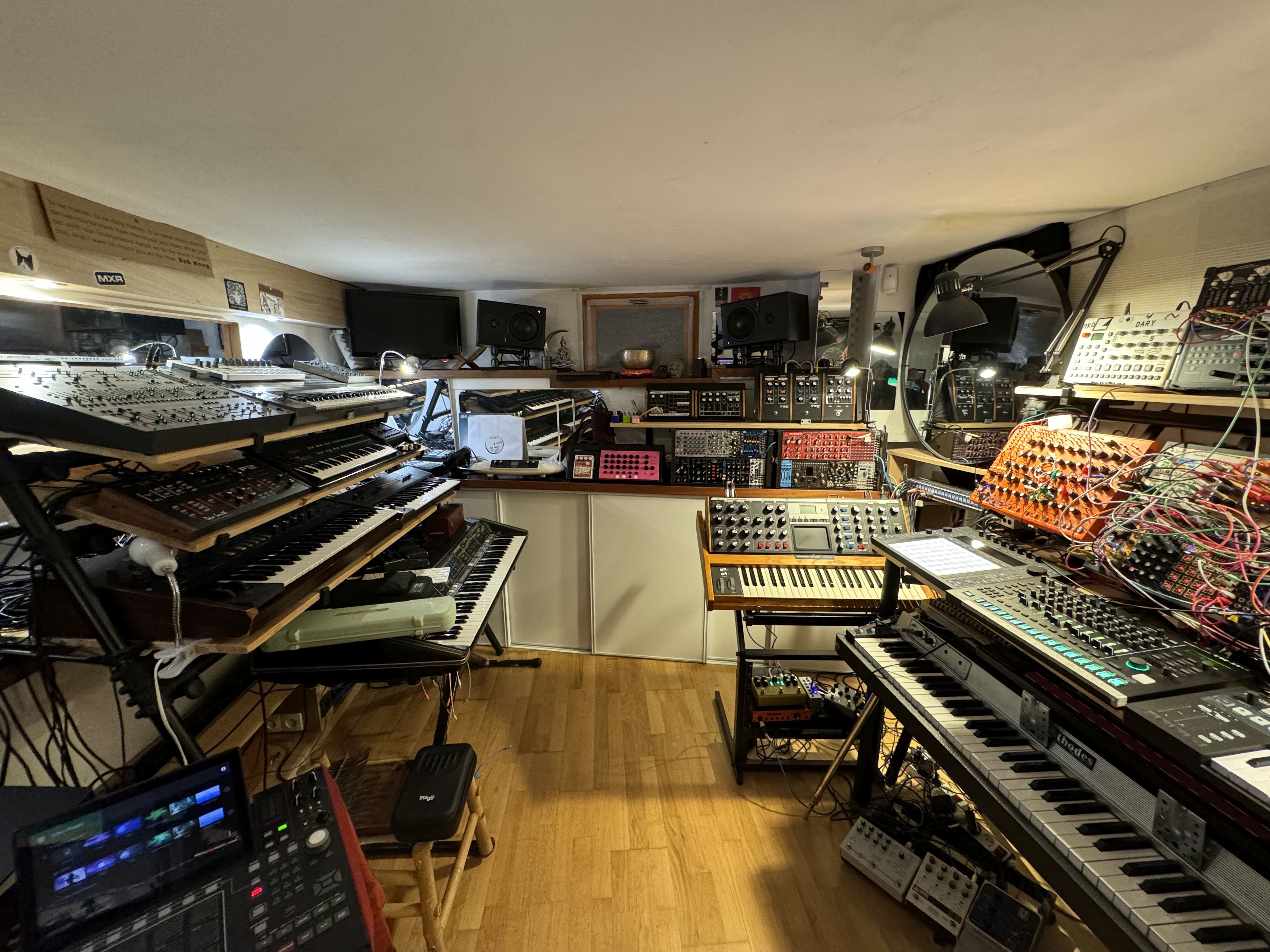
Jean Phi Dary Studio Image (c) the artist
I also use a modular system in which I have some Mutable Instruments, ENDORPHINE ES,4MS … I use these modules to create sounds textures and also leads, bass, weird sounds. Of course I also use my Polymoog, Mini Moog, Korg Mono Poly, Fender Rhodes, Prophet 12 and many others synths from my collection.
[Read our feature on the Moog DFAM]
[Read our feature on the Moog Modular]
[Read our Stephan Bodzin interview about how Arturia's Minimoog Made him Cry]
All these machines are recorded by two UAD Apollos via some old preamps and compressors (Studer 961), Neve 81, Telefunken, Drawner1961, Distressor.
Jean-Michel Jarre maintained that, despite the advances in virtual technology, we are still "analogue animals made out of blood and bones who need buttons and knobs to touch.” In how far is this statement true or false for your own music?
I‘m completly agree. We need to feel and see.
I'm not so comfortable with the mouse of the computer. I need to to touch a knob and feel that something is happening when I turn this knob.
What are examples of production tools/instruments that you bought for a specific purpose?
I would say my modular system really added a new way of thinking about the production. It's more fluid, more intuitive - so, more efficient in terms of creation and production.
Late producer SOPHIE said: “You have the possibility with electronic music to generate any texture, and any sound. So why would any musician want to limit themselves?” What's your take on that?
I guess as long as we have not identified our limits, we don't know how to go beyond them.
And even if the technology can help us to go beyond, the essence of the creation is coming from us.
From the earliest sketches to the finished piece, tell me about the production process for your current release, please.
I don’ t really have a ritual process. Sometimes the groove, the rhythmic and bass pattern comes first. Sometimes it’s the lead melody which comes first.
When I have something that fits between the ideas of rythm and melody, I move to the arrangement part.
What does your own way of working with sound look like? Do you find using presets lazy?
I'm used to creating my own presets. But once I’m happy with them, I will use them on many tracks.
Richie Hawtin, speaking about semi-modular equipment, has stated that a deeper understanding of sound synthesis can lead to “life lessons that go beyond what we can hear.” Can you relate to that statement?
For sure any material in music shows us that contrast makes things happen. In basic harmonic theory, for example, major chords and minor chords work perfectly together. Scales are made of different notes and each one is as important as the other.
Modular systems are the assembly of different modules. You decide to make them work together, but once you plug them together, the magic happens. It’s a kind of lesson for everyday life .
What were some of your most positive collaboration experiences? How did this "human element" enhance your solo approach? Did you record via filesharing or in the same room and if so, what did the recording process look like?
I’ve been lucky to work more than 20 years with The Master, Tony Allen. He’s the artist with whom I did the most albums and shows. He was like a father and a brother to me. I learned so much, I will always be grateful.
And I m also lucky to work and share some projects with Jeff Mills. We actually have two projects together:The Paradox which is a duo, and then Tomorrow comes the Harvest, which is a trio for now with Prabhu Edouard who plays the tablas.
All these collaborations are first and foremost human collabs - human adventures.
To some, the advent of AI and 'intelligent' composing tools offers potential for machines to contribute to the creative process. What are your hopes, fears, expectations and possible concrete plans in this regard?
To be honest, some pluggins we have been using for years now, are using AI. Some revebs, delays, some mastering- and mixing tools are already using AI.
I just hope artists will use them in such a way that the creation will stay the focus. And I hope these tools could also be used for educational purposes.
Have you used AI or generative music tools for your own productions? If so, in which way and what did they add?
For now I only use AI to create images for my Instagram and FB, Tiktok networks.
What is a production related question that you would like to ask yourself – and what's your answer to it?
Everyday I ask myself
How to be more creative?
How to have a better sound?
How can I do to make this music known worlwide?
I am still working in find the answers.
But if I could ask these questions to Jean Michel Jarre, I would be happy to know his secrets.