Published
Name: Jeff Snyder
Nationality: American
Occupation: Composer, sound artist, sound designer, instrument designer, educator, producer
Current Release: Jeff Snyder's Loom is out via Carrier.
If you enjoyed this Jeff Snyder interview and would like to know more about his work and music, visit his official homepage. He is also on Instagram, and twitter.
When it came to arranging, sound design, performing, composing, etc – what were some of the topics and aspects that interested you or where you wanted to challenge yourself on Loom?
This was the first "dance music" album I've made since 2003, and the first under my own name, so it was a challenge to figure out what I wanted my sound to be. When I started producing it, I decided that I wanted it to feel very austere and uncomfortably spare.
My first few tracks I made, I decided that I'd have a rule that there was nothing except drums, to try to set some constraints and see what I could do with that. After playing around with those rules for a while, I kept occasionally adding basslines to things and just having so much fun with bass programming that I gave up on the "just drums" constraint.
I had gone into the project feeling like I'd try to put forward a darker, more refined vision, but I just really enjoy fun active bass stuff and doing chord changes. I was a bit worried that my IDM roots from listening to 90s Warp artists so much would make me sound like just a throwback to that soundworld, but I eventually decided to let that take me where it would.
My approach is really quite different from Squarepusher or Aphex Twin, so I think I was able to mix that influence in with the other things that feel like my sound without it becoming the main flavor.
It interesting that you see Loom as a “dance album” (albeit “experimental”). To me, it has a real rock n roll spirit to it!
That's neat to hear. I think part of it is that I have a hard time with the standard dance music stratified form, where layers of loops are added and removed every 8/16 bars. It's not how I think musically and I struggled with how much I should follow that convention versus how much I should let a more "verse/chorus/bridge" structure develop. I ended up letting the music take more rocklike structures, though I think the material (as opposed to the form) still feels like dance music to me.
I don't DJ, although I'm working up a set to play this material live right now. Because I'm not from a DJ background, I wonder how much this music will serve the dance music purpose. It's possible I just made music for home listening that plays with dance music genre signifiers and elements. The third track, “The Plasmic Crystal,” is in 9/4 - does that mess up the dance floor?
I'm guessing it might, as we have two feet so a natural alternation is disrupted with odd-numbered meters. The classic way to sneak some metrical tomfoolery into a track meant for dancing is to keep it in multiples of 2, think of all the Pixies songs that have an extra 2 beats here or there. But also that's a rock 'n' roll reference!
So I think I'm basically mixing it all up. I really like dancing to it. Maybe I'm not the only one? I'm curious to see what the reaction is when the album releases.
There is a great flow to Loom in my opinion, everything blends together with the dynamics and energy of a live set. How did the album come together?
Thank you! It had a long gestation, originally starting during the pandemic. I had been making a lot of very "serious" music for a long time, and when the pandemic hit and I was stuck at home, I just wanted to make some techno and dance around.
My wife and I were in the house she grew up in (on an island in Maine) and it has a barn behind it that I turned into a little studio. I set up a bunch of modular gear and just started recording long live improvisations. I recorded a 2-hour improvisation every day for a couple of weeks, each day at a different tempo.
About a year later, I started taking those recordings and trying to figure out how to make songs out of them. Most of them were just a beat and a bassline, which was about all I could control simultaneously live, and the development over time was very slow because I was tweaking things to find interesting patterns without worrying about whether I ended up somewhere stupid momentarily (since there was no audience).
I edited them into song forms and added other elements to some of them - for instance the first track “Redox” is pretty much just an edited down version of the improv …
… but the fourth track “Neon Rain” only takes the beat from the improv, with the bassline, melody, and chords all composed afterwards.
I ended up with a lot of tunes, and I tried to find two sets of three tracks that would go together in a nice sequence, since I wanted it to fit on a vinyl LP. I plan to release another album reasonably soon with six more, since I've felt pretty inspired by this direction and I'm really enjoying making this music.
I rely a lot on some musician friends with good taste to guide the editing of the tracks, this one went through a lot of listening sessions getting input from people who I trust like Cenk Ergün , Tyondai Braxton, Quinn Collins, and Davis Polito.
[Read our Cenk Ergün interview]
About the fascinating title track, the press release speaks about an “implausible metamorphosis.” For many artists in the electronic realm, implausibility is often realized through randomization and algorithmical approaches. How would you describe your personal interest in implausibility and how do you go about putting it into action?
Good question ... I think a lot about how music can be seen as a manipulation of expectations. It happens over time, and the balance of satisfied expectations vs. surprise is one of the most powerful levers composers can operate.
Repetition gives music identity; the repetition of a phrase is the confirmation of what the piece is made of. Without repetition, form dissolves and the ear tunes out. Even music without literal repetition is tapping into this at some level, when a new note follows the first and is played by the same instrument, you've set up a consistency of what exists in that musical world.
I like to play a bit the listener's understanding of the limitations of the musical world. The moment in the title track where the bass goes full-on distortion feels like it doesn't belong to the same world, but because it's still the bass that's already been in the track doing it, I think it works. It also happens on a key change, but it's up a fourth, which is a very close relationship that's a common motion for pop music (probably the most common thing to do going from verse to chorus in country music, for instance).
The other motion in the track so far has been focused on half-step moves, which I think of as a dance music signifier (likely deriving from the practical limitation of how samples sound bad when pitched too far away from their original pitch). I like that the track makes those large moves simultaneously, both in timbre and in pitch center, in a way that feels like a bigger change than might be expected from a dance track. It's sort of my take on the traditional "drop".
Interestingly, the title track was very tough for me to make decisions on, and it felt a bit unfinished when I brought it to the mixing engineer. Seth Manchester mixed it, and I think his doom metal bonafides (he's mixed a lot of records for the Southern Lord label) helped push that one in a heavier direction - I was flip-flopping on whether the bass should stay clean or get distorted at that moment and he felt it would be disappointing not to go all out.
How and for what reasons has your music set-up evolved over the years and what were some of the most important pieces of gear and software for you on Loom?
Loom is actually the first record I've made that is centered around using the Manta controller. The Manta is a touch controller that I designed around 2008 and released as a small-run product. I've made about 300 of them. There are several musicians for whom the Manta is their main instrument, but it never had been quite right for what I do live, and my primary instrument for my own music since about 2011 has been a controller I built called the JD-1. Paired with a very small analog modular that I built, the JD-1 became my voice as a performer.
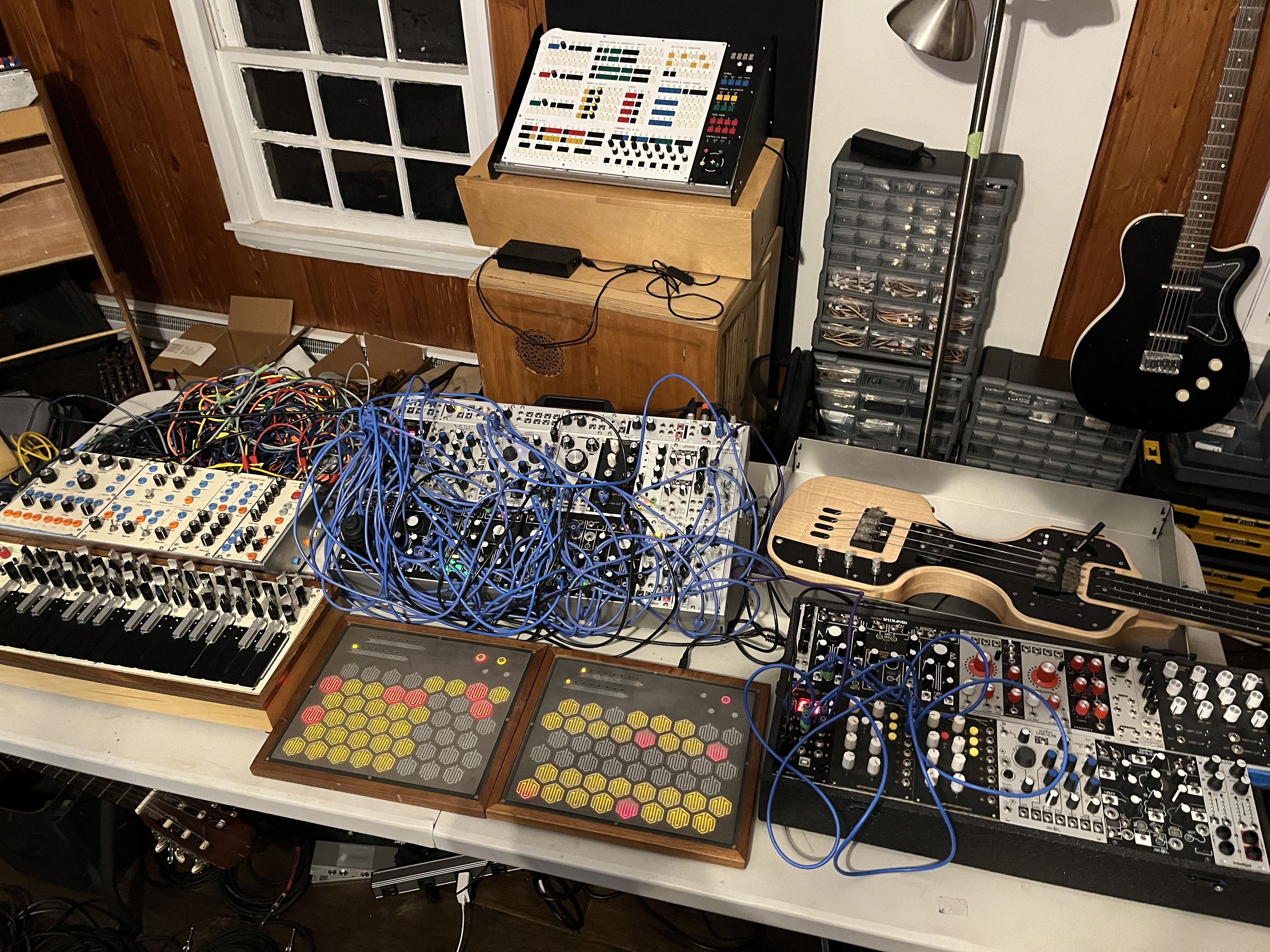
However, since I only have the one JD-1, and it doesn't fit in airplane carry-on luggage, I've been increasingly worried about traveling with it and I decided I should transition to playing Manta for more portability. At that time, I was using modular synths a lot, so I created the MantaMate module to let me use the Manta with my modular gear. I released the MantaMate in 2018, and this record heavily reflects the workflow and instrumental affordances of the Manta/MantaMate combination. 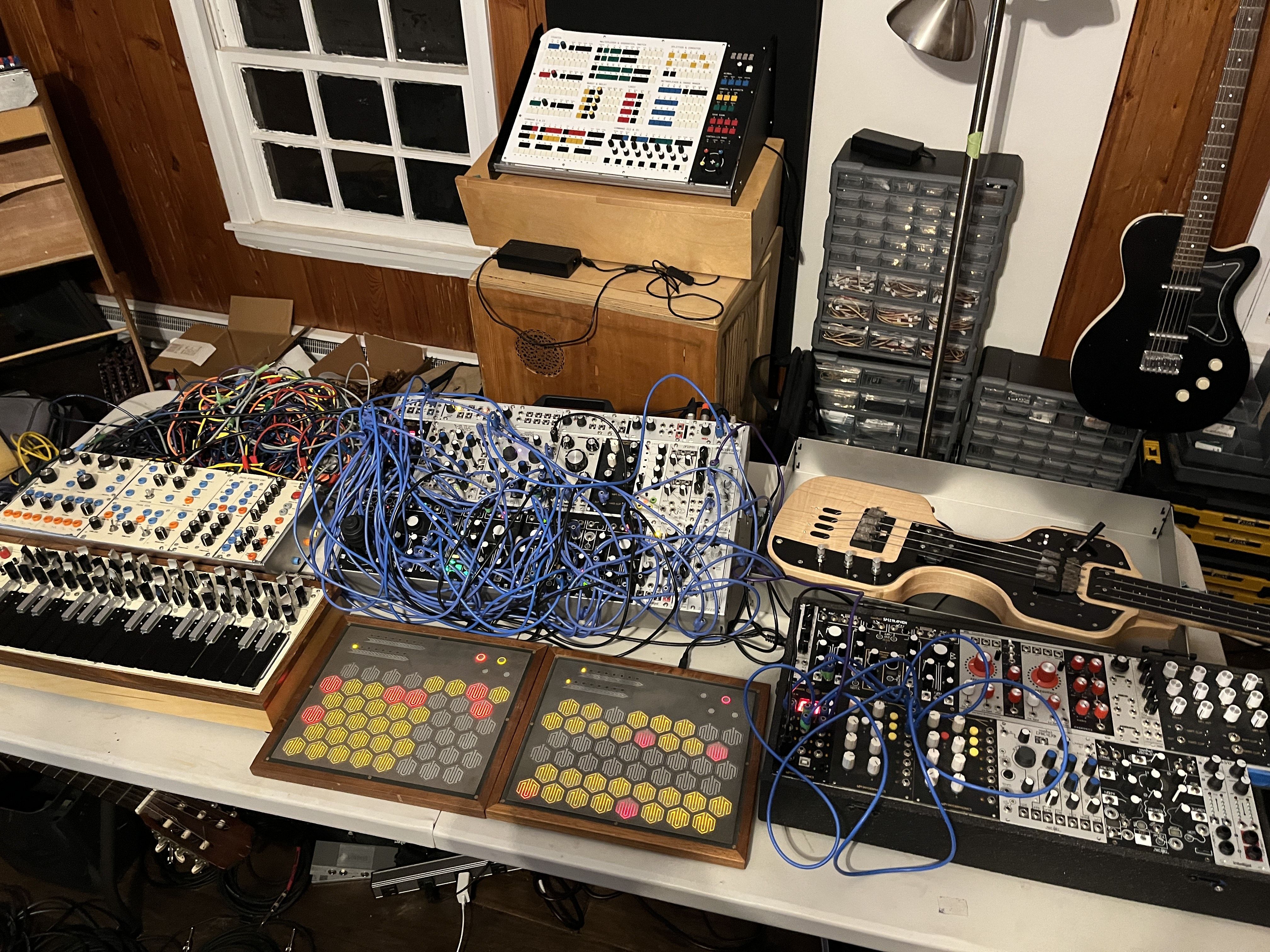
Jeff Snyder Studio Image (c) the artist
When I made the Manta, it was just a USB controller for a computer, and it leaves it up to the person using it to figure out what it is going to do. Creating the MantaMate meant that there wouldn't be a computer in the loop, so it forced me to design some logic of what the Manta will actually do when plugged into a modular system. I ended up building some very deep sequencer functionality that allows for percussive and pitched sequencing where the interaction is as live as I could make it. It's fast to change the step pattern of a sequence, change which steps are active, change the octave of multiple steps, and so on.
The core of the album was made with two MantaMates and two Mantas. Sometimes they were both handling drums, and sometimes one was handling the bassline. The modules in use were primarily my custom Genera module, which is a digital module I made that I can reprogram to do all kinds of different things. For some tracks on the album it was set up as a sampler with dynamic speed and envelope controls, for others it was an 808/909 drum simulator, for others it was a physical modeling synth or a set of 200 resonant filters.
The other modules that got frequent use were the MakeNoise DPO, Maths, Octomix, Erbeverb and Echophon, and the Verbos dual oscillator. I also brought in some Spectraphon as I was working on the prototype, as I designed the hardware brain for the MakeNoise Spectraphon while I was creating this album.
Most of the basslines that weren't originally from the modular synth are using my Electrosynth plugin, which is a simple subtractive synth I designed for the Electrosteel and Electrobass instruments. 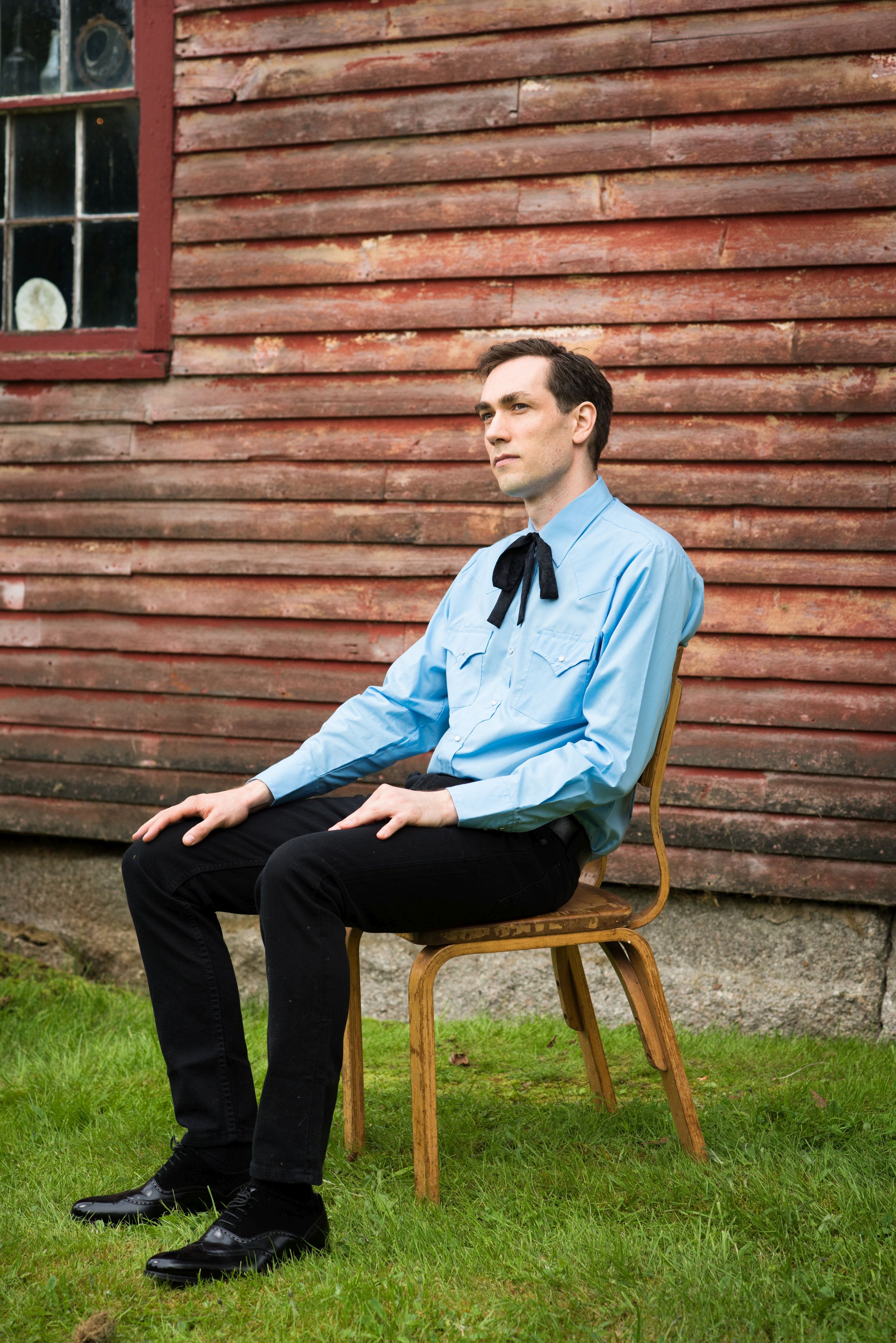
Jeff Snyder Interview Image by Kim Indresano
You're building your own instruments and your Instagram account hardly has a single picture of a “regular” modular synthesizer. What makes you decide to focus on modulars for an album like Loom rather than recording it using your own instruments entirely?
Two reasons. Firstly, the core material for the album was created while some of the newer instruments weren't yet playable. There's some Electrobass on it, but the Electrosteel wasn't ready yet while I was finishing the album.
Secondly, most of my instruments that aren't in the modular/software world are designed to be played live by players, and I was going for a more programmed/sequenced sound on this record. There is some live bass on the title track, but I played that on a Fender P-Bass because I wanted it to sound a bit like a sample from some funk record or something rather than a synth.
Also, I wanted to be playing all the instruments on this record myself, and honestly most of the instruments I make are played much more expertly by other people. I've spent a lot of time creating the Birl, which is an electronic wind instrument, and I can't play it at all. Even the Electrosteel, which I'm hoping to make my main performance instrument in the future, sounds much better right now in the hands of a serious pedal steel expert.
In relation to sound, one often reads words like “material”, “sculpting”, and “design”. For Loom, what did your own way of working with sound look like? Do you find using presets lazy?
I definitely think of making sound in this way. I try all sorts of things and make tiny tweaks constantly.
The question of whether using presets is lazy is fun, because I generally do, but ... I just listened to a podcast interview with Kieran Hebden (Four Tet) and he mentions in that interview that he never designs sounds. Everything is a preset, and he describes his process of finding sounds as scrolling through the presets in the plugins he likes and using the ones that fit what he's doing. His music is awesome, so I may have to revise my opinion of presets.
There is something to say for focusing on the parts of creation that you care about and ignoring those you don't. There's no need for everybody to do everything. I do a lot of sound design because it's fun for me and I think that the design of very specific sounds is a big part of what I want to do musically. But for Four Tet the arrangement and interaction of the beat with the melody/bassline are more important - to me that seems like he thinks more orchestrationally of the specific synth sound as being a choice of instrument between many options, rather than something that needs to be built from scratch.
I like to build from scratch most of the time because I enjoy starting from the basic elements of sound and building up. I also have a newfound respect for presets because I had to make a bunch of synthesis presets for my instrument the Electrosteel, since it was intended to be used by people who don't necessarily have a background in electronic music synthesis.
It's really hard to make a set of presets that provide a variety of sounds that have wide use cases. I didn't do it well yet, I'm taking another crack at it soon.