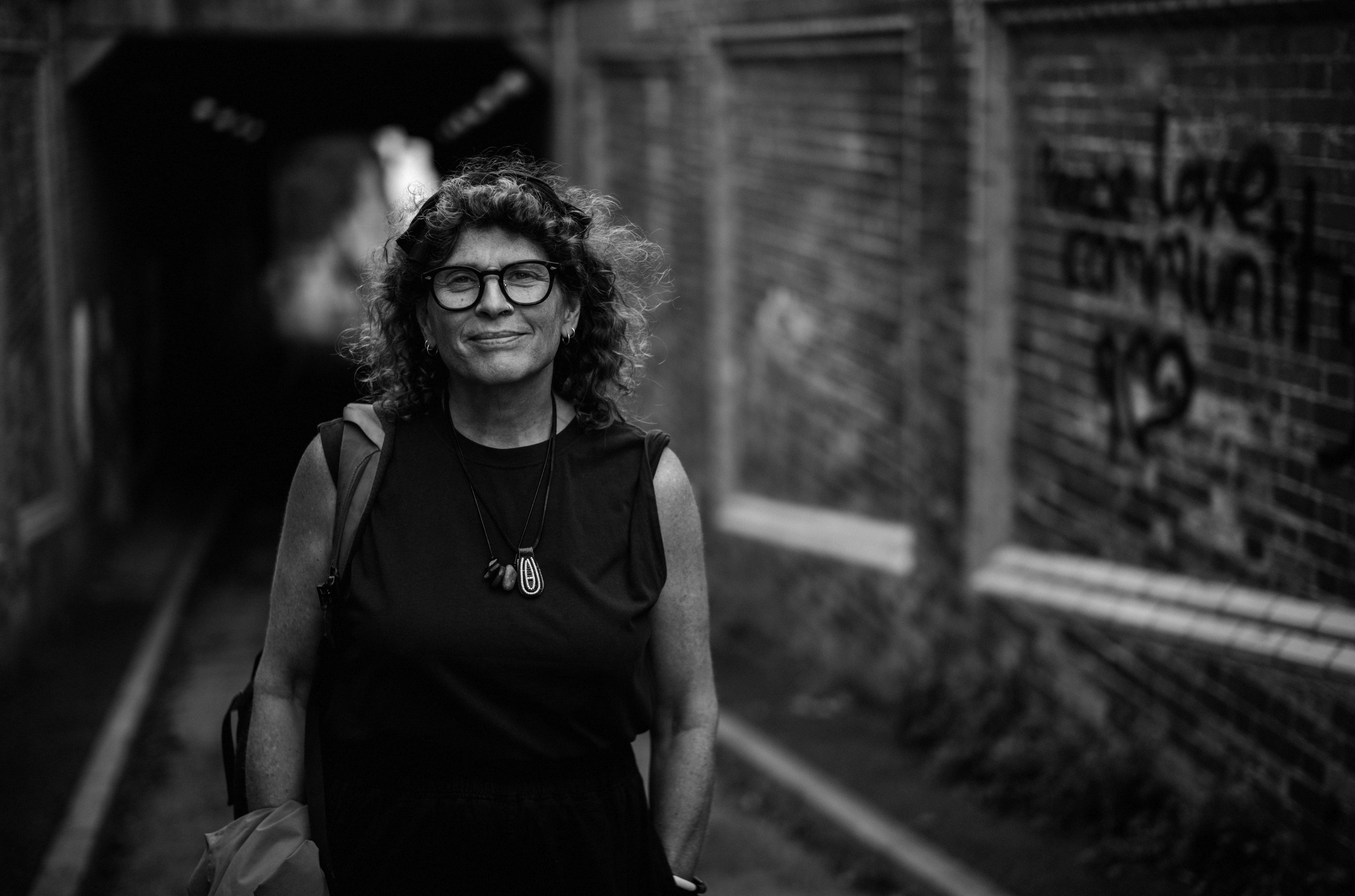
Published
Name: Jessica Lauren
Nationality: British
Occupation: Keyboard player, composer, improviser
Current release: Jessica Lauren's new album film, a reissue from the original released 25 years ago, is out via IMPRESS!VE Collective/BBE.
Recent event: Jessica is one of the artists performing at the new Queer Jazz event series at the Vortex. Her performance will take place March 19th. Curated by Tina Edwards and Arowah, Queer Jazz was founded as a platform to “nurture and celebrate the emerging queer jazz scene.”
Global recommendation: I moved to Margate, on the North Sea coast, 8 years ago, and it’s really buzzing at the moment. So many galleries, venues, bars, coffee houses, bakeries … and of course, the sea.
My favourite place? The International Food Centre on Northdown Road in Cliftonville. I lived in Dalston in East London for nearly 30 years, and Turkish food was my daily diet. Finding a Turkish food shop in Margate was instrumental in my realising I could live here. It might sound trivial, but it isn’t!
Topics I rarely get to talk about: I’ve recently started taking photographs with more intent, and I look forward to seeing how my style develops, and how that might feed into my music.
I’m passionate about cinema too, I go to the cinema at least once a week, if not more. I’m a chili head – spice with everything!
And I swim in the sea, all year round. That is so important for me.
If you enjoyed this Jessica Lauren interview and would like to know more about her music, visit her on Instagram, and bandcamp.
What were some of the musical experiences which planted a seed for your interest in jazz?
My mother didn’t have many records, but she really liked Oscar Peterson.
Peterson’s music isn’t what you might call profound, but it’s bluesy, swings like crazy, and I loved the classic trio recordings with Ray Brown (bass) and Ed Thigpen (drums).
I was just 16 when I saw a concert on the BBC with the Mahavishnu Orchestra and it blew my mind – what on earth was this, where was it coming from?
I’d listened to pop and rock music before that …
That led me to other fusion bands, Herbie Hancock, George Duke (through Frank Zappa), Weather Report, eventually realising they were all graduates of the Academy of Miles.
Over the years, other revelations came into my life: the spiritual jazz of Pharoah Sanders and Alice Coltrane, the cosmic space jazz of Sun Ra and the Arkestra …
What does the term jazz mean today, would you say?
Jazz is so diverse now. I really welcome that. I know the term itself is contentious, and has been for a long time with some of the great African American artists.
I don’t call myself a jazz musician any more (I’m undoubtedly ‘jazzy’ though!): I have too much respect for the extraordinary discipline it requires to be able to play pure jazz, and I’m also more interested in the meeting points between musical genres combined with a real interest in sonics and sound as an integral part of the mood the music creates …
We've sadly become accustomed to gender barriers in most corners of the music scene. I wouldn't necessarily have expected them in jazz, though, a music which is about freedom and the elimination of borders. Can you describe your experiences with inclusivity on the scene and where do issues stem from in jazz, do you feel?
I’ve been around a long time. The classic jazz of the 20th Century was a very male-dominated form, and also often macho in its performance and sexist in its attitudes. Women singers were the exception, but for women instrumentalists, it was incredibly difficult. Also there were so few openly queer jazz artists.
I’ve experienced sexism quite a lot over the years. It’s so great that the jazz scene now is so much more inclusive and diverse, such a positive change.
How, would you say, are your identity and your creativity connected?
I’ve always felt an outsider. I grew up in a secular Jewish household, so both ‘too Jewish’ and 'not Jewish enough’; and also as a trans woman who transitioned in the late 1980s, and then was very private about it for a very long time.
That outsider-ness definitely manifests in my music, and perhaps influences my wanting to combine genres rather than to stay within one. I’m always, as the French say, ‘le cul entre deux chaises’, the bum between two chairs!
Tell me about the importance of a safe, inclusive space for performing music for you, please.
That feels such an important and welcoming thing. When I was young, the only time I remember feeling safe was when I was getting lost in music, and improvising on the piano.
A few things have made me feel safe in the past. The first is sitting behind a keyboard or keyboards – it’s like being behind the ramparts of a castle, very protecting, that’s a safe space for me. I’m not good at being exposed. The second has been the extraordinary warmth and protectiveness shown to me by the musicians I’ve played with over the years. They created a safe space for me.
To be able to play for Queer Jazz with queer musicians in a safe, welcoming and diverse space means so much: in the past I couldn’t begin to imagine that ever existing.
For many artists, life-changing musical experiences take place live. How do you see that yourself?
The collaboration between musicians creating spontaneously, what a miraculous thing!
Listening, reacting, responding, the surprises, the unexpected, the mistakes, and trying to blend with it and disappear inside it. Those are transcendental for me.
Tell me about your upcoming performance at Queer Jazz, please.
I asked Queer Jazz to curate a trio for the event, and I’m so happy they suggested Isobella Burnham on bass and Cleo Savva on percussion.
I’m truly excited to see what comes out of the collaboration. They’re amazing musicians and vital powerful spirits. How exciting.
As of today, what kind of materials, ideas, and technologies are particularly stimulating for you?
I love the unpredictability and warmth of analog keyboards and effects: my beloved old Rhodes piano I’ve had since the ‘80s, a Moog monosynth, a 1960s Farfisa Compact organ, and a lot of analog effects including an Echoplex tape delay.
My album Film, which originally came out in 1999 and was just re-released in 2024, had lots of analog and early digital keys on it. There’s hardly a solo on it: instead, I tried to treat the whole album as a solo, using the wonderful musicians as colours, directing and guiding them, and sculpting it into a cohesive piece.
Nowadays, I love creating in the studio, layering and editing sounds (I use Logic), that feels like oil painting, collage or quilting to me. When I play live, which I think of as watercolour, I mainly use contemporary keys, as they actually work when you turn them on, which helps! Much less stressful …
I love my Nord piano, it seems to have soul and inspires me to play.
Where do most of your inspirations to create come from – rather from internal impulses or external ones? Which current social / political / ecological or other developments make you feel like you need to respond as an artist?
I’m a very visual artist, I’m inspired by visual cues. I describe my music using visual images, especially to get a feeling across to other musicians.
On my last album, Almería, “Simba Jike” is a tune that tries to embody the spirit of the lioness, and features a gloriously fierce baritone solo by Tamar Osborn.
On the same album, we created a spontaneous sonic portrait of the jungle as an introduction to a tune called “Teck et Bambou,” which I dreamt of on the morning of the session.
I’ve just finished a collaborative project with Nick Woodmansey aka Emanative, we’ve worked together for a really long time. It’s inspired by the coast, the sea, the beach, and the wildlife where I live. It’s more ambient music than jazz, a sonic dreaming.
I really hope that comes out soon, I can’t wait for people to hear it.
French Saxophonist Sakina Abdou told me that she "witnessed a powerlessness towards a world that is in absolutely no way in line with my values," and that she hasn't "yet found a way to overcome this in ways other than music, but I admire the activists around me who do it." Can you relate to this and what does it say about the role of music in overcoming our sense of powerlessness and actually empowering us?
I’ve been a Green Party activist for quite a while. It feels like a small thing, but at least I can still have ideals. I feel overwhelmed and profoundly affected by the current political situation in the world, and have done for a long time. The oppression of women, the racism, the violence, the rise of the far right, the shocking rise in transphobia in the USA and here in the UK, it’s all so depressing.
I’m not sure I have the ability to directly fight back with my music. I make instrumental music, and whenever I’ve attempted to write overtly political music it just feels like dodgy preaching.
How extraordinary the great jazz artists are who have been profoundly political in their work: Nina Simone, Gil Scott-Heron, Archie Shepp, Fela Kuti, Max Roach, Meshell Ndegeocello and so many more …
Personally, I’ve felt for a long time that my role has been to make people feel better, create an atmosphere of warmth and positivity, and take them somewhere else from all the oppression, for a little while at least.
What, would you say, are the key ideas behind your approach to improvisation?
As time’s gone on, I’ve become more and more minimal – how little can I do to tell my story?
“White Mountain,” which opens my Jessica Lauren Four album, has the piano repeating a cycle of just 3 chords over a pulse created by acoustic bass and 2 percussionists. No solos at all.
That’s the most minimal I’ve got yet. It seems to be a really popular tune of mine.
I’m experimenting with different modes to get away from my bluesy background, anything to open up a new feeling and take me somewhere unexplored.
I’ll always tend towards the warm, the expressive, the melodic. I have to stop myself from being too sweet!
What do you make of the idea that music and sound are a universal language - and how can artists use its specific and universal qualities to bring about change on a global scale?
Music as a universal language? Yes please! Change on a global scale? Not going very well really, is it?
Still, an extraordinary performance like Kendrick Lamar’s at the Super Bowl offers some hope.