Published
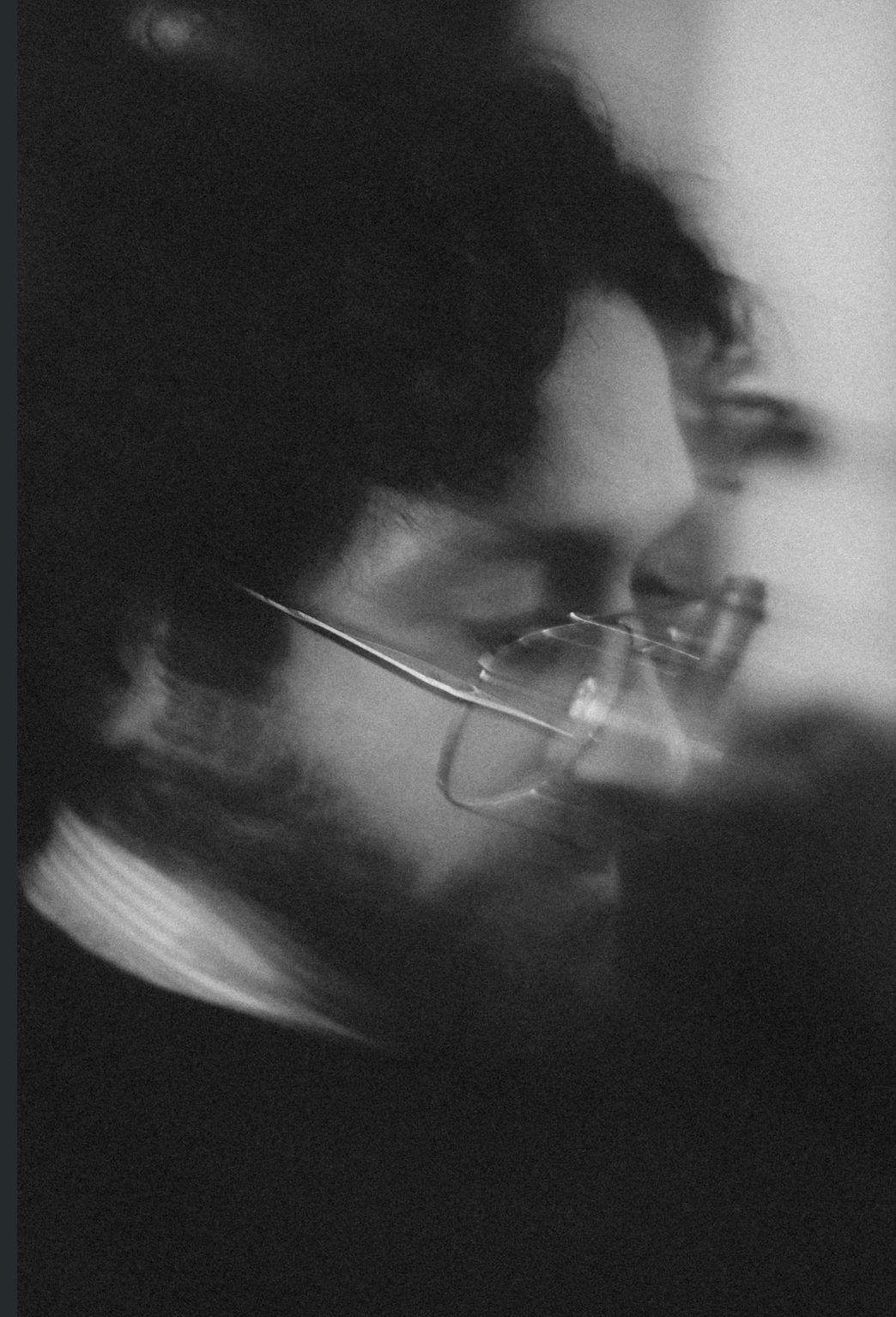
Name: Rotem Haguel aka JL Segel
Nationality: British
Occupation: Composer, producer, sound artist
Current release: JL Segel's Fog EP is out now.
If you enjoyed this JL Segel interview and would like to stay up to date with his music, visit him on Instagram, Soundcloud, Facebook, and bandcamp.
Many artists have told me that they're in discovery mode when working with the modular. What are some of the things you recently discovered while working with your own set-up?
Recently I've been inspired to use my Harmonic Oscillator (HO) in a different way.
In essence, the HO creates a series of tones above the fundamental frequency, which correspond with the harmonic series. What I discovered recently is that I could output each harmony separately and change its volume independently.
This means that I could feed a melodic pattern into the HO and create additional movements that are sympathetic to the melody. It's something I'm exploring with current works in progress.
There are artists who can realise their ideas best with a traditional – or modified – piano interface, others with a keyboard and a mouse, yet others by turning knobs or touching screens. What's your preferred and most intuitive/natural way of making music and why?
My first ever instrument was the piano, but I never really took to it.
I only began getting into music seriously as a teenager, when I picked up the bass guitar and started playing in bands. Bass playing became a more serious obsession when I decided to study music in London. So, even though I've learned to play keys and still do that every so often, it doesn't feel natural. Therefore, I don't consider myself a keyboard player.
One time I was asked to play the bass synth on a tour, so I saved up and bought a Moog. I remember being fascinated with all the knobs and how they had a direct impact on the properties of the sound. This fascination quickly turned into another obsession, and modular synths felt like a natural progression.
I think that what's interesting for me with these instruments is that they drive me to think beyond standard tools of melody and harmony. I'm definitely always aware of those things, but there's something about working with a simple musical phrase and letting the patch drive experimentation that really appeals to me.
And that's essentially what I do in "Guiding Still," which is based on a single sequence that repeats itself a number of times, and every iteration a new layer is added via generative patching techniques.
What did your first modular look like? Tell me about the first pieces you produced and performed on it, please.
My first ever system was a small 3U rack with an oscillator, filter, MIDI interface, LFO and envelope generator. It was very basic.
Because my previous workflow revolved around sending MIDI from Ableton to hardware synths, this new system could be easily incorporated. This setup was used on an Arpy Brown remix called “Your Love Is Lifting Me.”
Can you take me through the evolution of your modular system up to your current set-up? What are aspects you consider when buying a new module?
Wow, that's gonna be hard to trace ... it went through so many different stages!
After my initial modular experiments, I progressively wanted to turn my system into an independent instrument that I could perform with live, so I slowly expanded it to include a couple new oscillators and a quad sequencer (Orthogonal Devices ER-101/102). I remember experimenting with a few sequencers before landing on this one. I also tried different types of effects and multitrack recording using an Expert Sleepers ES-9 which is a modular USB interface if you will.
Eventually, some modules felt more intuitive than others, and I settled on a standalone system that could sequence several voices, generate sound, manipulate it to certain extent. And this was running through my laptop to manage tempo changes and some FX.
Fog was developed using this system for a series of live events with an artist collective called Unravel, which I started with a few friends. The approach I took for those shows and the subsequent recordings had its own advantages, but looking ahead I think I'd like to introduce more separation and refinement to my sound. So, right now I've reintroduced the ES-9.
Generally, I try to buy modules as seldom as possible, use what's available and get as much as I can out of it. I don't relish the idea of having racks upon racks.
Having said that, buying new modules is something I do from time to time, for utility reasons or to provide a source for inspiration. I try to imagine what central musical property do I want to explore — maybe something abstract like the harmonic series; using clock sub-divisions to create interesting patterns; or change the sound's envelope using an LFO.
Which modules incisively changed your way of making music – and why?
I guess that would have to be the ER-101/102 combo. I became aware of it through following Caterina Barbieri, who used it to create the additive minimalist pieces on Patterns of Consciousness and Ecstatic Computation.
[Read our creative profile of Caterina Barbieri]
I remember feeling that I wasn't really happy with the way I was composing. I also didn't want to sequence things from the DAW, because I felt like it prevented me from entering a deep state of flow when I was composing and performing. When I started working with this sequencer, I learned how it was at the same time very powerful and unintuitive. Therefore, I had to develop a disciplined and iterative workflow for working with it.
The limitations that it presented were a great source of inspiration for me and led me to start notating ideas before 'translating' them into the language of the sequencer. Then, I would 'play' my ideas on the synthesizer, and listen out to the possibilities offered by it. This process of scoring-translating-listening became a tenant and is heard in pieces like "Mist" and "Icy Shards."
With a keyboard and a traditional synth, I would instantly know what something would sound like if I pressed down the keys a certain way. Would you say the same is true for the modular and certain patches and modules? How does working with wires, cables, and plugs change your perspective on music?
With traditional instruments, we can often develop this intimate relationship you're describing, whereby thought equals action equals sound. I think that in modular instruments it can be made possible in certain respects, but quite often thoughts are formed less as predictions and more as hypotheses.
In that sense, the thought of plugging a cable into a module is more of an experiment. You think to yourself, "I wonder what will happen if I route this into that" or "have this module control that module".
Sometimes you hate the result, sometimes it's exactly what you expected, and sometimes you're surprised beyond belief and think "this is the greatest thing I ever heard in my life" haha.
Modulars suggest a more immediate relationship with sound. In how far does this hold true from your point of view and what has working with them taught you about sound in general?
Very much so. My experience leads me to believe that when we engage in modular synthesis we focus our attention more on sonic properties and less on the so-called source of the sound.
It's like Pierre Schaeffer's rather controversial state of reduced listening, where one focuses on the reality of sound itself and less about semantics and value judgements — listening to it without thinking about what it means.
Similarly for me, when engaging with modular interfaces, I'm often less concerned with pitch relations or rhythm and more with how things sound, and the feeling they invoke in me.
In which way does the modular influence musical results and what kind of compositions does it encourage / foster?
I think that heavily depends on what kind of instrument you design. I know people that use the modular as an idea-generation machine, and this would usually involve their system acting as a signal-processing unit.
My own approach for composing and performing with my modular system meant that I had to let go of some habits, like MIDI sequencing, or endlessly editing and overdubbing to create the 'perfect' take. Instead, I started embracing the physical and financial limitations of working with modulars, and the serendipity that modular synths invite. That means learning to work with what you have, be less precious and commit.
Of course it leads to a minimalist aesthetic. But for me as a listener it's also about living and resting within a certain echo system, giving it the time it needs and letting it.
Many modular set-ups still do not support saving patches or quickly switching between them. What possible benefits or inspiring consequences does this quite severe limitation have for your own music and creative practise?
I've always been really inspired by limitations, maybe because they help provide structure and safety for my inner child. So, even though modular systems are unpredictable and irreproducible — they are chaotic in nature — they force me to practice non-attachment and self-discipline.
They're also linked to ritual, because you have to enter an intentional and spiritual space of creation, knowing that everything you make is ephemeral and that you're essentially capturing a moment in time.
So, you have to be very intentional, methodic and patient. That's my take on it, at least.
I am under the impression that choosing the modular is not just a musical decision, but somehow extends into other parts of one's life as well. Can you reflect on this a little bit?
I think that my previous answers may have revealed some aspects of my personality, and someone who reads those answers might say, "of course he works with modular synths".
There must be a correlation between who you are, your own habit-patterns, and the choice of exploring these instruments, but I can't say that I have a good perspective on that. People who work in advertising must've figured it out, 'cause they're doing a hell of a job targeting me on social media haha.
But seriously, for me fascination with synthesis (and modulars especially) coincided with a fascination with self-reflection and contemplation. As a composer, when I create a patch, I feel like I'm engaging in world-building, and as a performer, I try to interact with the world I've built. And that's what I did with "Grey Into Grey."
Hopefully, the listener can share in that world a little bit, feel what it's like to be there and maybe find themselves within it. They might resist sometimes, but that's part of it.