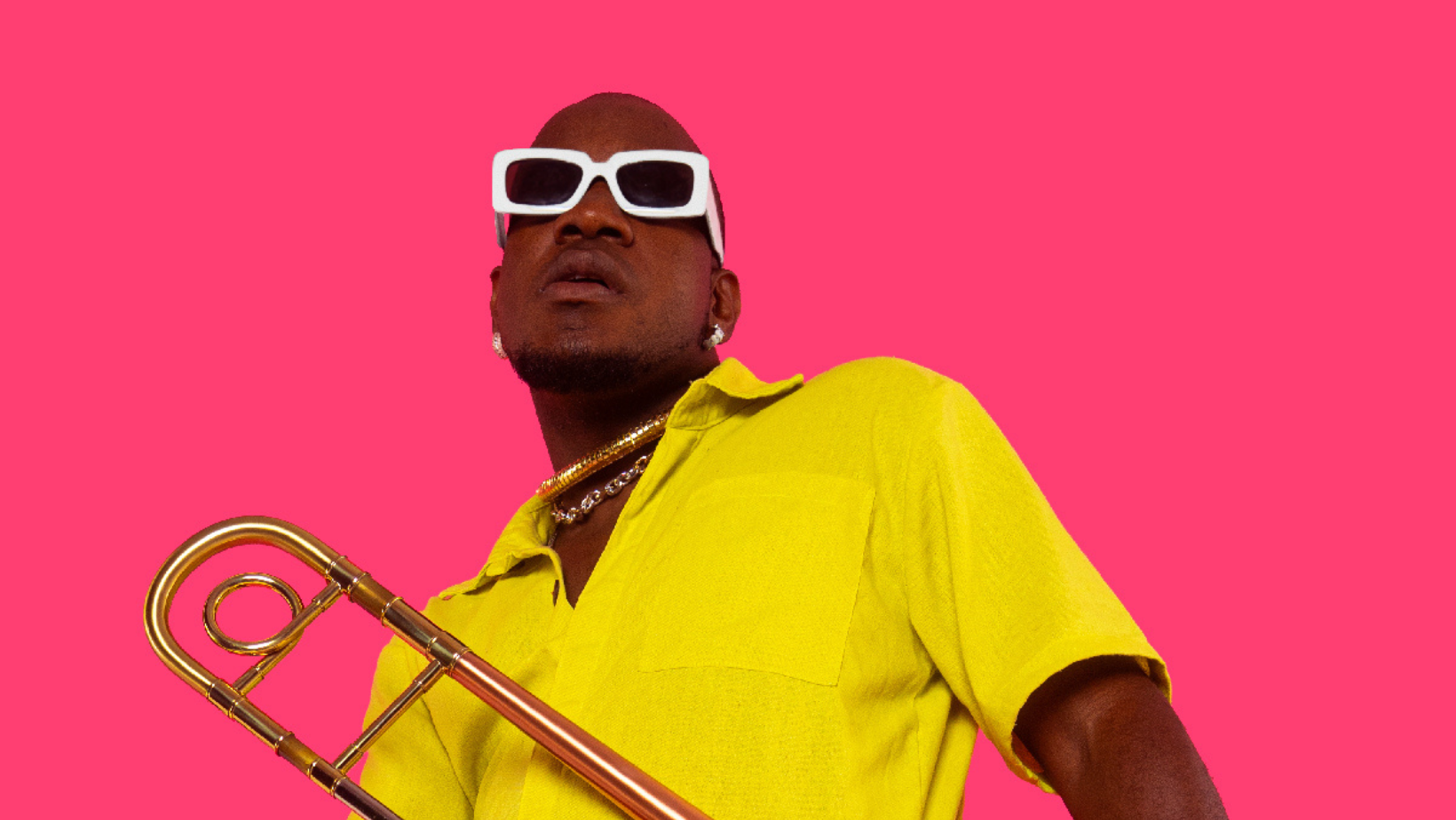
Published
Name: Joabe Reis
Nationality: Brazilian
Occupation: Trombonist, composer, improviser
Current event: Joabe Reis will perform at London's Ronnie Scott's club July 2nd 2025. For more information, visit Ronnie Scott's website.
If you enjoyed Joabe Reis interview and would like to know more about his music and current live dates and releases, visit him on Instagram.
When did you first consciously start getting interested in musical improvisation? What was your first improvisation on stage or in the studio and what was the experience like?
I first became interested in improvisation when I was 12 years old, after receiving two albums from a trumpet player in my hometown, Cachoeiro de Itapemirim, in Espírito Santo, Brazil.
He gave me two records that had a huge impact on me: one by J.J. Johnson, Trombone Master, and another by the Brazilian trombonist Raul de Barros. Those two albums completely changed my life and the way I thought about music.
At the time, I was playing in a marching band at church, but when I listened to those CDs, they sparked a massive interest in improvisation.
That’s when I started transcribing solos, playing along with records, and developed a deep desire to become a trombone improviser.
Tell me about your instrument and/or tools, please. What made you seek it out, what makes it “your” instrument, and what are some of the most important aspects of playing it?
At first, I didn’t choose to play the trombone. My first instrument was the euphonium – an instrument that’s very common in marching bands and military bands. I started with it because, at the time, my band needed euphonium players. And I loved playing it. If it were up to me, I probably would’ve never switched.
But eventually, there was a need for trombone players in the band. I was very young, and the conductor came to me and said, “From now on, you’re going to study the trombone.” I didn’t have much of a choice. I just picked up the instrument and took it home.
My older brother already played bass trombone in the same band, so he showed me a few things. I figured the rest out on my own as best as I could.
How would you describe your own relationship with your instrument – is it an extension of your self/body, a partner and companion, a creative catalyst, a challenge to be overcome, something else entirely?
My relationship with the trombone? Without a doubt, it’s my greatest companion.
It’s been 21 years with this instrument. It took me from a very small town in the countryside of Espírito Santo — a small state in the southeast of Brazil — to some of the most important stages around the world.
Through the trombone, I’ve met musicians from all over the globe, and I’ve had the opportunity to perform on major stages, playing for massive audiences — even for crowds of over 100,000 people.
No question about it: the trombone is my best friend. It’s my life’s tool.
Derek Bailey defined improvising as the search for material which is endlessly transformable. What kind of materials have turned to be particularly transformable and stimulating for you?
For me, the eternal pursuit is technical refinement and the maturity of an improviser who has the intelligence to compose a new melody with each chorus.
Do you feel as though there are at least elements of composition and improvisation which are entirely unique to each? Based on your own work or maybe performances or recordings by other artists, do you feel that there are results which could only have happened through one of them?
I believe so, but in a way, every time I sit down to compose, I am improvising. And every time I pick up the trombone to improvise, I am composing. For me, these two practices come from the same source.
Composing is always a dive into melodies, into ideas I have absorbed throughout my life and that are stored inside my mind. And when I have some choruses to improvise, I also allow myself to bring to the surface melodies I have inherited along my journey, listening to a variety of sounds.
In the end, composition and improvisation end up meeting. One feeds the other.
When you're improvising, does it actually feel like you're inventing something on the spot – or are you inventively re-arranging patterns from preparations, practise or previous performances? What balance is there between forgetting and remembering in your work?
I study technique and patterns to develop my skills, but I don’t think about patterns or any other creative models when I’m improvising.
I always think in terms of melodies and try to apply to them some of the technical tools we study — approach techniques and others — that help build an interesting solo.
Artists from all corner of the musical spectrum, not just “free jazz” have emphasised the importance of freedom in their creativity. What defines freedom for your improvisations?
Freedom, to me, is about being whole. It’s not being limited by a specific aesthetic, genre, or technique. It’s being able to bring my Afro-Brazilian background, my spirituality, and everything I hear from the streets and the world into the music.
Freedom also means having the space to make mistakes and still create something meaningful.
What are some of your favourite collaborators and how do they enrich your improvisations?
Bob Mintzer, Theo Croker, Toninho Horta, Zudizilla, Elliot Mason … are artists I’ve had meaningful experiences with. Working with them pushes me out of my comfort zone and challenges me to think beyond the usual.
I also have a lot of respect for the musicians in my band — each one brings their own language and musical identity. Playing collective improvisation with them is a real and honest exchange.
[Read our Theo Croker interview]
In a live situation, decisions between creatives often work without words. From your experience and current projects, what does this process feel like and how does it work?
On stage, I communicate a lot through my eyes and gestures — just like the musicians in my band. It’s as if I had a baton in my hand, without actually needing one. With just a glance or a simple movement, I can connect even with the musician on the other side of the stage.
That said, we rehearse a lot, so everything is already well-organized before we step on stage.
Stewart Copeland said: “Listening is where the cool stuff comes from. And that listening thing, magically, turns all of your chops into gold.” What do you listen for?
I am always listening to the story the improviser wants to tell, and I observe the interaction between the soloist and the rhythmic and harmonic section.
There can be surprising moments during improvisations – from one of the performers not playing a single note to another shaking up a quiet section with an outburst of noise. Can you tell me about such situations from your own performances and how they impacted the performance?
One time, my saxophonist was using an EWI, an electronic instrument that runs on batteries. In the middle of his improvisation, the drums stopped, and he couldn’t play a single note.
It was a somewhat funny situation, and I had to take over the solo from that point on. It was quite unexpected and amusing.
As a listener, do you also have a preference for improvised music? If so, what is it about this music that you appreciate as part of the audience?
I also like improvised music; I think that creative freedom is very interesting.
But at the same time, I also love other musical styles that are more predictable.
In a way, we improvise all the time. In which way is your creative work feeding back and possibly supporting other areas of your life?
Yes, definitely. The life of a jazz musician, an improviser, is the life of someone who plans, organizes, and studies many times, but when we get on stage, everything happens differently.
Learning to deal with this kind of situation in music helps me approach life more lightly as well, without fear of making mistakes and without fear of venturing into the unpredictable — whatever may happen in a given moment or specific situation.