Published
Name: Joane Hétu
Nationality: Canadian
Occupation: Composer, musician, improviser, conductor, cultural worker, manager
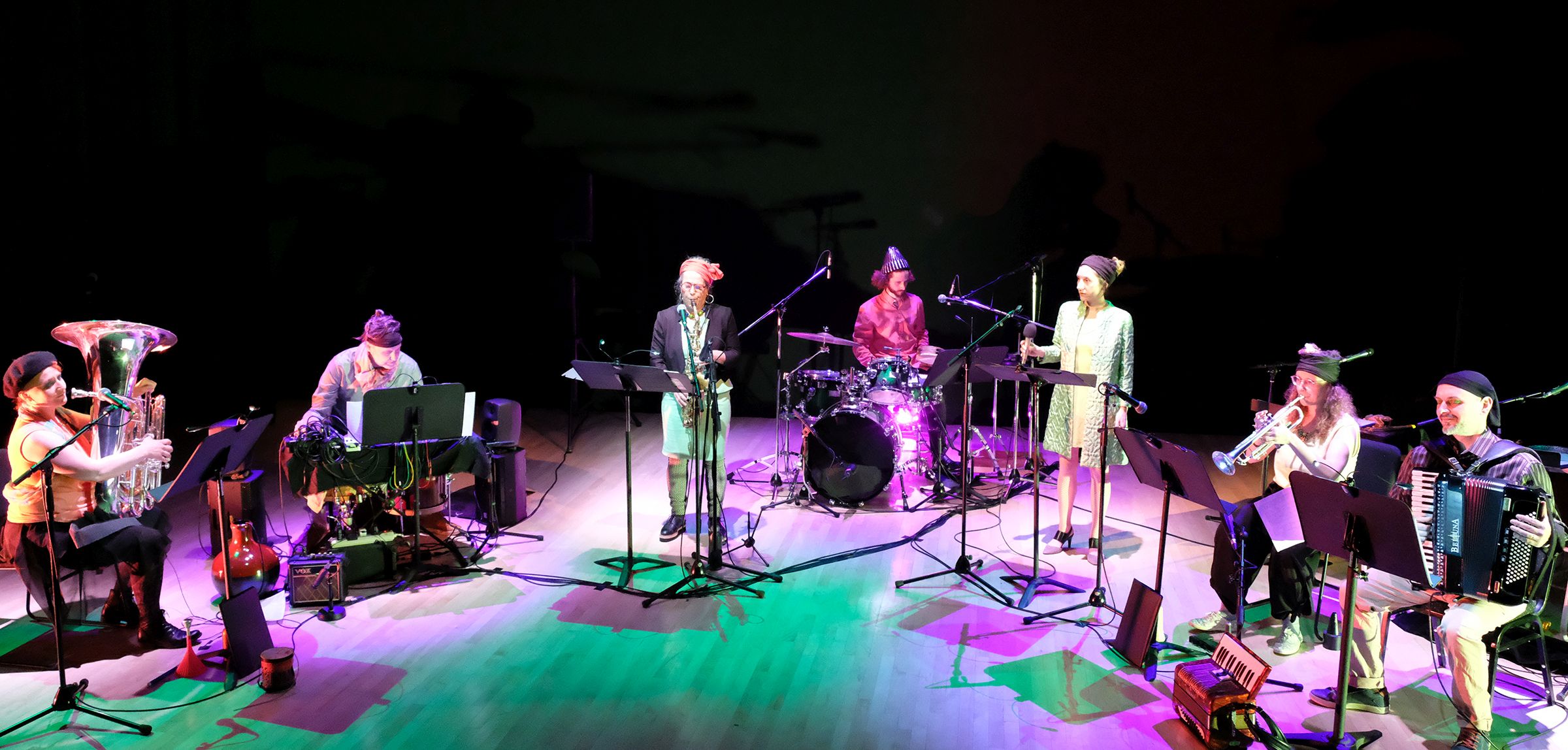
Current Release: Joane Hétu's new album Elle a son mot à dire, performed by the Ensemble SuperMusique is out now via DAME.
If you enjoyed this Joane Hétu interview and would like to know more about her music, visit her on bandcamp.
Where does the impulse to create something come from for you? What role do often-quoted sources of inspiration like dreams, other forms of art, personal relationships, politics etc play?
Since I became a musician in my early twenties, it has always been obvious to me: I would play original compositions, either my own or those of the members of the ensemble I was playing with. I never questioned it—it was a given. Was it the era, the early 1980s, that influenced me?
It's a bit of everything you mentioned. Sometimes it's specific commissions based on a theme or concept. Other times, it's a personal impulse that takes hold.
I would say that life as a whole inspires me: politics, personal matters, a season (winter), the absurdity of life, love ...
For you to get started, do there need to be concrete ideas – or what some have called a 'visualisation' of the finished work? What does the balance between planning and chance look like for you?
I can't visualize the final work from the outset. I often start with a text or a melody that stays with me.
Chance is always present—I'm an improviser, and I believe in chance. Little by little, the piece takes shape, through a lot of trial and error ... and a lot of joy in composing.
Is there a preparation phase for your process? Do you require your tools to be laid out in a particular way, for example, do you need to do 'research' or create 'early versions'?
Each piece has its own process. No, I don't need my tools to be arranged in a particular way.
Above all, I need peace and quiet, concentration, and time. I like to set aside periods of time for composing, in the countryside for example, far from the hustle and bustle of everyday life.
The creation of a piece continues until its first public performance. Yes, I go through several preliminary versions, and I draw inspiration from the performers' playing to continue writing.
Do you have certain rituals to get you into the right mindset for creating? What role do certain foods or stimulants like coffee, lighting, scents, exercise or reading poetry play?
My lifestyle is an integral part of my life as a composer: a healthy, predominantly vegetarian diet, physical exercise (running, swimming), regular practice of Iyengar yoga, and little alcohol.
And, as I mentioned, I need peace and quiet.
For your latest release, what did you start with? If there were conceptual considerations, what were they?
I initially formed my ensemble based on the availability of the performers. I quickly realized that it would be rare to have them all together at the same time. So I designed pieces for subgroups, in addition to a few large works. That was my first consideration.
Then I wanted to build a concert around my texts. I started by writing new ones, which I juxtaposed with old texts that had never been presented with music, or that I wanted to revisit with a larger ensemble.
Many writers have claimed that as soon as they enter into the process, certain aspects of the narrative are out of their hands. Do you like to keep strict control or is there a sense of following things where they lead you?
I completely agree with this statement. Music escapes me; it dictates what comes next.
I let it emerge through me—I become a channel, a vehicle for transmission.
There are many descriptions of the creative state. How would you describe it for you personally? Is there an element of spirituality to what you do?
Music is spiritual. So yes, there is undeniably a spiritual dimension to my practice.
Once a piece is finished, how important is it for you to let it lie and evaluate it later on? How much improvement and refinement do you personally allow until you're satisfied with a piece? What does this process look like in practise?
I often work with tight deadlines. Once a piece is created, I rarely have the opportunity to play it again. When possible, I rework it—there are always elements to adjust, to enrich.
I always hope to be able to bring my pieces back to life.
How do you think the meaning, or effect of an individual piece is enhanced, clarified or possibly contrasted by the EPs, or albums it is part of? Does each piece, for example, need to be consistent with the larger whole?
Most of my personal albums have a theme that runs through the work. On the other hand, the albums with the Ensemble SuperMusique are independent compositions, each with its own journey, without necessarily forming a whole.
Even when an album follows a theme, it is possible to extract a piece from it if necessary.
What's your take on the role and importance of production, including mixing and mastering for you personally? In terms of what they contribute to a song, what is the balance between the composition and the arrangement (performance)?
I really enjoy recording and digitally distributing my music, whether in the form of CDs or digital files.
I always take great care with mixing and mastering.
Music and the accompanying artwork are often closely related. Can you talk about this a little bit for your current project and the relationship that images and sounds have for you in general?
The images that accompany my albums often have a subliminal role. I work with a team of graphic designers and let myself be guided by their suggestions.
The cover of my current album was designed by Gabrielle Godbout, and the overall visual design by Marie-Pierre Morin. It's a true collaborative effort.
After finishing a piece or album and releasing something into the world, there can be a sense of emptiness. Can you relate to this – and how do you return to the state of creativity after experiencing it?
I don't feel empty after a project, but rather a sense of satisfaction at a job well done.
I'm always ready to move on to the next one.
Creativity can reach many different corners of our lives. Do you personally feel as though writing a piece of music is inherently different from something like making a great cup of coffee? What do you express through music that you couldn't or wouldn't in more 'mundane' tasks?
You can always try to infuse art into everyday life—making a good cup of coffee, cooking a good meal ... but music is different: it's more invasive, more haunting, more demanding ... and, as a result, more satisfying.
My compositions never leave me: they are engraved in me, they are part of my being. I can say that I have a certain culinary talent, but it has nothing to do with the place music occupies in my life.
I didn't really “choose” to be an artist—it's a difficult path, especially at the time, for a 20-year-old woman in the early 1980s. It was over time that this vocation—because that's what it is—took hold and has never left me. It's been 45 years now.