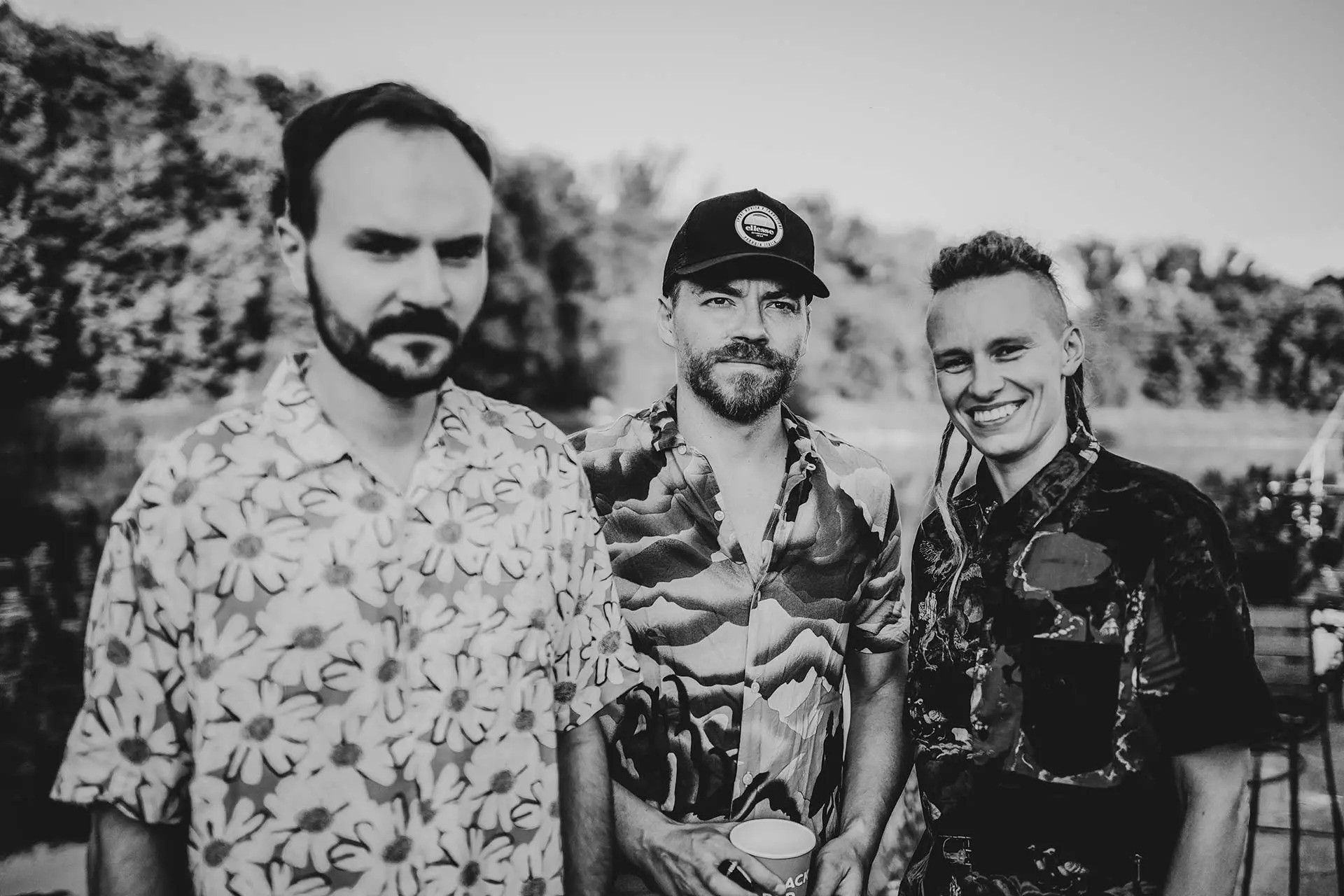
Published
Name: Joanna Duda
Nationality: Polish
Occupation: Pianist, composer, improviser
Current release: The Joanna Duda Trio's new album Delighted is out September 19th 2025 via Byrd Out.
Current event: Joanna Duda will perform with her trio at London's Ronnie Scott's club July 17th 2025. For more information, visit Ronnie Scott's website.
Recommendations for Gdańsk / Oliwa, Poland: In the Oliwa district where I grew up, there is a beautiful area called Dolina Radości (The Valley of Joy). I used to go there for mushroom picking when I was spending time in my home city. Oliwa is even older than Gdańsk and has its own tiny - city - vibe and a beautiful garden built in the XVII century. I would definitely recommend visiting this place.
Topic I am passionate about: Actually a lot of people are asking me about it, it’s my second passion called kitesurfing. As I'll mention in this interview, I’m an outside person and I need a lot of movement. I discovered this sport thanks to my partner who invested a lot effort into convincing me to learn it. It helped me to overcome a fear against the water and surprisingly opened a lot of doors I had no idea that existed. I cannot imagine my life without kitesurfing at this point. It’s giving me a freedom and feels like nothing else in the world.
You can have a glimpse of places I’ve been and the lifestyle in my friend’s movie.
If you enjoyed this Joanna Duda interview and would like to know more about her music and upcoming live dates, visit her official homepage. She is also on Instagram, and, bandcamp.
What were some of the musical experiences which planted a seed for your interest in jazz?
I remember some very early moments, not particularly connected to jazz but with music in general, a sound that was making me feel a special way, that made me think - this is it, this is where I want to go. It was about the sound or feeling I had during listening to a track.
I felt it while I was listening to some of AIR's songs when I was a teenager - especially the Moon Safari album; there is the simple beauty of acoustic sounds blended with an analogue, cosmic touch which is adding the “untuned” layer to the music.
I was also fascinated by real live bands like Jamiroquai. I was a huge fan of them since I was 10 years old. I wanted to have a band like this - unstoppably grooving, sounds as one big entity putting the audience on fire.
[Read our Stuart Zender of Jamiroquai interview]
What does the term jazz mean today, would you say?
To me as a musician on stage, jazz is one of the conventions I’m using and playing with.
I wouldn’t identify my music with jazz only. It has typical jazz elements, like improvisation, harmony, rhythm but also these are not exclusive just for jazz music.
Jazz as a genre is a bit empty word that everyone gives a subjective meaning. Still it means that there is a presence of improvisation and dialogue on stage and this is the most important thing about it.
As of today, what kind of materials, ideas, and technologies are particularly stimulating for you?
The most stimulating for me is my lifestyle and the balance I’ve figured out and worked on during last few years.
To create I need to have a clear mind. To have a clear mind, I need a lot of time to be outside, doing physical activities. When I’m staying too much inside buildings, cities or just sitting in front of the laptop, I’m neither inspired nor motivated.
At soon as my mind is ready, I’ll start getting ideas.
Where do most of your inspirations to create come from – rather from internal impulses or external ones? Which current social / political / ecological or other developments make you feel like you need to respond as an artist?
It’s an internal impulse, a will to do something, a very special tuned-in feeling. Like something is saying inside - we can start now. That’s the best moment to begin something.
It’s also very subtle, I need to focus to catch it in the right moment.
What makes me feel to respond as an artist is not really connected with the material world.
Tell me a bit about the sounds & creative directions, artists & communities, as well as the colleagues & creative hotspots of your current hometown, please. How do they influence your music?
The community was crucial for me when I moved to Warsaw approximately 20 years ago from Gdańsk - my hometown - and wanted to get into the professional music environment (Gdańsk had no opportunities for me at that time).
It was beginning of my career, so I was playing a lot on the jam sessions, having good time on stage, meeting new friends and partying hard having absolutely no money. I had help from so many good people at that time - finding flats to live, playing first gigs, borrowing keyboards.
In Warsaw I formed my first serious band AuAuA (2008?) and we recorded an album in 2010.
After many years spent in Warsaw I moved back to Gdańsk for private reasons and then I was living in Gdynia for a few years.
I took part in the cultural life, co-organizing artistic events in a private house, also participating in an Open House Festival and cooperating in the Halo Kultura association that is placed in the basement of a modernistic trading hall in the centre of the city.
But I had this feeling that I want to move to the countryside, preferably outside Poland. Soon it happened. I moved to Italy where I’ve been staying until now most of the time. Only the last part of this story has really influenced my music in a good way. The city and the way of life connected with it wasn’t really working for me; it was a constant distraction.
I managed to make a solo album while staying in Gdynia, thanks to nice living conditions and quiet surroundings back then. But I feel I’ve found the real way after 2020.
What role do electronic tools and instruments play for your creative process?
Oh I love them. I love new tools, new instruments.
I’m basically working with samples and VSTs. I don’t own too much stuff, trying to keep the amount to fit in one car in case I’d like to move somewhere else. I’ve got a really nice midi keyboard, a few smaller MIDI controllers, and only tiny synths.
But the most important part is the sampling, the sound itself.
Thanks to technological advances, collaboration has become a lot easier. What have been some of the most fruitful collaborations for you recently and what approaches to and modes of collaboration currently seem best to you?
I think my most fruitful collaboration has been with the Amareya Theatre (since 2013) – together, we realised 8 pieces and toured a lot.
This cooperation led me to others, like the one with Maya Ciarrocchi, a visual artist from NYC - we already created Site:Yizkor (in conjunction with an improvising ensemble from the US, including Ben Goldberg on clarinet).
And since last year we’re working on LoopCurrent, a multidisciplinary project based on field recordings, movement, tapestries, sound - generating scenography (still in progress). Recently the project had its outcome in Baryshnikov Arts Centre in New York.
For collaborations the “residential mode” work best for me. It’s important to spend a lot of time with other artists, creating and rehearsing, but I also need time for myself to find a way in such a process.
Jazz has always had an interesting relationship between honoring its roots and exploring the unknown. What does the balance between these two poles look like in your music?
My roots are European; I took a lot out of classical music, including the form, feeling, operating with motives and small elements of construction, the way I compose and notate, the amount of emotion (or lack of them) I want to have in a particular composition.
The unknown part is the feelings I want to put there and the way I want to feel playing it, as I’m the transmitter. For this I’m using the conventional tools and cultural codes, for sure not only European.
How, would you say are your live performances and your recording projects connected at the moment? How do they mutually influence and feed off each other?
From the moment we start playing the new material live it’s constantly evolving. I would say that rehearsing and recording an album in the studio can not be compared.
Concerts are a great process, looking for new paths, discovering and learning. Recording means documenting the message in a compressed, clean way. I’m trying to imagine what kind of album I’d like to listen myself and when, while thinking about the form of an LP.
Anyway after 6 years of playing “Fumitsuke” I can say that each composition has its own life and differs a lot from the album version - we’ve changed as people and as a band and the music has changed as well.
Now playing this material, personally I feel it’s just an occasion on the second level (the compositions I mean) for us to spend the time together with other people, catching mostly something in the air.
What, would you say, are the key ideas behind your approach to improvisation?
To know what, exactly, I want to say, to catch my own message. It changes from one concert to another of course but there is a core inside the theme of the composition. It’s important to think about it beforehand but also to blend it with what’s in the air at the very moment I’m playing.
Also sometimes there is a total plot-twist because someone from the band put something new on the table. It’s also a never ending story - changing things from one concert to another; what I hate most is when I feel bored or stuck with something on stage.
The Montreux Festival intends to preserve its archive of recordings for future generations. Do you personally feels it's important that everything should remain available forever - or is there something to be said for letting beautiful moments pass and linger in the memories of those that experienced them?
I would give so much to listen to the improvisations of Frederic Chopin, Johann Sebastian Bach or the renaissance bards.
I think it’s a great idea to keep the recordings, especially because of the big technological and cultural change that is in front of us. I think the ability of mastering the instrument is going to be more and more rare. Already when you listen to the very old recordings - from 40s, 50s, 60s - played by masters, you can feel the humanity was different. The spirit was different.
It’s important to remember this, it’ s a blessing we can get the message through this material.
Here is a perfect example: