Published
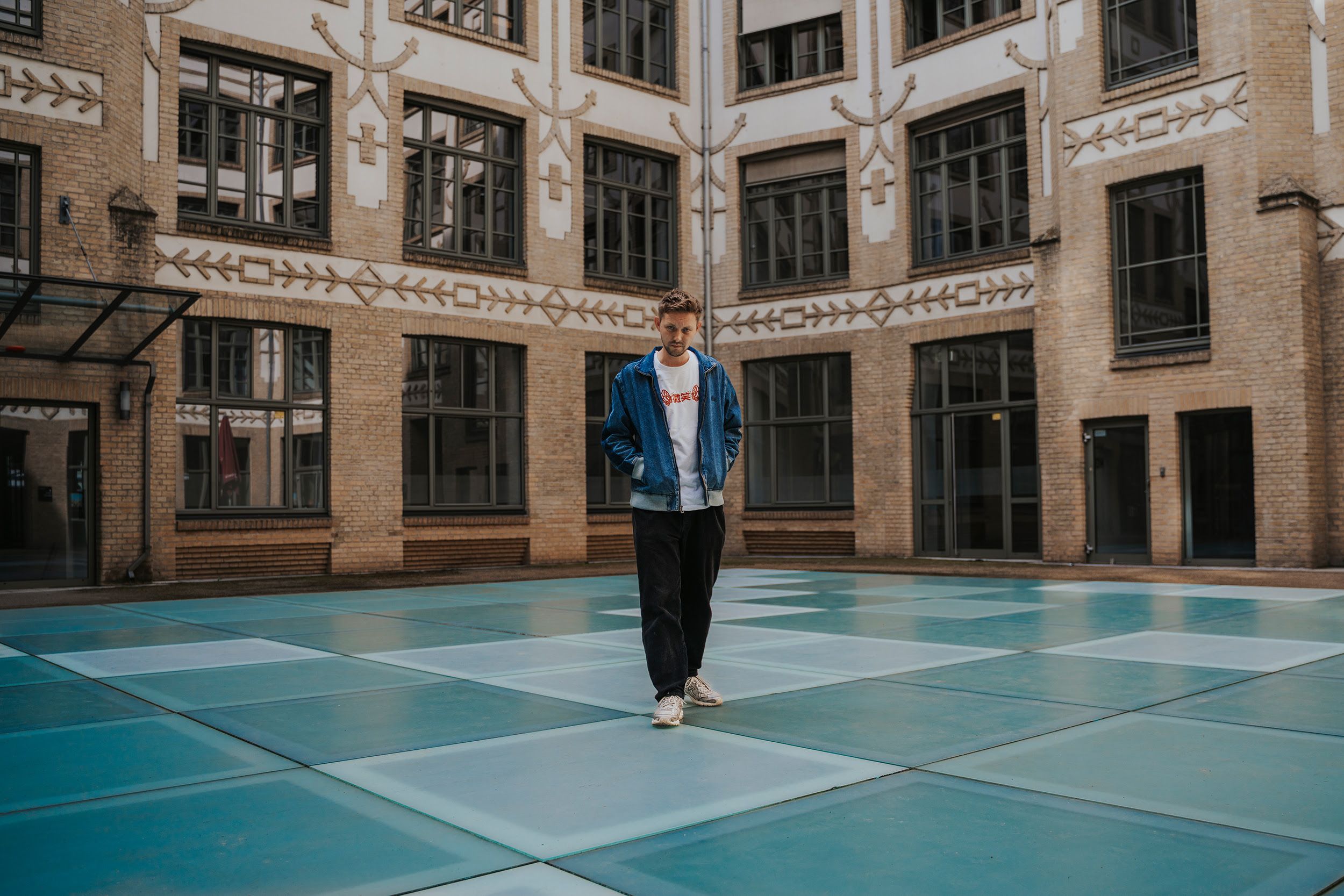
Name: Johannes Arzberger
Nationality: German
Occupation: Composer, pianist, producer
Current release: Johannes Arzberger's new album Rebirth, featuring 7apes and Silvan Strauss, is out via Block Opera.
Recommendation for Brunswick, Germany: If you like Ramen visit SANKU MAOTS’AI in the street called “Kleine Burg.“
[Read our Silvan Strauss interview]
If you enjoyed this Johannes Arzberger interview and would like to stay up to date with his music, visit his official homepage. He is also on Instagram, Soundcloud, and bandcamp.
The path to becoming a producer is a process - but from many interviews, I am under the impression that there are nonetheless one or a few defining moments. If this was the case for you – what were they and why were they so incisive?
My defining moment wasn’t a single event, but rather the time when I first started working with DAWs — discovering plugins, experimenting with delays and reverbs, creating new spaces. It felt like looking into something infinite and unknown. That sense of exploration and emotion is what made it so meaningful, and it still keeps the process endlessly exciting.
I’d say there are always new defining moments — hearing a different kind of production, catching a sudden idea, or stumbling upon an unexpected sound somewhere. Each of those little sparks can turn into something profound.
In the end, it’s the ideas that come to mind — the moments of inspiration themselves — that become the truly incisive ones.
Tell me about one or two of your early pieces that you're still proud of (or satisfied with) in terms of production – and why you're content with them.
I produced the album Heller Tag by Conic Rose together with the band. Each song had its own exciting and unique production approach — it was all about the emotions that can arise and be shaped through production. I think we really managed to capture that.
The whole record turned out quite cinematic — especially the track “Learn to Be Cool.”
On my first solo album Non Piu, I’m a big fan of the song “Mondays.”
It constantly sets a mood I love diving into, and I’m really happy with how it feels — I could honestly listen to it every Monday. :)
[Read our Conic Rose interview]
In how far, would you say, was your evolution as an artist connected to the evolution of your music set-up and studio? Were there shared stepping stones?
For me, my artistic growth has always been closely tied to my studio setup. These days, I’m trying to limit myself a bit more again — “less is more” — at least when it comes to the core idea of a song.
Once I start producing, though, I just use whatever’s around. When I first got into modular synths and effects, I discovered completely new sonic landscapes that deeply influenced my tracks. I also love running old, unassuming synths like the Korg Poly-61 or cheap Casio keyboards through different effect pedals to create new textures.
It’s always changing — depending on what’s currently patched up in the studio.
There are artists who can realise their ideas best with a traditional – or modified – piano interface, others with a keyboard and a mouse, yet others by turning knobs or touching screens. What's your preferred and most intuitive/natural way of making music and why?
Jamming! Lately, I’ve been spending a lot of time with the OB-6 from Sequential. With just a few tweaks, it can produce incredible sounds that immediately spark new ideas.
I also love working with my modular rack — I often start with a simple sequence and just jam around it. There’s something fascinating about modular gear; its unpredictability constantly pushes my creativity in new directions.
Tell me about the space of your current studio/workplace and how you've set it up to optimise creativity.
At the moment, my studio is actually a bit of a construction site — I’m in the middle of renovating the space. Right now, I’ve set up a temporary workspace around my piano in the living room. The piano is finally mic’d up, so I can record ideas quickly whenever inspiration hits.
Since I often work in different places and play live a lot, my current setup is quite minimal — everything I use is travel-friendly and easy to set up and tear down. Most of my older synths are patiently waiting for their turn again.
From the earliest sketches to the finished piece, tell me about the production process for Rebirth, please.
That process was actually quite interesting — and pretty unexpected for me.
I had made a bunch of sketches and demos using drum recordings by Silvan Strauss, and I put them together with some other beats to send over to my label and my friend and producer Salo (aka 7apes). For a while, nothing really happened. Then, about a year or two later, Salo suddenly said, “Hey, there’s a really good album here — what are we doing with it?”
That moment was super motivating for me — it felt great that someone else could see something in those early ideas and wanted to take them further. Salo and his producer friend Mike then joined me in developing the beats and shaping the tracks. All the songs had this kind of “spacey” vibe from the start, so we quickly knew the general direction and mood of the project.
From there, the process — from the early demos to the finished release — came together pretty smoothly.
Late producer SOPHIE said: “You have the possibility with electronic music to generate any texture, and any sound. So why would any musician want to limit themselves?” What's your take on that?
I completely agree with that. I’d even say you shouldn’t limit yourself. When I’m producing, I try not to set any creative boundaries at all.
The only kind of limit I sometimes have to impose is a “creative stop” — a point where I pause the endless experimenting so that the track actually has a chance to move on to the next stage: getting mixed, finished, and ready for release. Otherwise, you can keep producing forever and end up going in circles.
But when it comes to creating sounds themselves, there really are no limits for me.
Tell me about your aesthetic preferences for picking effects like reverb, delay, compression, chorus etc … - what was the role of these effects in the production of your current release?
Effects, to me, are there to bring certain elements into sharper focus.
On my current album, it was really exciting to explore how many different spaces you can create with delay and reverb — and to make full use of that, even when there wasn’t an obvious “real” space to begin with. Reverbs and delays open up extra layers and dimensions in a track, which makes the production process so much more engaging.
For the track “Sirens” with Silvan Strauss, it didn’t take much — just that piano tone with the right reverb. I think it was the Mood pedal by Chase Bliss, which is great for creating really interesting breaks and textures.
I worked with tape saturation a lot, and creating textures with that gave me the foundation to express myself more clearly and authentically than before
Producers work with sound in a very direct way for very long stretches of time. What are some of its qualities that you appreciate now more than before, and how do you try to bring these to the fore in your work?
I find creating experimental sound textures — almost ambient in nature — really captivating. It draws me in and connects me deeply to the process. There’s so much hidden detail to discover, things you’d normally miss if you didn’t take the time to really listen.
Over time, I’ve come to appreciate these small imperfections and textures even more, because they reveal so much character. In my productions, I try to preserve that feeling, leaving the sound a bit raw and natural so it can breathe and speak for itself.
The current production process allows for fast and infinite variations. Can you tell me about how you deal with this potential for the infinite and what ultimately decides on how many iterations to create and which version to release?
It’s funny — in this production, we really reached that point I mentioned earlier: we needed a creative stop.
I can reopen a track and continue developing it very quickly. New ideas are always exciting and a lot of fun, especially when working on beats or songs that are already there. That process allows you to gather a ton of new ideas or revisit old ones.
But at a certain point, it doesn’t help to keep going endlessly without finishing. That’s when it’s really valuable to have friends listen to your tracks and share what they feel. Thanks to Alex from the label (Block Opera), we were able to get to the final version pretty quickly.
Having that external perspective gave us focus and helped decide which ideas to pursue and which to let go, so the songs could finally be completed and ready for release.
Tell me about the role collaboration played in your recent productions – and how you see the potential for machines as collaborators compared to humans.
Actually, the whole album was created in collaboration with Salo, also known as 7apes. He and his producer friend Mike basically co-produced the record with me.
I was really happy to have them as great producers and music lovers on board — it helped to keep things on the right track throughout the process. I also built a lot of the songs around drum ideas from Silvan, which kind of automatically became the first collaboration on the album.
For example, the third song on the album called “Waves”.
In general, I always enjoy working with other musicians — it makes me feel more connected and in genuine exchange with others.
As for machine-like collaboration, I haven’t really had any experience with that yet — apart from the fact that my instruments are already machines in a way. I don’t really need an AI or anything similar to tell me what to produce or play. I don’t know, maybe it could be an interesting concept at some point, but I don’t want to give too much space to AI in my creative process.
Production, as opposed to live performance, can be a lonely process and feedback from listeners isn't always tangible. What is it about it that gives you satisfaction?
There’s something really meditative about being completely absorbed in your own ideas and sounds.
For me, producing isn’t about being seen or becoming successful — it’s more like therapy. Listening to and creating music can be something deeply healing, without wanting to sound too dramatic. It just keeps bringing me joy, again and again.
Producing regularly also feels a bit like practicing your instrument — it keeps you sharp and creative. I like to challenge myself too, like trying to come up with a song idea or an interesting sound texture in just ten minutes.
The only time I really feel alone is when I can’t share my beats with anyone — and that’s something you should always do. Getting honest feedback, both good and bad, has been super valuable for me. It helps me understand which emotions really come through and which don’t — and that’s what keeps me growing.
We can watch videos on production, take producer courses, and exchange deep insights on gear forums. Amidst these options to improve one's chops/skills, how do you keep things playful?
Honestly, I don’t have much time to watch online courses because of my two kids :)
I feel relatively uninfluenced and free in what I do.
AI is already capable of making something most people would recognise as music. I am curious, though, and will keep this question somewhat broad on purpose: What do you think that means?
Right now, it’s such a huge and constantly evolving topic that it’s hard for me to have a fixed opinion yet.
I do think, though, that AI can already imitate or produce music quite well—especially the kind that plays “in the background,” like radio music, study playlists, or wellness tracks.
Most people will probably start recognizing AI-generated music as “normal” only once they no longer know anything else. That really depends on how our general listening habits have developed and will continue to evolve. So for me, the question of AI often leads back to the topic of consumption. AI is impressive, no doubt — and I find the discussions around it fascinating — but it doesn’t touch me emotionally.
If I had to boil it down, I’d say: If you truly value music and everything that comes with it — if you want to support musicians — you shouldn’t use streaming platforms like Spotify that fill their pockets with AI-generated music. Because in the end, it’s about so much more. Who would actually want to replace real human beings with machines?
Creativity can reach many different corners of our lives. Do you personally feel as though producing a piece of music is inherently different from something like making a great cup of coffee? What do you express through music that you couldn't or wouldn't in more 'mundane' tasks?
I think when I make music, I can be endlessly creative and feel a sense of agency very quickly.
Music is my comfort zone. I feel confident with my instrument and not afraid to express myself through it. Unlike in more everyday activities, I don’t have to wait for anything or follow a certain “manual.”
When I create music, I enter a space where time feels different — where intuition takes over and small ideas can grow into something that surprises even me. It’s a dialogue between control and letting go, and that balance is something I rarely find in daily life.