Published
Name: Jonas Kocher
Occupation: Accordion player, sound artist, composer, improviser
Nationality: Swiss
Recent release: Jonas Kocher's new album Archipelago is out via Bruit Editions.
If you enjoyed this Jonas Kocher interview and would like to stay up to date with his music, visit his official homepage. He is also on Soundcloud, and bandcamp.
When did you first consciously start getting interested in musical improvisation? What was your first improvisation on stage or in the studio and what was the experience like?
I became interested in improvisation in the late 1990s, while studying at the conservatory.
My first improvised concert I played took place in the early 2000s. I played in a trio, and it went really well. This experience was a real discovery, a strong one.
The second concert, with the same trio, was a disaster, but it, too, left a lasting impression on me!
Tell me about your instrument and/or tools, please. What made you seek it out, what makes it “your” instrument, and what are some of the most important aspects of playing it?
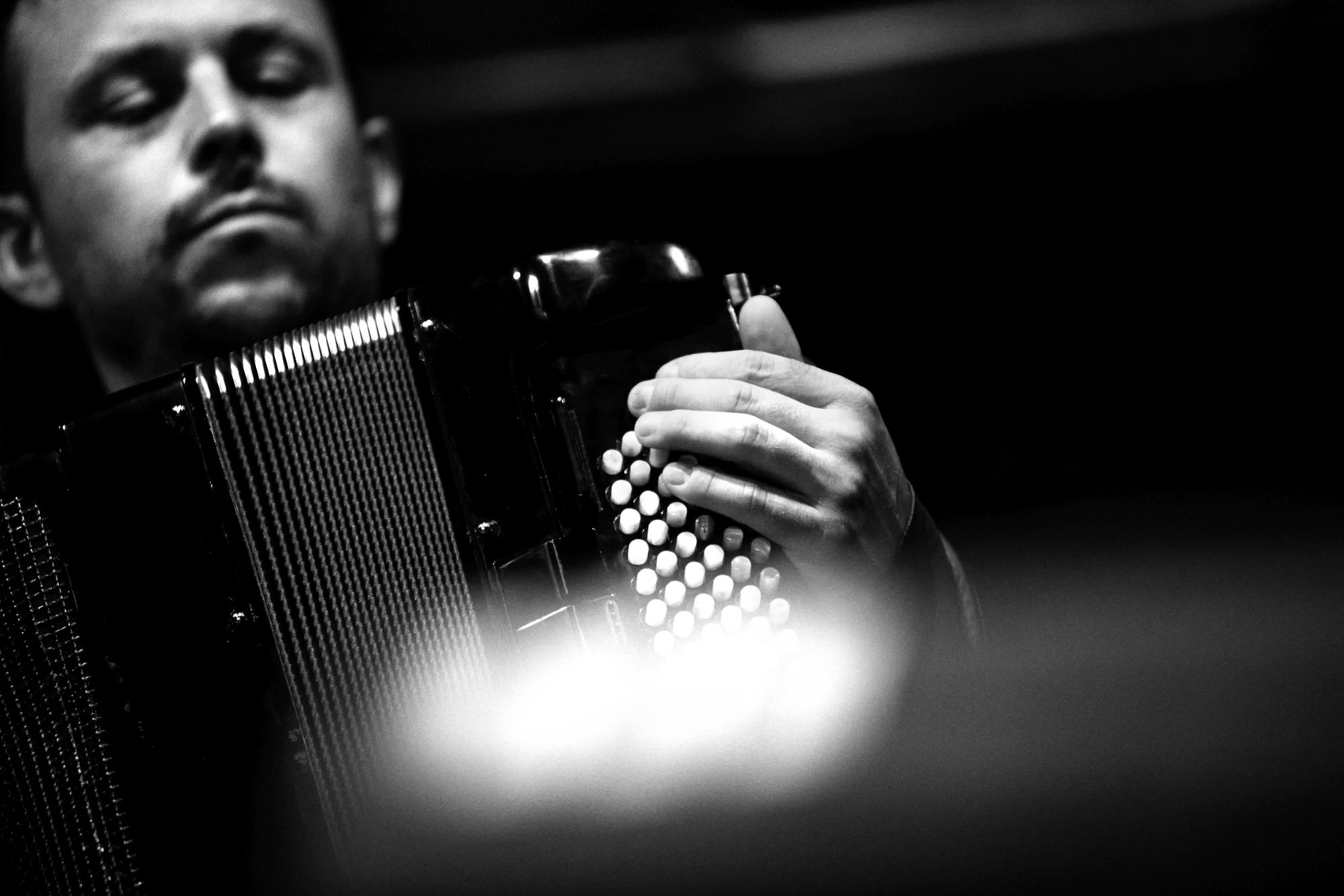
My instrument is the accordion, a concert instrument with a free-bass system, also called a bayan. I've been playing the accordion since I was seven years old. I then studied classical music with the accordion.
When I started out as an improviser, in order to break away from the classical style I came from, I expanded my playing with objects, drawing direct – even naive – inspiration from my colleagues and friends Alfredo Costa-Monteiro and Luca Venitucci, with whom I formed the accordion trio 300 Basses at the time. Before that, I also played an analogue electronic set-up for a few years in the early 2000s, which had a strong influence on how I rethought accordion playing afterwards.
For many years now, I have been developing a sound, techniques and music based on the very nature of the instrument and its history. Without amplification, electronics, objects or preparations, but by exploring the intrinsic possibilities of the instrument.
How would you describe your own relationship with your instrument – is it an extension of your self/body, a partner and companion, a creative catalyst, a challenge to be overcome, something else entirely?
I am very attached to my instrument. I have a very physical relationship with it, I breathe with it when I play it. It is a direct means of expression for my most intimate music.
And at the same time, it always remains a kind of machine that I sometimes struggle with, a sound generator that fortunately sometimes escapes my control and surprises me again and again.
Derek Bailey defined improvising as the search for material which is endlessly transformable. What kind of materials have turned to be particularly transformable and stimulating for you?
Unisons between two reeds (two notes) that I can slightly detune to create beatings. Or abstract two-part counterpoints between the right and left hands. Attacks with different qualities of sound projection. Repetitive patterns in which the sound of the instrument's mechanics takes over.
Or subtle playing with abrupt dynamic contrasts, which the instrument lends itself for wonderfully.
Do you feel as though there are at least elements of composition and improvisation which are entirely unique to each? Based on your own work or maybe performances or recordings by other artists, do you feel that there are results which could only have happened through one of them?
Composition and improvisation are two different ways of creating music. The processes and preparation are not the same, nor is the result.
I have been practising both disciplines for years. There are aspects common to both in my work, which are rooted in my aesthetic and my obsessions as a musician.
But again, I consider them a different disciplines, evolving in parallel and, of course, somehow influencing each other.
When you're improvising, does it actually feel like you're inventing something on the spot – or are you inventively re-arranging patterns from preparations, practise or previous performances? What balance is there between forgetting and remembering in your work?
It's definitely a combination of both.
Even if there are recurring elements, each improvised performance is a unique creation because the conditions are different every time: the acoustics, the audience's attention, how I feel on the day etc. It's fascinating to see how elements you've worked on suddenly appear in the performance and evolve from one performance to the next, combining in new ways each time.
I try to remain as open as possible, to let my body, my fingers and my instincts take over. Perhaps that's the greatest discipline to achieve: remaining open to the moment while playing, not clinging to ready-made processes or formulas.
Artists from all corner of the musical spectrum, not just “free jazz” have emphasised the importance of freedom in their creativity. What defines freedom for your improvisations?
Remaining as open as possible to the moment. Being as free as possible in relation to myself, playing with my own clichés, questioning them. Playing like a child. Letting go, losing control.
For me, freedom is the most important thing to cultivate. And when I am truly free, that freedom is transmitted to the audience. And that is where free improvisation comes into its own: opening up and transmitting this space of freedom.
It’s empowering to anyone assisting or making an improvised performance. It's also political then.
In your best improvisations, do you feel a strong sense of personal presence or do you (or your ego) “disappear”?
It's both. I have to be as in tune with myself as possible, centred, present.
This allows me to slip into the musical flow of the moment. And I become nothing more than a transmitter of music.
In a live situation, decisions between creatives often work without words. From your experience and current projects, what does this process feel like and how does it work?
That's the power and magic of non-verbal communication in improvised performances!
The process is fuelled by each protagonist's ability to listen, their flexibility and technical mastery of their instrument, which allows for a wide range of expression and great inventiveness in thinking about the music, what has happened, what might happen, etc. The ability to put oneself at the service of the music that is being created and not to put oneself forward.
Personal experience naturally plays a big role, as does humility.
As a listener, do you also have a preference for improvised music? If so, what is it about this music that you appreciate as part of the audience?
I am fascinated when I can follow the musician's musical thought process live. When the musicians' playing draws me into this thought process, I start to think with them and I am completely in the present moment.
I had this fantastic experience again recently during a solo performance by French saxophonist Pierre-Antoine Badaroux.
In a way, we improvise all the time. In which way is your creative work feeding back and possibly supporting other areas of your life?
I try to be as open and creative in my everyday life as I am when I improvise, which isn't always easy.
Musical improvisation has definitely given me valuable tools for life. Among other things, it has taught me to be as non-judgmental as possible, to question myself, to quickly analyse the potential of a situation, to follow my instincts and to listen.