Published
Part 1
Name: Jordfäst
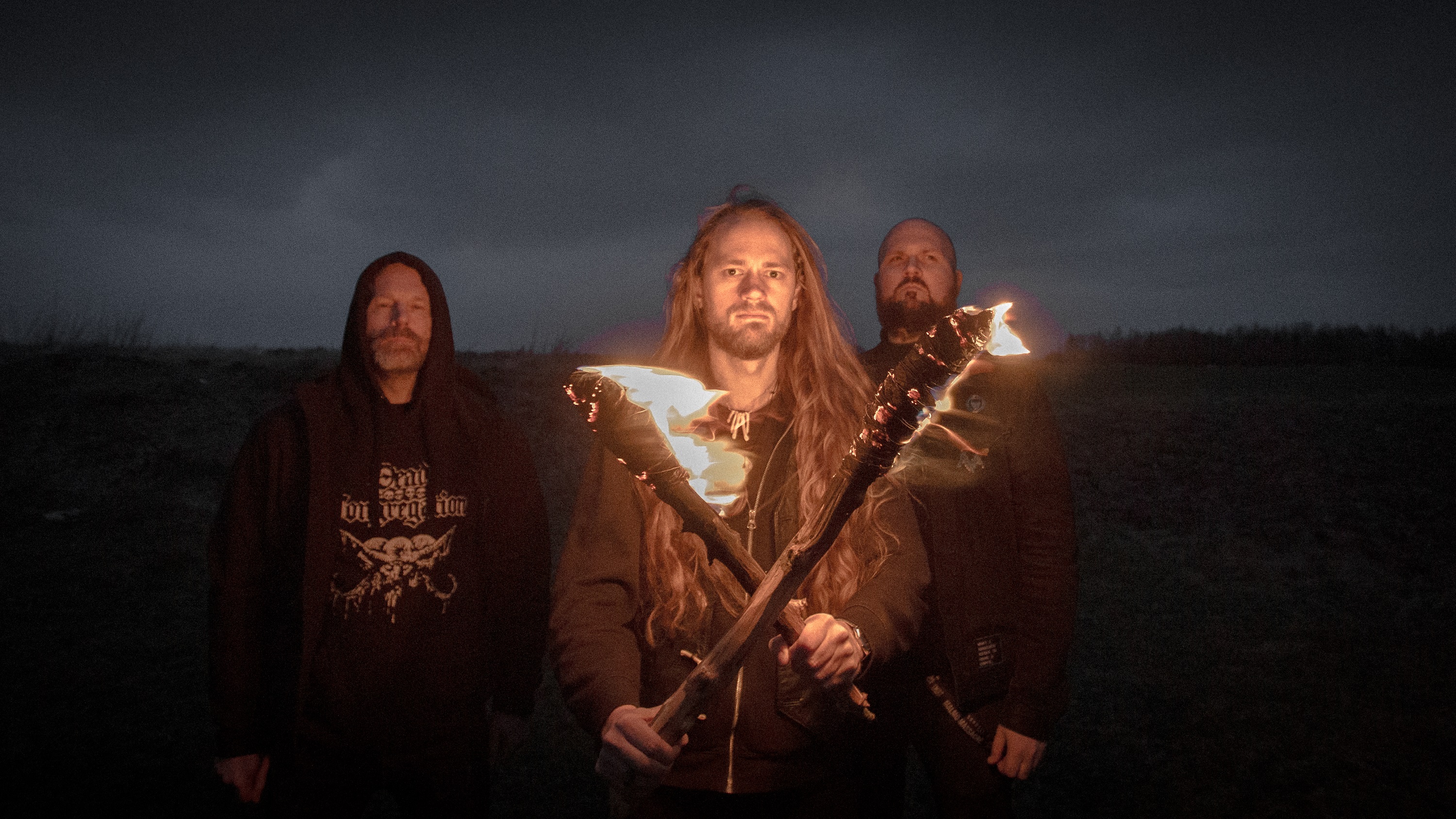
Members: Elis, Olog, Jocke Unger
Nationality: Swedish
Current release: Jordfäst's new album Blodsdåd och hor is out via Black Lion.
Hometown Recommendations:
Olof: Please don't come to Tromsø, we are already drowning in tourists. It is understandable though, since it is fantastically beautiful. Not the city itself, but the nature surrounding it. If you do chose to come, despite my pleas, I recommend to either come in July, when there is midnight sun, everything is green and lush and the mountain walls are dry of melting snow for rock climbing, or in March when the mountains are covered in snow, perfect for skiing and there is enough light to enjoy it. Fuck it, what am I saying, this interview was about darkness, come in late November, when it is cold, windy and snow and rain interchange and the sun has set below the horizon until the end of January, and if you are lucky and it is not overcast you may see the magical display of the northern lights.
Elis: You visit my extreme metal fest called Malmö Massacre. That is what you do in Malmö in August. For the rest of the year the vinyl stores are open, there are great gigs and we are close to the airport which is really nice to visit.
Things we are passionate about but rarely get to talk about:
Olof: Way too many, which is probably a good thing because then I'd never shut up about them. Spear fishing, climbing, Swedish horror literature and not choosing barbarism at the inevitable collapse of the current economical system to mention a few.
Elis: I enjoy spending time with my pack, family and friends, I like to draw and create designs, and I love being out in nature and of course playing my favorite game Backgammon.
If you enjoyed this Jordfäst interview and would like to stay up to date with the band and their music and live dates, visit their official homepage. They are also on Instagram, Facebook, and bandcamp.
When was the first time you noticed you were drawn to darker themes and moods in music, literature or the movies?
Olof: As far back as I can remember. I remember my parents reading Babar the Elephant to me as a small kid and there is one scene where the elephant king eats a poisonous mushroom and dies and I found it terribly scary, the image of the shriveled up elephant with greenish skin stuck in my brain. I think I even asked them to skip that part, but every now and again I would open that page just to look at the image because it was something intriguing in that scariness.
And just aesthetically, I always thought that it was such a shame that the bad guys in Disney movies like Scar or Jafar were looking the coolest, while the good guys looked boring.
Elis: I can't remember a time I wasn't drawn to darker things, I was always a fan of scary things as a child, a youth and so on. The first albums I had were classic hard rock, skate punk, hardcore and some extreme metal.
The few times I was reading as a kid I guess it was a bit darker books, for example Lord of the flies.
“Darkness” is, of course, not strictly speaking a term related to sound. What constitutes darkness to you, especially in instrumental terms?
Olof: A piece of music that evokes emotions of sadness, melancholy, anger or despair in the listener. A good start is to have either one or all three elements of minor key, dissonance or disharmony incorporated, but in the end it is up to the composer or performer to bring those feelings to life through skill or talent.
Elis: To be able to see darkness you have to mix it with light, or at least dim scale of grey. It is a hard question to ask, but I guess darkness is something that bring me to a place of creativity.
How would you describe the physical sensation and possible attraction of being exposed to darkness in music?
Olof: It is a strange, paradoxical sensation where you feel immense pain but at the same time, immense pleasure.
Catharsis would perhaps be a good word to describe it, where the music resonates with something you carry inside of you and brings it to the surface.
Does your interest in darker musical themes extend into extra-musical fields such as fashion, or politics?
Olof: That would be a perfectly ambivalent yes and no. I am drawn to darker themes in all forms of art, be it literature or visual arts, and I do mostly drape my body in black fabrics.
But politics, no. To me, obsession with darkness is something personal, a way to understanding yourself on all levels, even the uncomfortable ones, but not a set of ideals. Indulging in nihilism, misanthropy and death worship can be cathartic in the moment, and a great source of creative inspiration, but I fail to see how a society based on those ideals could be desirable or beneficial for anyone.
Elis: Fashion yes, I guess I dressed to provoke as a youth, nowadays I enjoy dressing for the moment.
I went to a funeral with a pin on my jacket showing a skull with the text "Memento Mori" on it. Maybe to provoke a bit, but mostly as a reminder to live my life fully and make the most of everyday. That isn't for everyone, but I enjoy being proud when I go to bed at night and feel good about what I've done, treated others and myself.
Regarding politics I am not a fascist, nazi or a ignorant scared person, I am definitely on the left side of the spectrum, I am not a follower, I think for myself and can argue for my stand points.
Who/what are currently artists, labels or even genres which draw you in because of their darker approaches, aesthetics and sound(s)?
Olof: The first thing that comes to mind is the Polish black metal band Medico Peste, who I discovered last year and who recently released a new album.
I think they have a unique approach to the genre with lyrical themes centered around mental illness and abuse, accompanied with a deeply disturbing and eerie soundscape.
I can especially recommend the songs “Hallucinating Warmth and Bliss”, and “The Black Bile.”
What were some of the first performances or releases when you became active in exploring truly dark places in your music yourself?
Olof: My lyrics have always revolved around dark themes in all bands that I have been involved with. However, whereas my earlier work were more of an expression of teenage angst, with Jordfäst I have delved deeper and farther, beyond the egocentric view of personal pain and anger and have explored perspectives of darkness from new angles.
It is exemplified already in our first released song “Buren av loppor”, where the lyrics follow the spreading of the Black Death, from a farmer in central Asia who succumbs to the plague despite his prayers to higher powers, to the siege of Caffa, where the besieged population faces the horrors of the occupying forces, starvation and disease brought to them by the Mongols launching plague ridden corpses above the walls.
Finally it is brought to Scandinavia by ship rats and causes panic among the population as a third of it succumbs. In contrast to the terror brought by the plague, the earth itself is fertilized by the decomposing bodies buried within it.
Elis: A first big concert for me was when I was 11, Metallica in Sweden, I guess that was dark for me at that moment. I don't know what to answer more than that, I guess I have seen 5000 shows over the years, mostly during my tours with The Arson Project and Birdflesh.
For my own part, Jordfäst is the darkest music I've ever been a part of creating, but with that said, Jordfäst is so much more than darkness to me, even though Blodsdåd och hor definitely is our darkest creation in my opinion.
Check out the album Disgust with The Arson Project, that is a bomb of darkness and angst for sure. The funny thing is that it gives me so much happy feelings to be able to create something as dark, weird how that works.
I have had a hard time explaining that listening to death metal calms me down. When you're performing a piece with a darker energy, does it tend to fill you with the same energy or feeling – or are there “paradoxical” effects?
Olof: I can definitely agree with the listening aspect, even if it also can fill me with immense, adrenaline fueled energy. But when performing, it is purely cathartic.
It can calm me down afterwards due to the energetic toll it takes on you to be so engaged and absorbed in that mindset however.
Tell me, if applicable, about the concrete lyrical themes that you felt drawn to for Blodsdåd och hor.
Olof: All of our lyrics are centered around the horrors of the past with a focus on Scandinavian history and the lyrics for Blodsdåd och hor (Bloodshed and whoredom) are not different in that regard.
But this time I wanted to explore the concept of worshiping and glorifying the past and how that tends to become an exercise in self isolation, deception and futility. Beyond that, I wanted to incorporate scenes from Völuspá, the prophecy of Ragnarok from the poetic Edda, as I find the imagery about societal decay, destructive war and ultimately rebirth of life and the return of Nidhogg to the roots of Yggdrasil very powerful and thought provoking.
We chose to contrast it with a story about interpersonal oppression and abuse in an effort to create an all encompassing theme of the human need to make sense of their existence under harsh and contradictory circumstances. The lyrics also take a deep dive into the horrors of war and the ravaging of nature during centuries of warfare and iron industry in Sweden.