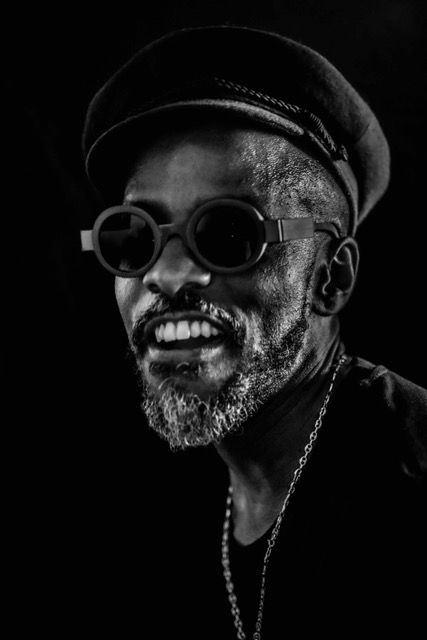
Published
Name: Jowee Omicil
Nationality: Haitian-Canadian
Occupation: Saxophonist, composer, multi-instrumentalist, improviser
Current Release: The deluxe edition of Jowee Omicil's Spiritual Healing: Bwa Kayiman Freedom Suite is out September 27th 2024. Jowee will also perform live at King Georg in Cologne on October 1st 2024 and at the Enjoy Festival Heidelberg on October 4th. 
Recommendations: Book: Poesie by Victor Hugo. Film: Monsieur Aznavour (coming out in October, where I play Mr. Sammy Davis Jr.). Music: "Embraceable You" by Joe Williams.
If you enjoyed this Jowee Omicil interview and would like to know more about his music, visit his official website. He is also on Instagram, Facebook, and twitter.
Do you think that some of your earliest musical experiences planted a seed for your interest in improvisation?
No, not at all.
The seed for my interest in improvisation was planted during my dramatic arts classes in high school. We used to improvise there, and that experience made me want to be an improviser—not in music, but as a part of who I am.
When did you first consciously start getting interested in musical improvisation? Which artists, teachers, albums, or performances involving prominent use of improvisation captured your imagination in the beginning?
I don’t remember a specific moment when I became conscious of improvisation in music; I’ve just always wanted to improvise.
Tell me about your instrument and/or tools, please. What made you seek it out, what makes it “your” instrument, and what are some of the most important aspects of playing it?
What intrigues me most about instruments is that each one has its own unique voice. Every instrument you play has something different to say.
Derek Bailey defined improvising as the search for material which is endlessly transformable. What kind of materials have turned out to be particularly transformable and stimulating for you?
I appreciate Derek Bailey's perspective, but for me, improvisation is about transparency. When you’re improvising, you’re totally naked—not transforming.
Do you feel as though there are elements of composition and improvisation which are entirely unique to each? Based on your own work or maybe performances or recordings by other artists, do you feel that there are results which could only have happened through one of them?
When you’re improvising, the elements that you bring are totally fresh and new. I agree with that.
That's what the art of improvisation is all about—the constant renewing of oneself.
When you're improvising, does it actually feel like you're inventing something on the spot – or are you inventively rearranging patterns from preparations, practice, or previous performances? What balance is there between forgetting and remembering in your work?
When I'm improvising, I'm always starting from scratch.
Coming from nothing means that sometimes melodies will come to mind, and you can’t avoid remembering or quoting melodies as you’re improvising. It's called an arsenal.
Are you acting out parts of your personality in your improvisations which you couldn't or wouldn't through other musical approaches? If so, which are these? What, would you say, are the key ideas behind your approach to improvisation?
Absolutely. When you improvise, you are free. Because of that freedom, you can display all kinds of facets of your existence, which you wouldn't be able to if you weren't improvising.
The key to improvisation is to release yourself. And when you've been released—who knows what’s gonna come out? We just don't know.
We should just listen and hear, or we should just wait and see.
In terms of your personal expression and the experience of performance, how does playing solo compare to group improvisations?
When you are playing solo, you don’t have to worry about anything except yourself. If you are considerate, you will think about what you put out for the people.
But when you are with a group, you must be mindful of every single being. And this is called teamwork.
In your best improvisations, do you feel a strong sense of personal presence or do you (or your ego) “disappear”?
The best improvisation is the one you totally don't remember. If you don’t remember, your self and your ego disappear.
And sometimes, it’s the one you think was the worst—like Putain de BasH!
In a live situation, decisions between creatives often work without words. From your experience and current projects, what does this process feel like and how does it work?
For me, the process of creating without words is essential in improvisation. The more you talk, the less pure the creation will be.
I encourage a state of meditation, silence, and then action.
Stewart Copeland said: “Listening is where the cool stuff comes from. And that listening thing, magically, turns all of your chops into gold.” What do you listen for?
When I'm sharing, I’m listening for the voices of the spirits, the voices of the ancestors, and the voices of the unknown. That’s what I’m listening for. It’s not complicated.
And at last, I’m listening deep inside.
There can be surprising moments during improvisations—from one of the performers not playing a single note to another shaking up a quiet section with an outburst of noise. Have you been part of similar situations, and how did they impact the performance from your point of view?
Just the fact that you are asking this question proves that you listened to Spiritual Healing. It was just magnificent to be part of this kind of situation—simply unpredictable.
I have always been fascinated by the many facets of improvisation but sometimes found it hard to follow them as a listener. Do you have some recommendations for “how to listen” in this regard?
Let me give you the ingredients to listen carefully. First of all, you must be humble. Second, you must be attentive. Third, but not least, you must love to listen.
If you can find a way to get to these points, you will be a great listener, and you will love listening. That means you love music.
When an improvisation ends, is it really gone, just like a cup of coffee? Or does it live on in some form?
When an improvisation is done, it is gone if it’s not recorded. If it’s recorded, it lives forever more.