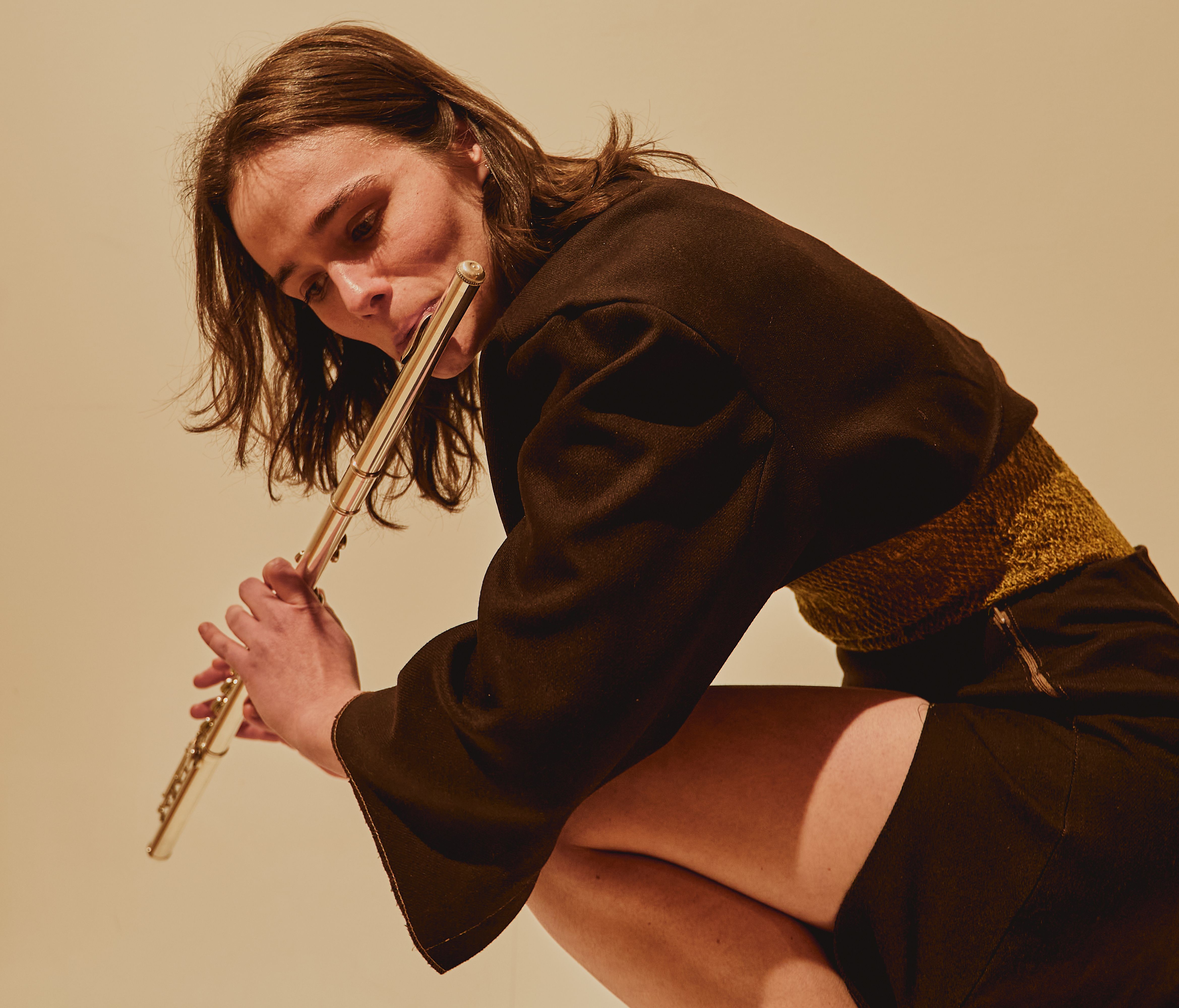
Published
Name: Juli Deák
Nationality: Polish-Hungarian
Occupation: Flutist, composer
Current release: Juli Deák's new album Brisk is out via Thanatosis.
If you enjoyed this Juli Deák interview and would like to know more about her music and upcoming performances, visit her official website. She is also on Instagram, and Soundcloud.
When I listen to music, I see shapes, objects and colours. What happens in your body when you're listening? Do you listen with your eyes open or closed?
I listen to music everywhere—at live concerts, on headphones on the bus, in the car, at parties, and even when there isn’t “music” per se, I listen to the world around me. Different types of music put me in different states of mind, but one thing is true for all: I cannot ignore the sounds around me.
For me, listening is like storytelling. Every sound has a history that I like to imagine while listening, and the beauty is that this story is different for each listener.
At concerts, I usually close my eyes so that the sound envelops my body and my vision does not distract me from the experience.
How do listening with headphones and listening through a stereo system change your experience of sound and music?
For me, the difference lies in the sense of space. With headphones, everything feels closer, more intimate, almost like a private experience.
Through a stereo system, the music occupies a room and the space becomes part of the experience. Stereo listening also brings a sense of community; sharing music in a space with others creates a collective atmosphere.
Tell me about some of the albums or artists that you love specifically for their sound, please.
It's always a tough one, as I discover new favorites constantly.
A long-time inspiration for me is Bendik Giske. When I first discovered their music, I was completely astonished. Giske uses breathing and extended techniques in a profoundly artistic way. While the performances are physically demanding, they remain light and emotionally charged.
In classical music, Emmanuel Pahud has shaped my tone and phrasing on the flute more than anyone else.
Cécile McLorin Salvant is another favorite; her album Ghost Song has been on repeat for years.
I also deeply admire Emahoy Tsegué-Maryam Guèbrou for her unique solo piano sound, as well as drummer Eli Keszler and guitarists Caspar Thorpe and Raphael Rogiński.
[Read our Eli Keszler interview]
Do you experience strong emotional responses towards certain sounds? If so, what kind of sounds are these and do you have an explanation about the reasons for these responses?
I connect most strongly to music with a distinctive, unique sound. Listening to such artists excites me and evokes vivid memories.
I create playlists during every period of my life, and listening back transports me to those moments—people, places, smells, emotions. For me, this is a deeply personal and moving experience.
There can be sounds which feel highly irritating to us and then there are others we could gladly listen to for hours. Do you have examples for either one or both of these?
It really depends on my mood! Loud city noise can feel overwhelming, yet when I’m discovering a new city, I find these sounds exciting.
Conversely, a calm piano record that I could enjoy for hours might become tiring or even irritating after a while.
Are there everyday places, spaces, or devices which intrigue you by the way they sound? Which are these?
I have an upcoming performance in Budapest, at the Kőbánya cellar system that is considered to be the largest cellar complex in Hungary, stretching 32–35 km.
Spaces like this are intriguing for anyone working with sound!
Have you ever been in spaces with extreme sonic characteristics, such as anechoic chambers or caves? What was the experience like?
In 2025, I performed at Norbergfestival in an abandoned iron mining complex in Sweden. The stage, Krossverket, is a massive concrete hall. It was ideal for my solo flute performance: the long reverb allowed the sound to travel around the hall, making it feel like the flute came from every direction.
Another memorable experience was in 2026 at MENT, in a tiny gothic chapel in Ljubljana Castle. While the venue had the resonant qualities of a church, its intimate size created a very personal connection with the audience.
What are among your favourite spaces to record and play your music?
It's definitely a church! I love performing in churches. If I visit a new city, visiting a church is often my first stop.
Acoustically, they resonate beautifully with the solo flute, and spiritually, the environment feels calmer and friendlier than a usual music venue.
My debut album, Brisk, was recorded in a church in Budapest, which contributed greatly to its atmosphere.
Do music and sound feel “material” to you? Does working with sound feel like you're sculpting or shaping something?
Coming from a classical background, my instrument was always a tool to produce music, and I felt somewhat detached from the result.
In recent years, I’ve started integrating the flute with my body, connecting them through breathing. My performances now aim to be interdisciplinary experiences.
For example, I designed a special dress that reflects the music: its movement, color, shape, and material all become part of the sound’s expression.
How important is sound for our overall well-being and in how far do you feel the "acoustic health" of a society or environment is reflective of its overall health?
Sound is extremely important for our overall well-being. I was born and raised in Budapest, a vibrant, loud, and fast-paced city—people are always rushing, shouting, arguing, crying, or celebrating. This energy is deeply reflected in the local music culture, which is full of contrasts and carries a sense of constant tension.
In contrast, my experiences in Scandinavia revealed a very different acoustic environment. Everyday life there is calmer, more even, and predictable, with a certain puritanical restraint, and I could hear this directly in the music. Compared to Eastern European music, it carries a profound sense of calm and balance.
In this way, the “acoustic health” of a society—its soundscape, its rhythms, and its sonic textures—can reveal a lot about its broader cultural and social well-being.
Sound, song, and rhythm are all around us, from animal noises to the waves of the ocean. What, if any, are some of the most moving experiences you've had with these non-human-made sounds?
Growing up in a top-floor attic apartment, I loved listening to the rain on the roof. The sound would lull me to sleep, and I still try to sleep near a window when it rains, enjoying the intensity of the drops.
The track “Contact” from the record Brisk starts with only a rhythmic series of key clicks on the flute. I had no conscious reference while composing, however after a concert a listener came up to me telling how it evoked in them memories of horse riding from their childhood.
Tinnitus and developing hyperacusis are very real risks for anyone working with sound. Do you take precautions in this regard and if you're suffering from these or similar issues – how do you cope with them?
Some sounds feel more intense to me than they might to others, which I suspect is mild hyperacusis.
I regularly use ear protection or headphones, even without music, especially when traveling or exposed to loud environments.
We can surround us with sound every second of the day. The great pianist Glenn Gould even considered this the ultimate delight. How do you see that yourself and what importance does silence hold?
Constant sound isn’t always delightful; it can be overwhelming. Silence, however, is precious. It allows thoughts to emerge clearly and gives space to the mind.
That’s why I often commute with earplugs in the city.
Seth S. Horowitz called hearing the “universal sense” and emphasised that it was more precise and faster than any of our other senses, including vision. How would our world be different if we paid less attention to looks and listened more instead?
Hmm, I honestly can’t imagine a world like that, but it aligns closely with my own approach: I listen far more than I watch.
Closing my eyes during concerts helps me focus on the details and subtleties of sound that might otherwise go unnoticed.