

Name: Julia Basso
Nationality: American
Occupation: Educator, researcher, choreographer
Current event: Julia Basso is part of the cast on the documentary We Become One, which explores the multifaceted ways that music affects our bodies, and minds and its pivotal role in welding together communities.
If you enjoyed this Julia Basso interview and would like to stay up to date with his work, visit the website of The Embodied Brain Lab.
For a deeper dive, read our earlier Julia Basso interview.
The focus of We Become One is firmly on club culture. What's your personal perspective on electronic dance music? Were you interested in it as a dancer as well? Do you consider it a natural successor of the communal dancing experience most human shares in our early days?
When I was younger, I loved going to the club. It’s just an amazing sensorial experience.
One of the first concerts I went to with my husband was Tiesto with Tegan and Sara in Atlantic City, NJ. It was absolutely the best night. The combination of sound, lights, and dancing is the ultimate way to boost your sense of excitement and wonder.
As a dancer, it gives me a space to improvise and move my body in a free and uninhibited way.
I imagine that in some ways club dancing is a natural extension or modern version of those early communal dance circles - where our evolutionary ancestors gathered around drums and vocal expression, moving their bodies in a shared social experience.
We can dance to the same music in an infinite amount of ways. What does dancing allow us to express compared to the act of writing and performing music?
Dancing is a full body expression of emotion, especially improvisational dance. By using the body in its fullest expression, we can cause neuroplasticity - enhancing the connection between the body and mind or body and brain.
Compared to writing or performing music, dancing engages a more expansive set of cortical and subcortical networks including those involved in motor coordination, spatial awareness, emotion regulation, sensory integration, and social cognition—highlighting its uniquely holistic impact on the brain and body.
Does the way we dance reveal something that's in the music, comment on it, enhance it? Do you think that dancing to a piece of music is similar to the process of interpreting or “covering” a song?
I think that it does, especially in highly experienced dancers or those with an excellent musical sense or rhythm - by watching these dancers, you can actually hear some of the nuanced or hidden rhythms within the music.
The dancer will allow those musical elements to resonate in a physical sense in the body. A dancer’s body becomes an instrument that responds to the music’s cues while adding something uniquely personal—gesture, timing, dynamics, and emotional texture. This will allow the music to be heard in a different way.
Dancing to a piece of music is definitely a way to cover or interpret a song, with no two dancers demonstrating the same interpretation.
From your experience, are there differences in effect between free/improvised versus “classical” dancing?
Improvised versus trained or choreographed dancing may have different effects on the brain, and this is something that we are starting to look at in our own research. Improvised dancing, may for example, cause the individual to be in more of a flow state where the limbic system is activated.
Choreographed dancing may cause more of a top-down control experience, where the prefrontal cortex is activated as individuals are trying to recall the dance movements. Attention is heightened and focus is key.
Does the kind of music we move to make a difference (moving to classical ballet music versus disco versus metal)?
Different types of music can activate our nervous system in different ways. For example, listening to classical music can stimulate the parasympathetic nervous system and cause a sense of calm or relaxation.
On the other hand, listening to rock, pop, or electronic dance music can activate the sympathetic nervous branch, causing us to get excited, move to the beat, and engage in social activities.
A while back, the festival for consciousness put dance in the spotlight. In as far as you have an opinion on this: What is the connection between dancing and consciousness?
Consciousness is a phenomenological process that occurs through the intimate mind-body connection. Consciousness is enhanced through physical actions and interactions with the environment around us.
Dance is a practice where internal states such as emotions, memories, and imagination, are expressed through physical action - creating a feedback loop between mind and body. From a neuroscientific perspective, dance engages a diverse network of brain regions responsible for sensory integration, motor planning and execution, emotional self-regulation, and self-awareness.
Dance also expands our felt awareness of internal states (interoception), where our body is located in time and space (proprioception), and our connection to others around us. Therefore, dance helps to expand our conscious awareness, which can include dancing alone or with other individuals - creating a sense of social or collective consciousness.
I have always been fascinated by dance choreographies but have found it exceedingly hard to do these myself. On a very practical level, what would I need to do to improve my ability to dance?
Practice. Dance skills can be learned at any age. Of course, it is easier to learn from an early age (during the childhood period). These complex patterns of movement can get entrained in your body and brain - systems including the basal ganglia, where habitual patterns of movement are stored.
In order to improve your ability to dance, try a zumba class or even a beginner ballet, jazz, or hip hop class. Many local dance studios will offer such opportunities, and it is a great way to connect with your local community.

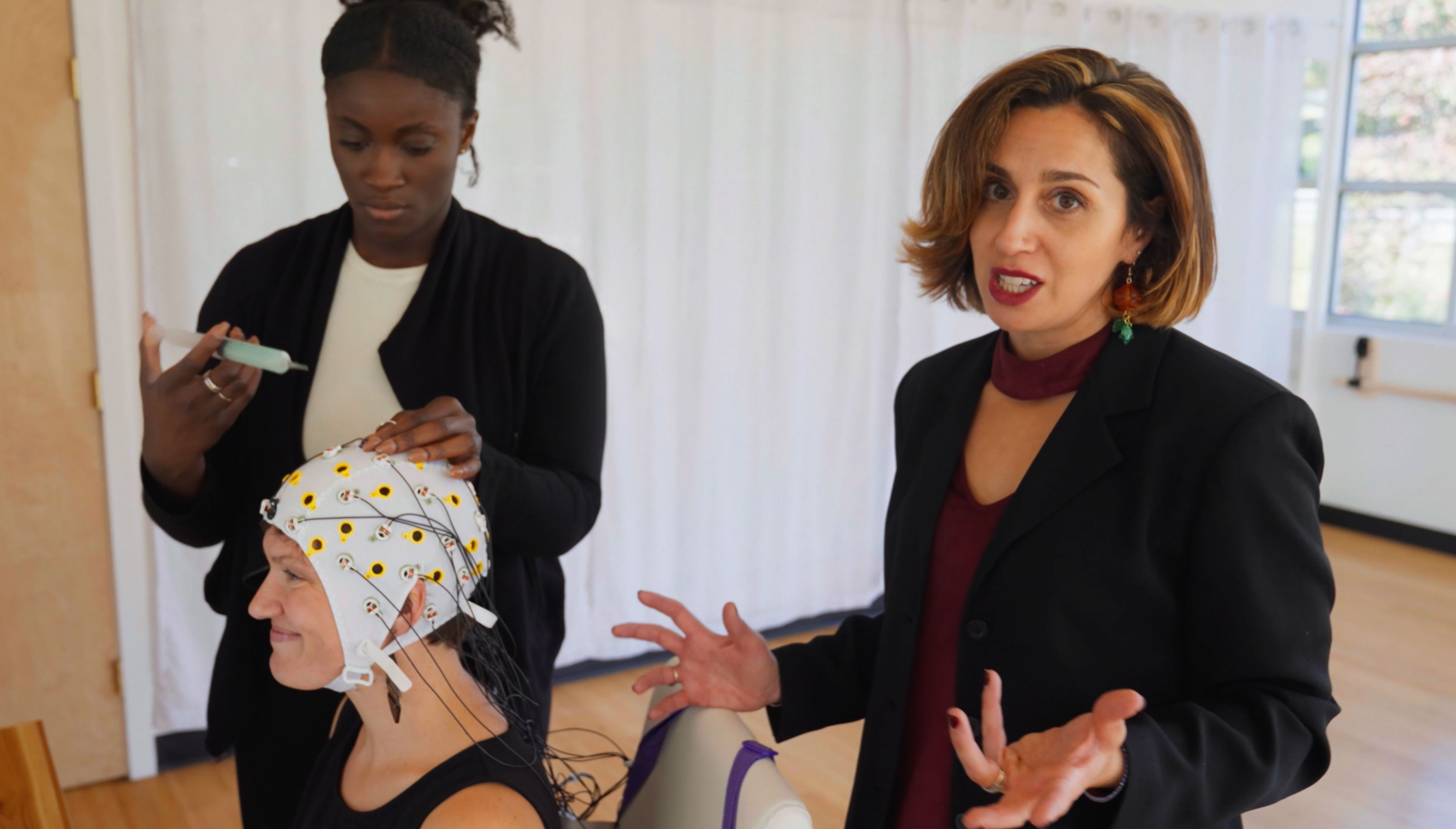 Julia Basso Interview Image taken from the We Become One documentary
“A dancer’s body becomes an instrument.”
Video
