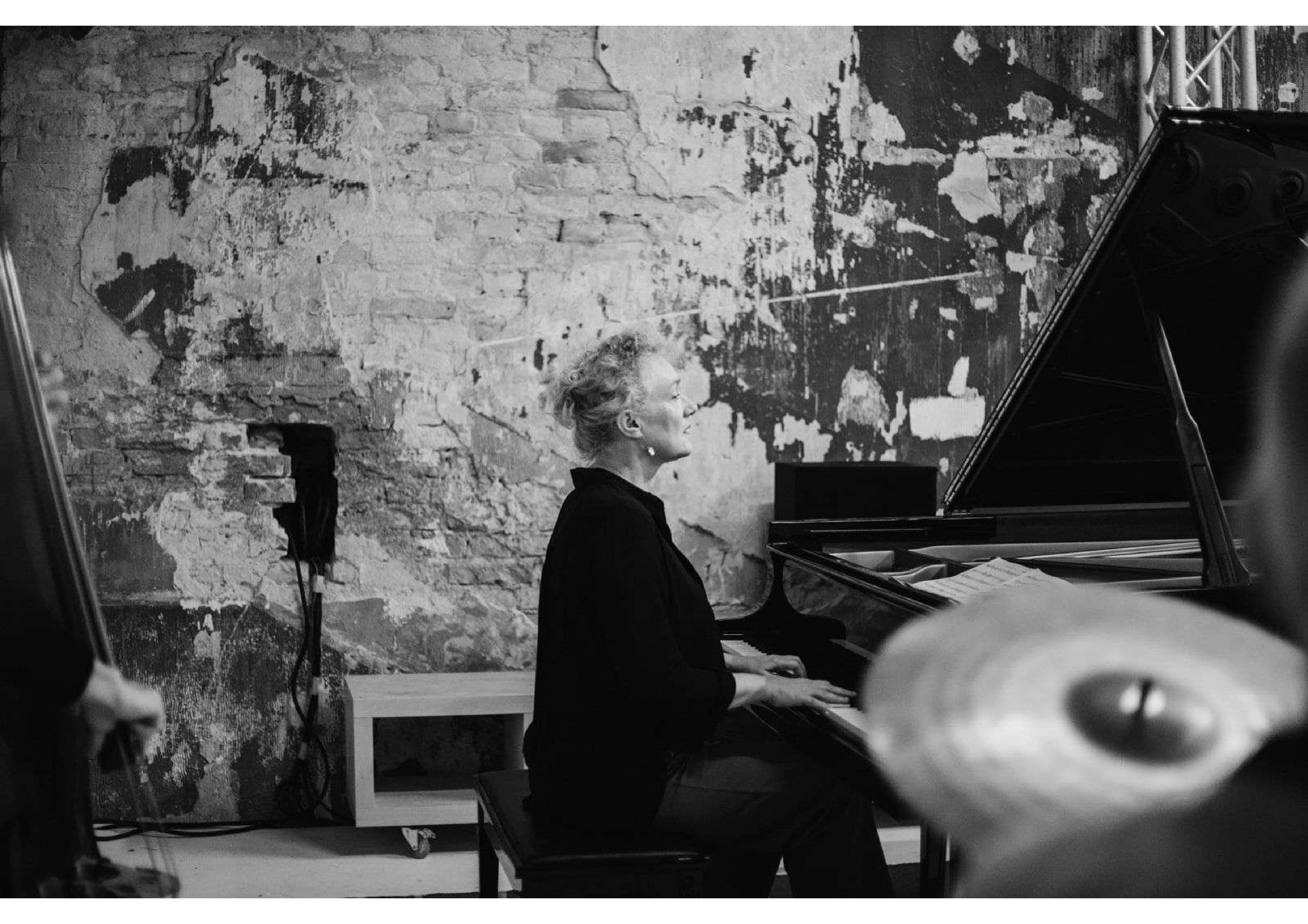
Published
Name: Julia Hülsmann
Nationality: German
Occupation: Composer, improviser, pianist
Current release: The Julia Hülsmann Octet's new album While I Was Away is out via ECM. Aside from Hülsmann on piano, it features Eva Klesse (drums), Eva Kruse (bass), Héloïse Lefebvre (violin), Susanne Paul (cello), Aline Frazão (voice), Live Maria Roggen (voice), and Michael Schiefel (voice)
Recommendation for Berlin, Germany: I love the Neue Nationalgalerie; they have a wonderful art collection and always interesting special exhibitions. The building itself is a work of art!
[Read our Eva Klesse interview]
If you enjoyed this Julia Hülsmann interview and would like to stay up to date with her music and upcoming live dates, visit her official homepage. She is also on Instagram.
Where does the impulse to create something come from for you? What role do often-quoted sources of inspiration like dreams, other forms of art, personal relationships, politics etc play?
My inspiration comes from very different places. It can be a book, a picture, a personal encounter, even politics, or simply a feeling. Sometimes after attending a concert I feel so inspired that I want to go straight to my instrument to write something new.
When I write for voice, I read a lot of poetry—that’s a wonderful source of inspiration. On the octet album, I set several poems to music.
For you to get started, do there need to be concrete ideas – or what some have called a 'visualisation' of the finished work? What does the balance between planning and chance look like for you?
I always try to stay “in the flow,” to actively search rather than wait for an idea to be gifted to me. Of course, luck sometimes plays a role too. But fundamentally, I’m convinced that creativity can be practiced.
The process of visualization is also very important to me—I love the state of planning and brainstorming, that moment when everything is still open and I can let a vision take shape.
Is there a preparation phase for your process? Do you require your tools to be laid out in a particular way, for example, do you need to do 'research' or create 'early versions'?
My writing process involves a lot of sketching; I have many, many sketchbooks in which I try to write down every small idea. Sometimes it’s just one or two chords, a motif, or a rhythmic idea. I write at the piano, as tools I also need my pencils and erasers.
I do research depending on what I want to write. That often simply means listening to music, reading scores, and, for example, diving more deeply into the specific characteristics of certain instruments. I also enjoy reading books about orchestration.
Do you have certain rituals to get you into the right mindset for creating? What role do certain foods or stimulants like coffee, lighting, scents, exercise or reading poetry play?
I’ve trained myself to be able to write quickly, even if I only have 20 minutes.
This started with the birth of my son (21 years ago). There were always only small time windows—here and there 10 or 20 minutes—that I wanted and needed to use. From that came the ability to work without long preparation; I can dive straight into the process. Sometimes I also write when a student arrives late.
Of course, I do enjoy it when my surroundings are pleasant. In my studio, with my grand piano, it’s important to me to have, for example, beautiful pictures on the wall, a good atmosphere, and nice lighting.
But I’m not dependent on that—what matters most is having an instrument.
For While I Was Away, what did you start with? If there were conceptual considerations, what were they?
For the octet, I thought a lot about the overall concept.
I wanted a strong focus on vocals, while also incorporating different perspectives, characters, and cultural influences. That’s how I arrived at Live Maria Roggen, Aline Frazão, and Michael Schiefel.
I then wanted additional instruments, but no horns. So I chose strings, partly with the idea that they could form a classical trio with piano, violin, and cello. And then at the same time there is jazz trio with piano, bass, and drums.
For the repertoire, it was important to me to include the different influences of the singers; that’s why there are compositions and lyrics by Live Maria, Aline, and Michael, alongside my own settings of poems plus songs that have always been important to me, such as “Up, Up, Up, Up, Up, Up” by Ani DiFranco.
Tell me a bit about the way the new material developed and gradually took its final form, please.
It’s always an exciting process to write new pieces and arrangements and then hear them for the first time at rehearsal. The octet program developed over many years, through concerts—piece by piece, the music grew together and changed. Songs were replaced, new ones emerged … a long process.
A recording is really just a snapshot, capturing one version that may already sound different at the next concert. That’s what I love so much about this music: it’s flexible, hopefully never static, always alive.
Many writers have claimed that as soon as they enter into the process, certain aspects of the narrative are out of their hands. Do you like to keep strict control or is there a sense of following things where they lead you?
I always want to follow things where they lead to, but I guess I also try to be in control a lot. Sometimes that helps, sometimes it doesn’t.
I believe that the music can have its own narrative, but first you have to get to a certain point. To get there might take some time.
There are many descriptions of the creative state. How would you describe it for you personally? Is there an element of spirituality to what you do?
Yes and no. Fundamentally, writing is a complex process for me. It’s work. You’re searching for the moment when you realize you’ve found something. And then you hope that you can capture it, that it’s not flying away too fast.
I often like to quote Randy Newman, who says, “Composing is, at best, difficult.”
Once a piece is finished, how important is it for you to let it lie and evaluate it later on? How much improvement and refinement do you personally allow until you're satisfied with a piece? What does this process look like in practise?
I don’t really like to change anything once a composition is really finished. Sometimes it’s important to put it on the side and wait, other times a song needs some more work.
I really like to bring music that’s not finished to a rehearsal and work on it with the whole band, that can change everything. It might also happen that we rehearse a new piece and never play it again because it didn’t work the way I thought it would.
To me it’s really important to be open, to look at a piece of music from different angles, different perspectives, to allow it to be something else than what you planned it to be. An uptempo tune can become a ballad and the other way round.
How do you think the meaning, or effect of an individual piece is enhanced, clarified or possibly contrasted by the EPs, or albums it is part of? Does each piece, for example, need to be consistent with the larger whole?
That’s different for every piece. Songs can work alone without a context of whole album. But when you create an album it’s really important to look at the material and try to balance it.
I think it’s different for an LP, EP or a concert. Dramaturgy is very important. On an album, there can be short connecting compositions that wouldn’t make sense in a live setting.
What's your take on the role and importance of production, including mixing and mastering for you personally? In terms of what they contribute to a song, what is the balance between the composition and the arrangement (performance)?
Balance in a production—mixing and mastering—is extremely important for the music. An album can feel completely different depending on how it’s mixed.
The same applies to the balance between composition and arrangement, as well as orchestration. A composition can take on a completely different character depending on the orchestration and arrangement.
At a live concert, you're sometimes very influenced by the sound, the instruments, the atmosphere in the room, the audience. All of that plays a role. But of course, you're not at its mercy; you can deal with the situation, you have to be in the moment and accept what’s there.
After finishing a piece or album and releasing something into the world, there can be a sense of emptiness. Can you relate to this – and how do you return to the state of creativity after experiencing it?
My life is filled with many different kinds of work. Teaching takes up a large part of it, and I enjoy it very much—it brings me a lot of inspiring input.
I rarely experience a sense of emptiness after releasing an album; there’s always something waiting to take its place. I’m also the kind of person who likes to begin something new as soon as one project comes to an end.
I would love to know a little about the feedback you've received from listeners or critics about what they thought some of your songs are about or the impact it had on them – have there been “misunderstandings” or did you perhaps even gain new “insights?”
Reading too many reviews can be challenging. Misunderstandings are inevitable, but they don’t bother me; they can even be productive. I hope the music leaves room for many interpretations.
I once had a composition called “Juni” (June). During the introduction to this song at a concert, I said, that it’s of course possible that the piece sounds like a different month to each listener.
Afterwards, many people came up to me and convincingly assured me that it sounded more like February or September to them.
I find that very beautiful, and all of it is right. I think it’s important to leave enough space for personal images, associations, and feelings.
Creativity can reach many different corners of our lives. Do you personally feel as though writing a piece of music is inherently different from something like making a great cup of coffee? What do you express through music that you couldn't or wouldn't in more 'mundane' tasks?
I think this is very individual. For me, writing music is very different from making a cup of good coffee. Writing music fulfills me, though the process can also frustrate me at times—for example, when I get stuck. As I said: composing is, at best, difficult.
But I can absolutely understand that for someone else, making coffee can be an art, a creative and fulfilling act. I personally love baking, for example—a very calming activity for me, which can also be very creative (but doesn’t have to be).