Published
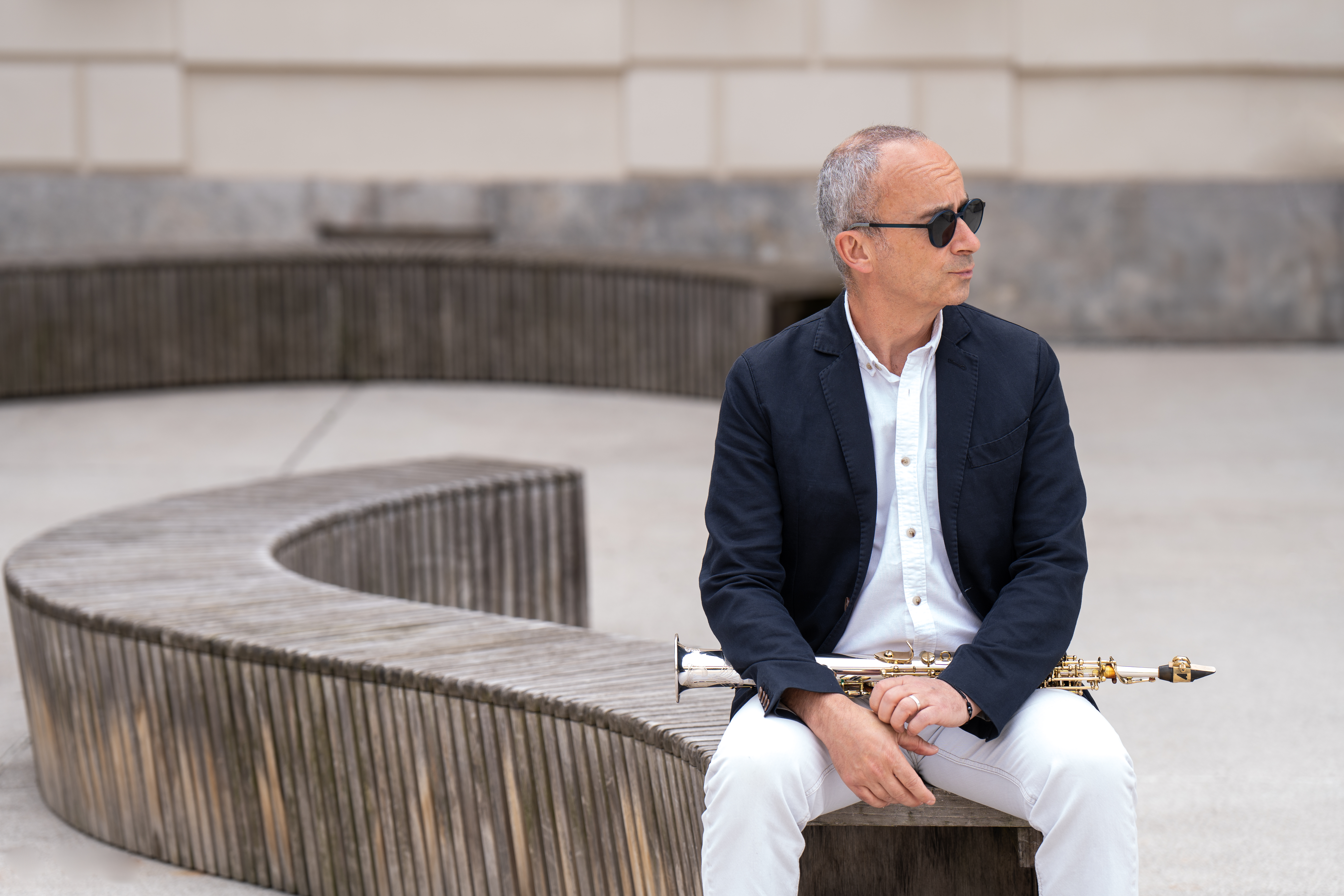
Name: Julian Argüelles
Nationality: British
Occupation: Composer, saxophonist
Recent release: Julian Argüelles teams up with Steve Argüelles (drums/percussion), Helge Andreas Norbakken -(drums/percussion) and Martin France (drums/percussion) for Doublespeak, out via Escapade.
Recommendations: A short History Of Nearly Everything – by Bill Bryson; Survivor's Suite – Keith Jarrett
[Read our Helge Andreas Norbakken interview]
[Read our Martin France interview]
If you enjoyed this Julian Argüelles interview and would like to stay up to date with his work and music, visit his official homepage. He is also on Instagram, Facebook, and bandcamp.
Do you think that some of your earliest musical experiences planted a seed for your interest in improvisation?
I started playing quite young, and I was always into jazz and improvisation.
Many jazzers find their way to it through other music - classical and pop music are the usual ones. It was always there for me.
When did you first consciously start getting interested in musical improvisation? Which artists, teachers, albums or performances involving prominent use of improvisation captured your imagination in the beginning?
I was always interested in improvisation. There were two main threads to it, the recorded and the personally experienced. There were many recordings which affected me deeply, but the 3 main artists from recordings, were in order, Charlie parker, John Coltrane and Keith Jarrett.
The musicians that I experienced live and hugely affected me were centred around the band Loose Tubes and ECM recordings (John Taylor, Kenny Wheeler and John Surman etc)
Tell me about your instrument and/or tools, please. What made you seek it out, what makes it “your” instrument, and what are some of the most important aspects of playing it?
I play a few instruments: all the saxes, various clarinets and flutes, piano, percussion, and in this recent recording I considered the digital audio workstation a tool.
I play tenor and and soprano saxophones 'seriously', all the others are 'fun'. With the tenor and and soprano saxophones, I want to play them with an element of control and detail to enable me to be free with the ideas and content. I don't want to be limited by what I am able to do, but of course I am.
How would you describe your own relationship with your instrument – is it an extension of your self/body, a partner and companion, a creative catalyst, a challenge to be overcome, something else entirely?
It's not something I think about, but now that I am, I think it could be all those things!
Derek Bailey defined improvising as the search for material which is endlessly transformable. What kind of materials have turned to be particularly transformable and stimulating for you?
Nothing specific, there is enough in sound, melody, harmony, rhythm, composition and improvisation for a lifetime.
There are many ways of defining what improvisation is. I don't think one definition is enough for me.
Do you feel as though there are at least elements of composition and improvisation which are entirely unique to each? Based on your own work or maybe performances or recordings by other artists, do you feel that there are results which could only have happened through one of them?
In some ways composition and Improvisation are the same, with only a different timeframe. They both deal with creation and the new. Improvisors are composers and composers are improvisers.
Some composers find it difficult to deal with the instantaneous and some improvisers find it difficult to consider the possibilities that 'time' allows. There is magic in both approaches.
When you're improvising, does it actually feel like you're inventing something on the spot – or are you inventively re-arranging patterns from preparations, practise or previous performances? What balance is there between forgetting and remembering in your work?
I am interested in different approaches to improvisation.
I recently received a recording of me playing with Evan Parker, Kenny Wheeler, Barry Guy and Louis Moholo playing totally free. Something like that is totally improvised, nothing is spoken about or prepared. Other times, like on this new recording, I have a starting point or an initial idea, I am not sure where it will lead but I have a thought out framework.
I've also been exploring reversing the composition/improvisation order. Traditionally improvisations are based on compositions, playing standards from the American song book obvious examples, where improvisations are on the song's form. Recently I've been reversing this, I've been improvising and then composing things based on the recorded improvisations. Blurring the lines between the two interest me.
Music is very similar to language, and improvisation is a lot like conversation. In improvisation you do use things that you have been thinking about or working on, as conversations can often include stuff you've been thinking about too.
Improvisation and conversation doesn't come from nowhere, it goes to a completely unique place. But it's not unconnected to past experiences.
Are you acting out parts of your personality in your improvisations which you couldn't or wouldn't through other musical approaches? If so, which are these? What, would you say, are the key ideas behind your approach to improvisation?
I'm not sure I can answer these questions. I can say that my main goal with performing generally is to produce something emotional.
With all my music, whether improvised or composed, a certain emotional depth is what I am striving for.
In terms of your personal expression and the experience of performance, how does playing solo compare to group improvisations?
In some ways they are the same. I have the same goals, an emotional depth.
In your best improvisations, do you feel a strong sense of personal presence or do you (or your ego) “disappear”?
Depends on your definition of ego I guess. Improvisation is always very personal, and so it should be.
In a live situation, decisions between creatives often work without words. From your experience and current projects, what does this process feel like and how does it work?
If everyone speaks the same musical language, or put another way, hears the music the same way, then the process feels magically simple and satisfying.
I'm equally comfortable with no words or a long discussion before a performance or recording.
Stewart Copeland said: “Listening is where the cool stuff comes from. And that listening thing, magically, turns all of your chops into gold.” What do you listen for?
I listen mostly for emotion. I like things that are fresh, interesting, impressive, motivating and stimulating, but I think ultimately it's an emotional content that I am most attracted to.
There can be surprising moments during improvisations – from one of the performers not playing a single note to another shaking up a quiet section with an outburst of noise. Have you been part of similar situations and how did they impact the performance from your point of view?
Yes I have been in those situations, and if they are done for the right reasons then they are totally comfortable musically.
I have always been fascinated by the many facets of improvisation but sometimes found it hard to follow them as a listener. Do you have some recommendations for “how to listen” in this regard?
No, sorry! Improvisation is used in a lot of musics – jazz, classical, pop, folk etc – the spontaneous is everywhere!
As a listener of anything I would suggest be open, patient, inquisitive, and maybe those qualities can be applied to life in general.
In a way, improvisations remind us of the transitory nature of life. When an improvisation ends, is it really gone, just like a cup of coffee? Or does it live on in some form?
Life is improvisation in a way, it never repeats, it's always new, it's in the moment.
When it ends it is gone in a way, but it is experienced, and that has some lasting effect even if very small.