Published
Name: Kaj Duncan David
Nationality: British-Danish
Occupation: Composer, performer, sound artist
Current Release: Kaj Duncan David's new album Only birds know how to call the sun and they do it every morning is out via Hyperdelia.
If you enjoyed this Kaj Duncan David interview and would like to know more about his music, visit his official homepage. He is also on Instagram, and bandcamp.
Where does the impulse to create something come from for you? What role do often-quoted sources of inspiration like dreams, other forms of art, personal relationships, politics etc play?
Creativity has been a part of my life since I can remember.
I was lucky to go to schools (until I was 11 a Waldorf school) that fostered creativity (not a given today apparently). My parents are art lovers and have also been professional artists for short periods on and off. From the age of 6 I was taking piano lessons and performing school concerts. I played in bands as a young teenager and began making electronic music on a computer from about 15 years of age.
This little biographical intro is just to say that ‘being creative’ is not really something I ever consciously decided ‘to do.’ It's just something I've always done.
In terms of my professional career as a music maker, there are many sources of inspiration. Perhaps my central inspiration comes from reading, mainly theory but also some literature. In particular, I am inspired by theories of consciousness, evolution, ecology, transhumanism, futurology and anti-capitalist politics.
For you to get started, do there need to be concrete ideas – or what some have called a 'visualisation' of the finished work? What does the balance between planning and chance look like for you?
I generally have a feeling of the whole as I begin a project. I need to have an idea of the dramaturgical arc before I can begin on details. Although things often change as I go along, the finished work is normally not too far off my initial idea.
That being said, when chipping away at the details, a lot is left to 'chance,' if you can call it that. I improvise a lot, usually playfully, to generate material. Often, the final music is stitched together from various improvisations that happened in different moments and with different things in mind. The compositional effort is then the process of editing these many loose ideas together.
But often, when I try and 'improve' an improvisation that has some 'faults,' I don't like the result, and I end up keeping the original. These initial improvisations often have some sort of aura that I'm not able to recreate, however hard I try. It's as if they arise in a state of intuition.
When I get rational and try and do them ‘better’, they lose something essential.
Is there a preparation phase for your process? Do you require your tools to be laid out in a particular way, for example, do you need to do 'research' or create 'early versions'?
I do research quite a lot for my projects, yes. As I already mentioned, a lot of my ideas come from reading. In this sense, there's usually an idea or a 'story' of some sort behind the music. At the very least a series of references.
I'm not sure if I've ever started from a blank sheet, without any overarching concept.
Do you have certain rituals to get you into the right mindset for creating? What role do certain foods or stimulants like coffee, lighting, scents, exercise or reading poetry play?
Even before I had a kid, I was pretty disciplined in the sense that I would be at my studio in the morning and work until the early afternoon, every day of the week. I very rarely work creatively in the late afternoon or evening. If I do, then I need some sort of stimulant.
In the morning it's just coffee. During the pandemic, while I was making my first album ‘All Culture Is Dissolving’, I got into meditating for ten minutes when arriving at the studio at about 08:30. That was really great.
I have since lost the habit, unfortunately. But good sleep, a healthy lifestyle and discipline are key to my creativity.
I can't just sit around and wait to be 'taken' by an impulse. I need to create the space in which work can happen.
In fact, I often find that special things can happen when I'm fed up, after feeling uncreative sitting at my desk for hours with no ideas. Just before turning everything off, I think: ‘no, I'll give it one last go!’, out of desperation at having failed all day. For some reason, this situation often leads me to solving a problem that I’ve been stuck on for ages, or to me generating some really nice material.
Probably because, in this last-ditch attempt, expectations are set so low, that the mind is freed from certain pressures and unimpeded intuition can take over.
For Only birds know how to call the sun and they do it every morning, what did you start with? If there were conceptual considerations, what were they?
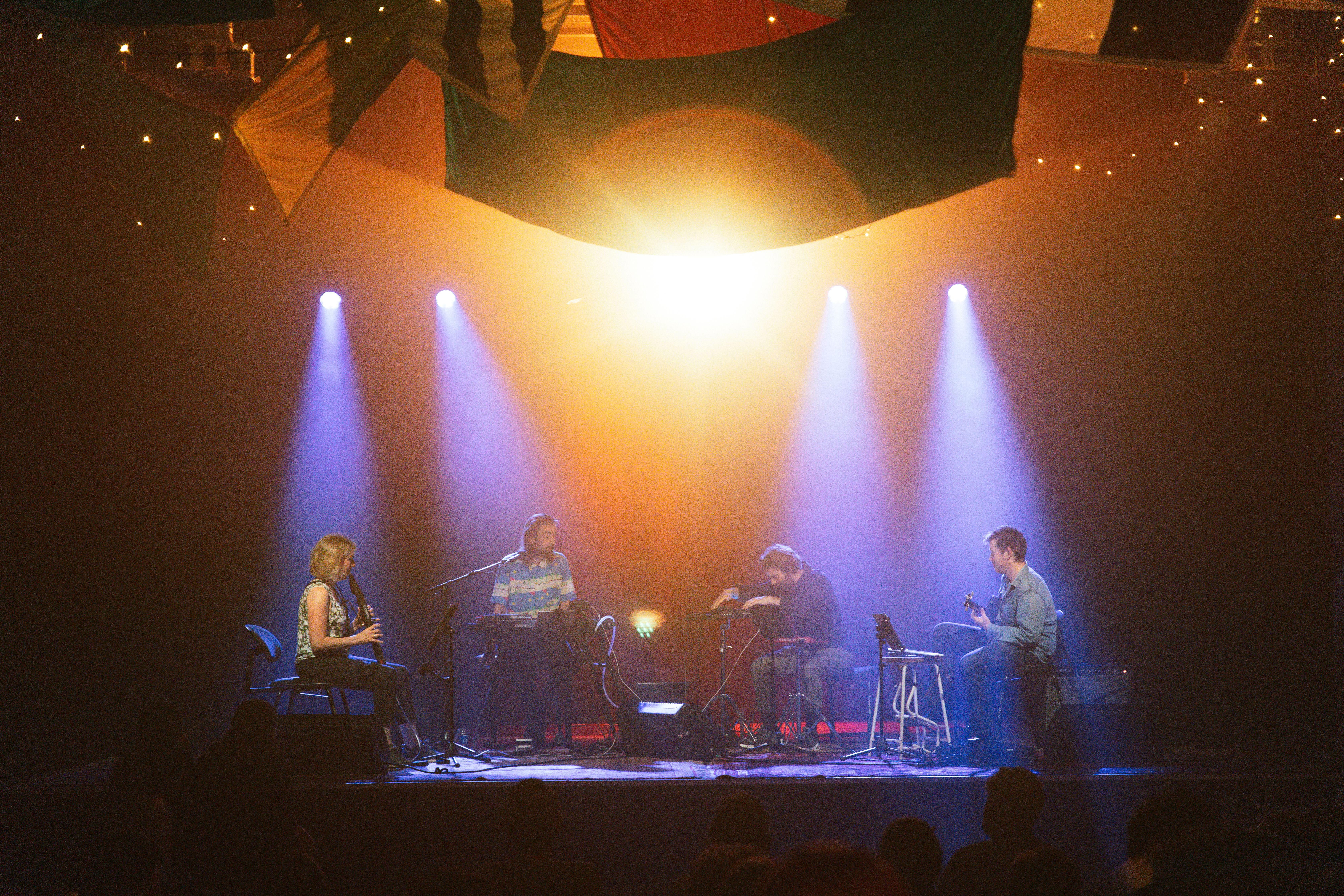
So, for the latest release I knew I wanted to continue in the vein of my first solo album mentioned above. I also knew I wanted to write electronic music that would be playable by four instrumentalists (one of them being myself). And I knew that I wanted to perform the vocals live, using a talk box and vocoder.
Like the previous album, I knew I wanted to create some sort of 'character' represented by the voice, and that the album would tell a sort of evolution-story, that the character would at the beginning be learning how to speak, and gradually words would appear.
I also knew that I wanted the album to be strange, trippy and beautiful, all at once.
Tell me a bit about the way the new material developed and gradually took its final form, please.
It was a long process.
Two of the songs on the album came about through a commission from Frequenz Festival in Kiel in 2021 and through [the contemporary ensemble] Scenatet. I wrote some electroacoustic songs, that were performed at the festival with another vocalist. At this point I already had a feeling that I wanted to continue the project and make an album. But initially the direction I was planning was something very different.
In any case, I worked on and off on new ideas for the project in 2022, but it was only when I had a concrete deadline with a concert at Spor Festival in 2024 that I seriously got around to finishing off an hour of music. Towards the end of 2023 I performed some of the song-sketches on my own at a couple of concerts, including during a residency working on the vocal part at Sound Art Lab in Struer, Denmark.
After the premiere of the project at Spor, we performed a few more times during 2024, and at the last of those concerts, at the MINU Festival in Copenhagen, I recorded all the MIDI (we play almost exclusively on MIDI instruments). I then spent December and January 2025 editing together the tracks from the MIDI captured in Copenhagen and overdubs of my vocal and synth parts recorded in the studio of the Akademie der Künste in Berlin. I mixed the record there too.
Many writers have claimed that as soon as they enter into the process, certain aspects of the narrative are out of their hands. Do you like to keep strict control or is there a sense of following things where they lead you?
When I start a new project, I often tell myself ‘I will keep strict control and aim to go exactly in this direction’. But usually it's impossible, and things happen that force me to follow new leads.
I admire artists that make very clear conceptual work, process-based, for example, where there's an initial proposition and the outcome is a result of following this through logically until the end. At the same time, I know from my own creative process that intuition and 'the ineffable' are very important.
For me there's something magical in these moments when great material appears almost by mistake or even through frustration.