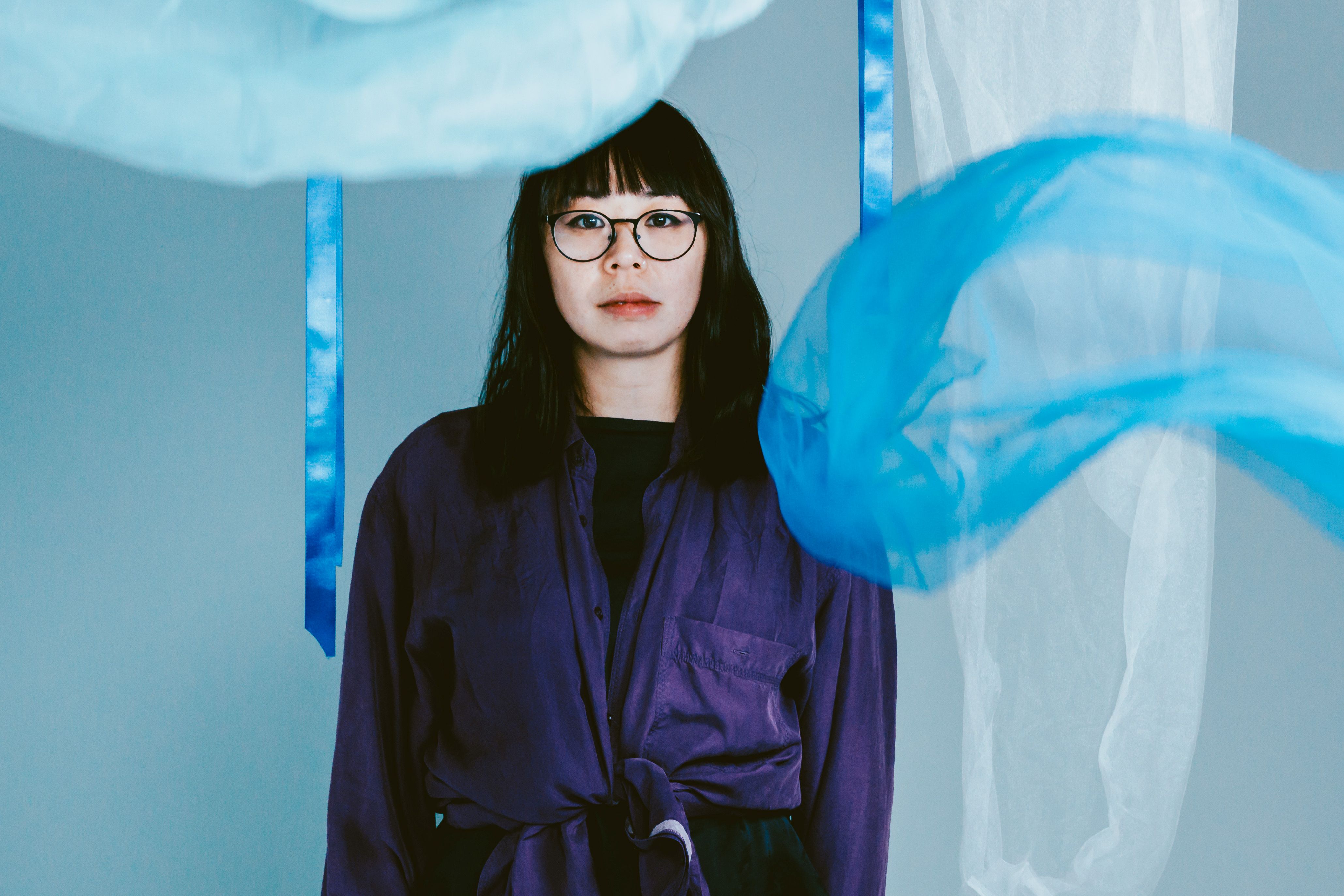
Published
Name: Karen Ng
Occupation: Improviser, multi-instrumentalist
Nationality: Canadian
Current release: Karen Ng's debut full-length album Backwards Blue is out October 17th 2025 via Halocline Trance.
Recommendation for Toronto: I usually insist on taking friends to Buk Chang Dong at Clinton and Bloor for soon tofu, but above all I do insist folks stop by the Tranzac for some music. It’s one of the last true listening spaces we have left for free improv music and is such a long standing important community space for the music scene.
Topic I am passionate about but rarely get to talk about: I’ve done a lot of organizing and curating alongside my performance practice. I’m currently taking a bit of a break from it as I struggle to make sense of the world and all of our current predicaments (humanitarian, political and environmental being the most obvious ones) but most of all I feel there is something extremely broken in arts institutions and music presentation. I really hope we as arts administrators, musicians and audiences continue talking about how it might be better, and move towards a healthier and more sustainable way of engaging with music and musicians.
If you enjoyed this Karen Ng interview and would like to stay up to date with her music, and live dates, visit her on Instagram, and bandcamp.
Where does the impulse to create something come from for you? What role do often-quoted sources of inspiration like dreams, other forms of art, personal relationships, politics etc play?
I love this question, it feels amusing and elusive to try and pinpoint the source of inspiration to create.
I think my process and practice generally exists in live settings, where creation happens in the moment, in a room. At least this feels to me the best representation of who I am and what I do. Then it becomes a matter of creating situations where this can happen, finding the right room and vibe to invite friends to come and improvise and be together.
I suppose that mirrors personal relationships and how I move through the world. It’s less about expressing or executing a static thought or feeling, and more about being and connecting. To see what might come from a collection of personalities and perspectives gathering to create something together.
I suppose if I were to think of what I do more aesthetically I definitely think of the parallels to other forms of art, the dynamics and forms created with light and colour, texture and tone, form and movement.
In the end it’s also about the privilege and ability to create something beautiful, and to be inspired by other beautiful things whether in art or life or relationships or dreams.
Do you have certain rituals to get you into the right mindset for creating? What role do certain foods or stimulants like coffee, lighting, scents, exercise or reading poetry play?
I’m definitely a night owl and feel most creative when the rest of the world is quiet.
There was a very nice moment in time when I was sharing a studio space with a bunch of friends, and I could go there late at night to practice and write. I think ideally having a separate space where I physically have to go to, where I can go to regularly and late, knowing that no one can hear me is the best environment for creating.
Of course in a city like Toronto (and so many others) this is now a bit of a luxury with affordable space being such an issue. Limitations have always been interesting as well so I’m having to find other ways and still happy with the results, especially lately!
For Backwards Blue, what did you start with? If there were conceptual considerations, what were they?
This album concept is built on an ongoing interest in recording. I’ve always been in live and acoustic situations and it was interesting to me how creating in a studio (or home studio) setting gave me extremely different tools for composing and a very different atmosphere.
Like the range of projects I play in, it was interesting for me to try something that felt like a polar opposite in terms of process to give a wider scope of possibilities for music making in my practice. To go from performing almost exclusively in an acoustic improvised setting, to composing with a pretty basic home recording set up during the pandemic, Backwards Blue became a place where there two meet.
I became very interested in how acoustic and electronic sounds interact and talk to each other. Sometimes it’s literally a saxophone and synth in hyper unison and cracking apart; other times its hearing how these elements blend, or not. Fx pedals and plug-ins don’t feel as interesting to me at the moment but rather the study of relationship and dynamics between the two elements, opposed to one being assimilated into the other.
Tell me a bit about the way the new material developed and gradually took its final form, please.
I am extremely grateful to David Psutka, because without his initiative this album would not exist. David reached out years ago expressing his admiration for my music and wanting to work together, but other responsibilities had been taking up all of my time. After bumping into each other at a show last year we scheduled a couple sessions at his studio just to get started and see what would happen.
Throughout the year we would work back and forth, David first taking some of what we recorded and creating preliminary ‘beds’. Some of these became concepts to which tracks were based on such as ‘Flimsy Pink’ which were randomized chords created and gated to saxophone long tones, or ‘Brittle Brown’ which is essentially a tape collage David created from bits of saxophone parts from longer improvised takes I recorded.
Other tracks would have a few stages of extrapolation or deconstruction that we would trade back and forth with me working at home and overdubbing and/or David writing patches that would interact with various aspects of recorded material. ‘Backwards Blue’, ‘Certain Silver’ and the second half of ‘Tactile Black’ were all worlds that came from a few rounds of recording, disassembling, reassembling and overdubbing.
In the end I also included two tracks that were made at home during the pandemic as it still fit loosely with the overall album concept.
Many writers have claimed that as soon as they enter into the process, certain aspects of the narrative are out of their hands. Do you like to keep strict control or is there a sense of following things where they lead you?
Since improvising is at the foundation of my artistic practice, I’m absolutely all for following a thread, a flow and not keep strict control.
Sometimes I try to execute a controlled specific idea as an exercise, there are definitely a couple tracks on Backwards Blue of that and it has a distinctly different sound (I wonder if it’s obvious which ones!)
The notion of control has come up several times during the making of this album, it’s a very curious aspect that I think generally doesn’t sit well with me in creation and collaboration.
There are many descriptions of the creative state. How would you describe it for you personally? Is there an element of spirituality to what you do?
There is definitely a state that I find myself in, that I am searching for when improvising in performance and this state I suppose could be described as something like spiritual … It is a place that one can arrive at where there are no more thoughts, worries, doubts … just plain presence and being. And connection with those who are engaged with you.
I think in the creation or composition process it happens in a different way, there are times where I truly get lost in the act of creating/composing, but it’s a bit more rare - probably because I’m less experienced with this aspect.
Once a piece is finished, how important is it for you to let it lie and evaluate it later on? How much improvement and refinement do you personally allow until you're satisfied with a piece? What does this process look like in practise?
I definitely really love letting recordings sit long enough until I’ve completely forgotten what I did, before evaluating and reflecting - but this applies mainly to live free improv sets.
The recording/composing process for me I really took the opposite approach, working on it regularly though pauses definitely needed to happen as I would lose perspective once in awhile. A piece of great advice once given to me is to always have others listen, the more ears you get to give you some outside perspective, the less crazy you’ll drive yourself and the less narrow of a sentiment you’ll have.
A beautiful reminder that there are so many ways to hear and interpret things and other perspectives will surprise you, ease your doubts and clarify your intentions.
How do you think the meaning, or effect of an individual piece is enhanced, clarified or possibly contrasted by the EPs, or albums it is part of? Does each piece, for example, need to be consistent with the larger whole?
I learnt a great deal going through this process and it was clear that I absolutely think of each piece as a part of the whole - not necessarily in consistency but rather in variety of concept and intention.
It was pretty alarming to feel so strongly about it when I didn’t realize yet that it was a necessity!
What's your take on the role and importance of production, including mixing and mastering for you personally? In terms of what they contribute to a song, what is the balance between the composition and the arrangement (performance)?
Production had a huge part in the creation process with David at the helm.
Much of the electronic content was made with a specific aesthetic in mind and served as the foundation for Backwards Blue. It was such a joy to build these worlds with such high quality sounds at our disposal. The arrangement/composition of these elements in relation to the acoustic components was a very new and challenging, though fulfilling journey.
I have so much respect for the art of mixing and mastering, and was super fortunate to have an amazing team of Joseph Shabason and Stephan Mathieu (Schwebung Mastering) work on this album.
I’m a great admirer of Joseph’s music, and had him in mind from the very beginning to work with, as someone who has so much knowledge of the saxophone as well as recorded audio. We are very different saxophone players too, but I really respect his ability to think of sound as an engineer first, with a deep understanding of how to translate the essence of saxophone tone as authentically as possible.
Stephan was Joseph’s recommendation and a new name to me, the pair of them worked seamlessly with Stephan bringing out some of Joseph’s work to the front in a really beautiful way. I think Backwards Blue is absolutely better because of them both and am grateful for the chance to work with them.
[Read our Joseph Shabason interview]
[Read our Joseph Shabason interview about working as a session musician for Destroyer, and the War on Drugs]
Music and the accompanying artwork are often closely related. Can you talk about this a little bit for your current project and the relationship that images and sounds have for you in general?
When it came time for naming tracks I got really obsessed with playing with words, particularly adjectives, in relation to colours. I thought it would be fun to try using descriptive adjectives that do NOT describe colour, yet at the same time my mind couldn’t help trying to make connections between say ‘inflatable’ and ‘grey’.
When it came time to shoot the album cover, my photographer friend Green Yang and I went into several fabric stores and just started picking out things that reflected colours and textures related to these words.
In the end we ended up with this image of tiny bits that look like artefacts that should be on display in a museum or something … very striking and I loved it.
After finishing a piece or album and releasing something into the world, there can be a sense of emptiness. Can you relate to this – and how do you return to the state of creativity after experiencing it?
This moment absolutely exists and I speak about it often with friends. The end of a prolonged process or production is often accompanied with a period of existential questioning for many, including myself.
Finishing an album, or tour, or recording - I’ve learned that I need to give myself quite a bit of time to first come down from the energy of whatever the project was, sit with the feeling of nothingness (after a long period of having a regular task or purpose), then to be patient as I reintegrate back into a place of openness, ready for the next thing. Sometimes it takes weeks! Without this time of recalibration (which ultimately happens at some point) burnout is usually the result.
But now that I’m aware after witnessing it so many times, it feels less dire, and just part of the process. I’ve got some tools at my disposal to help with it - resting without guilt is a huge part of it, self-care in the form of tasty meals, long walks in nature and a reminder that the pressure of late capitalism, to always produce exponentially, isn’t my reality.
There are so many moments where it feels like I can’t afford to take this time to rest, but I have learned to make time for it in whatever way I can manage - because my happiness and health are worth it.