Published
Name: Keiichiro Shibuya
Nationality: Japanese
Occupation: Composer, artist, musician
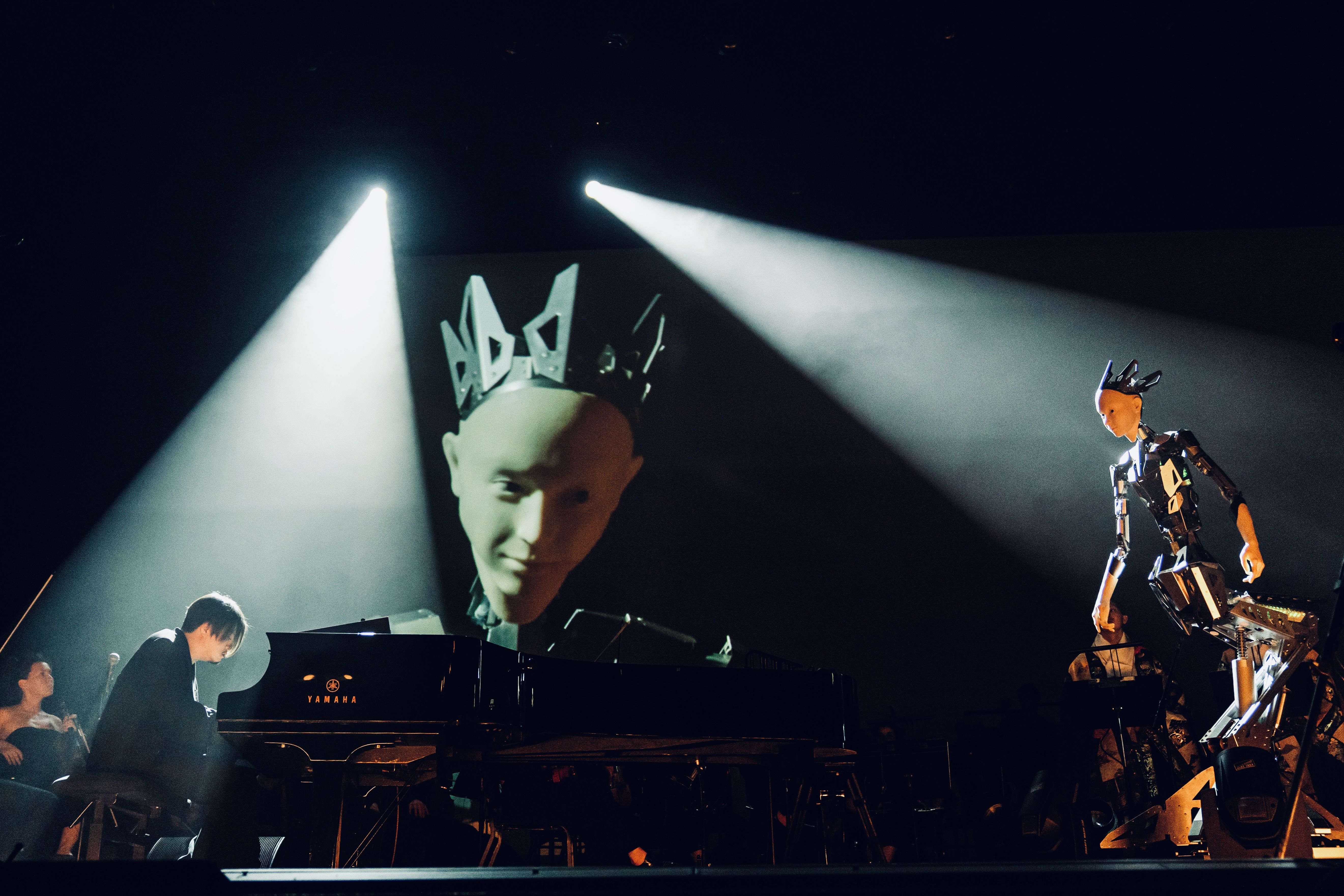
Current release: Keiichiro Shibuya's new album, ANDROID OPERA MIRROR, is out via ATAK.
If you enjoyed this Keiichiro Shibuya interview and would like to know more about his music, visit his official homepage. He is also on Instagram.
Many seem to be under the impression that AI recently burst onto the scene and changed everything. But technological progress has been steady and gradual. What have been some of the points over the past decade where you personally had the feeling that something really had shifted?
In music, songs have become shorter—almost functioning like sound logos. More and more, people are not just listening to the music itself, but also to the context, the iconography, and the superficial impact that the sound carries. In that sense, the fact that music has been "designed" is a decisive change.
While smartphones, streaming, and various other factors have played a role, I believe that many technological changes were already underway even before the emergence of AI.
What's your own take on the balance between technology and creativity?
For me, there's not much difference between collaborating with another person and collaborating with technology.
I think people tend to overvalue "originality" in humans. After all, humans are inherently imitative creatures, and even technologies like AI and androids can offer unexpected, serendipitous contributions.
That's why I don't see a strict dichotomy between human and technological input as particularly meaningful.
THE END was the first time you openly explored non human input in your work. What was the process of working towards that piece like?
I lost my partner—my wife—and I struggled to come to terms with her death.
In an effort to overcome that pain, I created an opera, THE END, featuring an "absolutely undying virtual character" as the protagonist, using it to question the very nature of death.
This process served as a form of personal healing, and it was incredibly gratifying to challenge the human-centric approach typical of Western opera by embracing a radically different perspective.
The press release mentions that you were “drawing from both your artistic background and your years working on AI music creation methods at Osaka University of the Arts’ Android and Music Science Laboratory.” Tell me about that time, please, and some of your findings and conclusions.
At the lab, I served as a professor and brought together not only students but also external artists and engineers as collaborators to experiment with and develop projects at the intersection of music, robotics, and programming. We utilized the lab much like a residency space, spending extensive time with collaborators from both Japan and abroad.
One of our projects involved developing a program in which an android could generate and improvise melodies in response to piano and vocal performances. Ultimately, these experiences reinforced the importance of sharing time and space with collaborators during the creative process.
Vocals are one of the key cornerstones of what makes us human. Why precisely replace them? On an experiential and emotional level, what did you get out of the use of non-human vocals on THE END?
Whether it’s opera, rock, or dance music, the conventional human-centered approach always placed a human vocalist or star at the core, supported by an orchestra or band and an audience. By deliberately introducing a non-human element at the center, I essentially created a void—a space for something different.
I believe that encountering a new kind of romanticism, complexity, and emotional resonance can be an enriching experience for people, precisely because it challenges our usual expectations.
ANDROID OPERA MIRROR was, I believe, finished five years after THE END. What were some of the triggers in terms of the narrative and musical approach?
Android Opera was actually a spontaneous idea that came to me in 2013, right after I had premiered THE END, a Vocaloid opera starring Hatsune Miku that explored themes of life and death, in Paris.
The first creative step was to find a compelling text that would be interesting when sung by an android rather than a human singer. I spent a lot of time thinking about what kind of poetry could create a meaningful and intriguing sense of dissonance.
The “libretto” to the opera was mostly penned by Chat GPT. What were you looking for?
I thought it would be fascinating if an AI could express its own perspective on life and death.
To achieve this, I worked with a collaborator—a monk versed in esoteric Buddhism—who taught me about philosophy and Buddhism. I then incorporated those ideas into the prompts for GPT, which helped shape the text of the lyrics.
In doing so, I believe a unique and complex simulation emerged of what an AI might sing or proclaim as the world comes to an end.
For the orchestral parts, what was the process of creation like and how did you get the results you wanted?
Initially, I planned to use live recordings from theater concerts for the orchestral parts. However, I wasn't satisfied with the outcome—the performances were too imperfect, and in a classical sense, overly "human" compared to the futuristic concept and feeling of the work. So I discarded that approach and replaced everything with software.
That said, not everything was entirely computerized: I exported all the parts, brought them to a mixing studio, set them up on an analog mixer, and processed the sound of each part individually.
The effort was no different from working with human orchestra data—the only difference being that there were no humans involved.
ANDROID OPERA MIRROR also contains passages written by you personally. What is the relation between your own contributions and those generated by AI?
Take the first track, “MIRROR,” for example. I developed the underlying concept and crafted the text myself.
I consider this to be on a different layer entirely from the words generated by AI.
What is the pleasure and allure of working with AI tools for yourself?
Unexpected sounds and rhythms are generated at an incredible speed, and by editing them, I can create sonic textures that I wouldn't be able to produce on my own.
There's a fascinating aspect in the fact that the very approach to composition is transformed.
Is your experience that AI reduces your involvement in the creative process – or does it conversely increase it?
It's not about reducing involvement; it’s just that the way I engage with the process changes.
After working with AI extensively on this project, I'd be curious about your take on what the term “composition” means today.
I’ve discovered that editing massive amounts of data is also a form of composition. I believe this represents a significant shift for composers.
The stage performance of ANDROID OPERA MIRROR is quite remarkable. Did you get the chance to talk to the orchestra musicians about how they saw performing this score – was it in any way different to them than a regular modern classical piece?
From a musical standpoint, the show was designed as a "simulation of the world after its end," so it prioritized an overall, cohesive image and impact over the nuances of traditional modern or classical music. It’s rare to see a contemporary work where extramusical conceptual elements function so powerfully, so it came as quite a surprise to the orchestra.
With an android positioned between me—the composer—and the performers, communication somehow flowed more smoothly. Because the android is an imperfect entity that only functions when its program is executed, it creates an atmosphere where everyone feels compelled to collaborate.
While technology and humans are often portrayed as opposing forces, in this case they support each other. I believe this could even serve as a model for future society and human relationships.
You also worked with monks on the project. As so much of the current debate about AI and this opera in particular revolves around deep, existential topics – how do they see the advent of AI and its impact on humanity?
The monks are not only well-versed in Buddhist teachings but also in Western philosophy and thought. They reference and reflect on a broad spectrum of ideas—from classical figures like Socrates to thinkers such as Descartes. Their chanting is the oldest music in Japan, dating back 1,200 years. Coincidentally, this was around the same time that Gregorian chants emerged in the West, marking the birth of song in both Eastern and Western musical histories.
While they might see Western symbols like the orchestra and innovative symbols like the android as entirely different, they actually regard the coexistence of disparate elements as perfectly natural. In fact, the leader of the monks remarked, "Everyone thinks they should never mesh, but in reality, they do—because music is an art founded on harmony." I completely agree with that sentiment.
Additionally, they don't seem particularly pessimistic about the impact of AI on humanity; rather, they are eager to embrace new elements. I believe this optimism stems from their deep and rigorous study of ancient traditions.
For the album release, you mentioned that it was hard to “get everything to reality” and that “mixing and mastering” was rather unusual. What did that mean in practise?
As I mentioned earlier regarding the orchestra, I wanted to bring the digitally generated orchestral sound closer to the texture of a real human orchestra. This required an extremely analog approach, making the mixing process highly intricate.
The only human performance in the album is my piano, but playing alongside a digital orchestra feels entirely different from performing with a human one. Selecting the right phrases from those recordings was challenging.
The android's voice also varies from track to track, often layering multiple voices, which required extensive adjustments that continued even into the mastering stage. Normally, track replacements don’t happen during mastering, but given the scale and complexity of this project, it was necessary to refine the final sound and get as close as possible to the sonic image I envisioned.
At the start of ANDROID OPERA MIRROR, you wondered “how an AI-equipped humanoid robot might react to the most human artistic experiences.” After finishing the project and diving in even deeper for the album release – how do you think it would react?
In the process of creating the album "AI-written lyrics sung by an android," something futuristic has become a reality now. In a way, the fact that I wasn't necessarily satisfied with an accompaniment from a human orchestra is something suggestive. In fact, the process I applied to the artificial orchestra turned out to be far more complex than human orchestration.
This demonstrates that, while an artificial orchestra alone doesn’t provide the full answer, human effort is still required. I feel that this album symbolizes the transitional phase between AI and humanity.