Published
Name: Kerretta
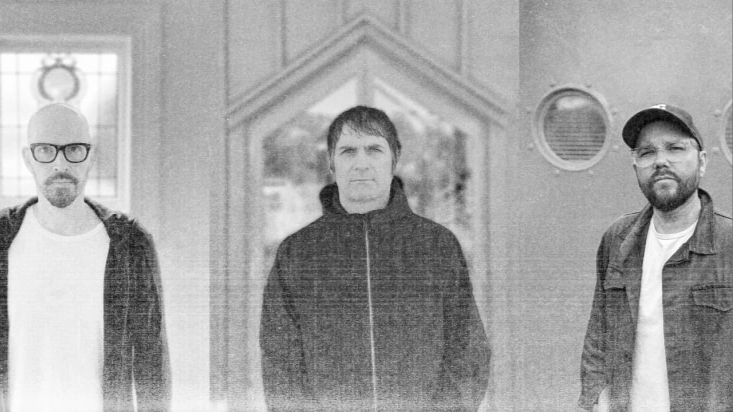
Members: Hamish Walker, David Holmes, Mathew Bosher
Interviewee: Hamish Walker
Nationality: New Zealand
Current release: Kerretta's new album Angelm is out November 18th 2024 via DUNK! and A Thousand Arms.
Recommendations: I wouldn’t know where to start here! I figure challenge yourself with anything and everything.
But if I think of things I have been listening to recently music from Yoshiaki Ochi, The Terminator 1 soundtrack, Mantar records are always fun, anything by Aldus Harding, and a cursory listen to percussion of the world playlists.
Books, I don't have anything in particular but I’m reading a lot about the history of human language. The voice is an interesting instrument so I guess there is some linguistics literacy tourism I’m dabbling in.
If you enjoyed this Kerretta interview and would like to know more about the band, visit them on Instagram, Facebook, twitter, and bandcamp.
For a while, it seemed as though the model of the bed room producer would replace bands altogether. Why do you like playing in a band rather than making music on your own?
For us there is a place for both. Often there is a time where creating alone you have opportunity to stretch an idea. And then being in a band in a room also gives the chance to be spontaneous which may never have been achieved alone. There is no replacement for connection with others and being in a band allows this.
To summarize, being in a band is fun. Sharing musical ideas is enjoyable. We’re humbled to be able to keep doing it.
What, to you, are some of the greatest bands, and what makes them great?
Using some well known bands as examples, I would say those that were able to capture an emotion or took risks and tried new things and whose work I continue to enjoy.
Bad Brains, Kraftwerk, The Jesus Lizard, Warpaint, Fugazi. AC/DC for their enduring ability to still capture a new audience throughout generations is fascinating.
Before you started making music together, did you in any form exchange concrete ideas, goals, or strategies? Generally speaking, what are your preferences when it comes to planning vs spontaneity in a collaboration?
We never formed ideas, goals or strategies at the start. We began performing improvised and it was only after a few years that we decide to officially begin as a group and create a release with our first 7” (Kerretta -”Death In The Future”).
We live in different continents now, so to make things work we need to plan a long time in advance and have our parts or ideas ready.
When we meet up we aim to create as much spontaneity out of the situation as possible so those planned parts have room to organically move around or be flipped etc. It’s a balance of the two I guess.
There are many potential models for creativity, from live performances and jamming/producing in the same room together up to file sharing. Which of these do you prefer – and why?
Each of the three has its place. Kerretta shows in a sweaty club are visceral, raw and a sensory overload. Each time we play it’s different. Different performance, songs, different audience.
Jamming, producing in a studio is a considerably more calm affair and getting to the meat and bones of ideas and forming songs from these is fun. We’re lucky that we are able to source interesting and accessible equipment too, so this helps. We used to begin rehearsal at around 05:00 in the morning when focus was optimal and we had other requirements of our time during the day so this sat somewhere in between.
The file sharing thing is cool for short bursts of ideas or laying out a structure and as we live in different countries, quite necessary. But it isn't my primary preference. It’s more an useful tool to try and utilise time in jam spaces or rehearsal rooms together more efficiently. Almost like a rehearsal before the rehearsal.
How do your different characters add up to the band's sound and in which way is the end result – including live performances – different from the sum of its pieces?
I try and plan a lot in advance and leave spontaneity to the end of any process. Dave is a little more spontaneous at the start and then is more thorough at executing the final recording or songwriting. He mixes our records and does most of the recording as well.
We have a new member now, too, whom we’ve known for a really long time and respected his art. So we’ll see where that takes in future music making.
Is there a group consciousness, do you feel? How does it express itself?
The only group consciousness is to strive to make music that moves us emotionally and we haven't heard before.
There are no rules. If it’s exciting or grooves, or brings about an emotional response, that’s where we aim for.
Tell me about a piece or album which shows the different aspects you each contribute to the process particularly clearly, please.
Here’s one that was slightly different. “Bloodlines” from our second record Saansilo.
Will (ex-bassplayer) came into the studio one day and had a bassline that was a regular 4:4 signature but each cycle was of different lengths. I wanted to experiment with making a very regular kick where it would pulse, but not do anything too driving or rhythmic until the second half. So the song was built around irregular lengths but very regular drums rhythms.
Dave had these loops he would layer and emphasise the mood without dominating the bass lines. We had additional pātē added. Pātē is a log drum from Polynesia and when it’s traditionally performed, it’s often alongside a pulse type drum pattern.
What is your sense of ownership like as part of the collective songwriting process? What is the balance between the lyrics, melodies and harmonies, and the groove in terms of your sound?
We use rhythms as the base a lot. These spark ideas that may then run into something a lot more guitar melody based over the course of the track. We don't tend to have any gatekeeping on anyone else’s instrument. I’ll happily get involved with bass, guitars etc if I feel the need to and other members feel the same way.
Dave has had ideas where he’s had a specific drum pattern in mind. There are large sections of Kerretta tracks I have written sections for guitar or bass. We try and keep the process as democratic as possible. This is more exciting I think. As an example I wrote the guitar for the end of ‘Until The Atlas’ (Angelm) because I felt it needed a really rolling rhythmic riff through it.
Dave conversely had these drum ideas for the start of “Kept From The Brilliance Of The Outer World” (Saansilo) because he had an effect he wanted created where there would be a feedback loop coming through monitoring speakers and back through the guitar pickups and via a delay that would feed into itself. Consequentially he wanted the drum pattern to work with the effect.
What tend to be the best songs in your opinion – those where you had a lot in common as a band or those where you had more differences? What happens when another musician take you outside of your comfort zone?
Our best song is the one we haven’t written yet.
Sounds stereotyped but that’s a part of what keeps us writing. There are always new paths to investigate.
What are your thoughts on the need for compromise vs standing by one's convictions? How did you resolve potential disagreements?
We all argue our case if there is a disagreement. If someone feels strongly about something they don’t like, it’s usually worked over a few times and if the person continues to not like, it’s dropped. No one wants to have that track they dislike on a record, or aren't fully invested in.
Over time we may look back and consider we would have done something differently, but it’s never something we released for the sake of it or pushing through ideas despite objections from other people. You can and should always pivot to a new idea if the current one isn’t working.
Do any of the band's members also have solo projects? If so, how do these feeds into the band's creative process?
Dave owns and runs recording studios in London UK, so a lot of his energies are put into this and he often turns up on other peoples records. I lose count!
I released a record with Jeff Boyle from Jakob as ‘Mean’. We have only released one album entitled ‘Knowing’. Could be time for another!
Mathew (bassplayer) also records under the name Magnalith.
In a live situation, decisions between band members often work without words. From your experience and the performances of your current tour, what does this process feel like and how does it work?
Reading cues and knowing the people you perform with and whom you can mutually trust is a big thing. Things can and have gone wrong on stage and knowing you’re able to read what’s going on with other people is vital.
We’ve had situations when on tour where we’ve had medical emergencies and continued in a reduced format for example. We just got in the dirt and figured out a way to do it and how to make the show work and unique.
How has the interaction within the group changed over the years? How do you keep things surprising, playful and inspiring?
We’re still the same people in most aspects. Of course, we are a little older but for the most part it’s the same.
Being honest is probably the most important part and I guess that makes it often a surprise or playful for better or for worse.
The inspiring part I think can come from working on your songwriting or idea or instrument more and more. Knowing there is always more room to make something different or learn more from others is inspiring.
Have you worked with outside contributors - from sessions musicians via producers to other songwriters? How did this change, improve or challenge the established dynamic and how do you look back on that?
We have had guests performers on songs for sure. And every guest has always changed a song in some way, some more than others. For the most part we knew what we wanted out of the session.
We have had voice for “Kawea Tātou Ki Ngā Hiwi” (Pirohia) and “Eyes In The Bull Temple” (Angelm).
Voice is a magical instrument and this has been rewarding to have on our tracks.
I like to have additional percussion/rhythms as well such as on ‘Valley Towers’ (Angelm) and ‘Sister, Come Home’ (Pirohia).
The guests have always been super cool and we have always been humbled that they were willing to take part in our ideas.
Most bands eventually break up. What makes you stay together? What are essentials for a successful band?
Success should only defined by enjoyment or a sense of accomplishment / purpose.
If you’re able to have fun or feel a sense of purpose in your art, and create with people to make a band you enjoy being around, that unto itself is success.