Published
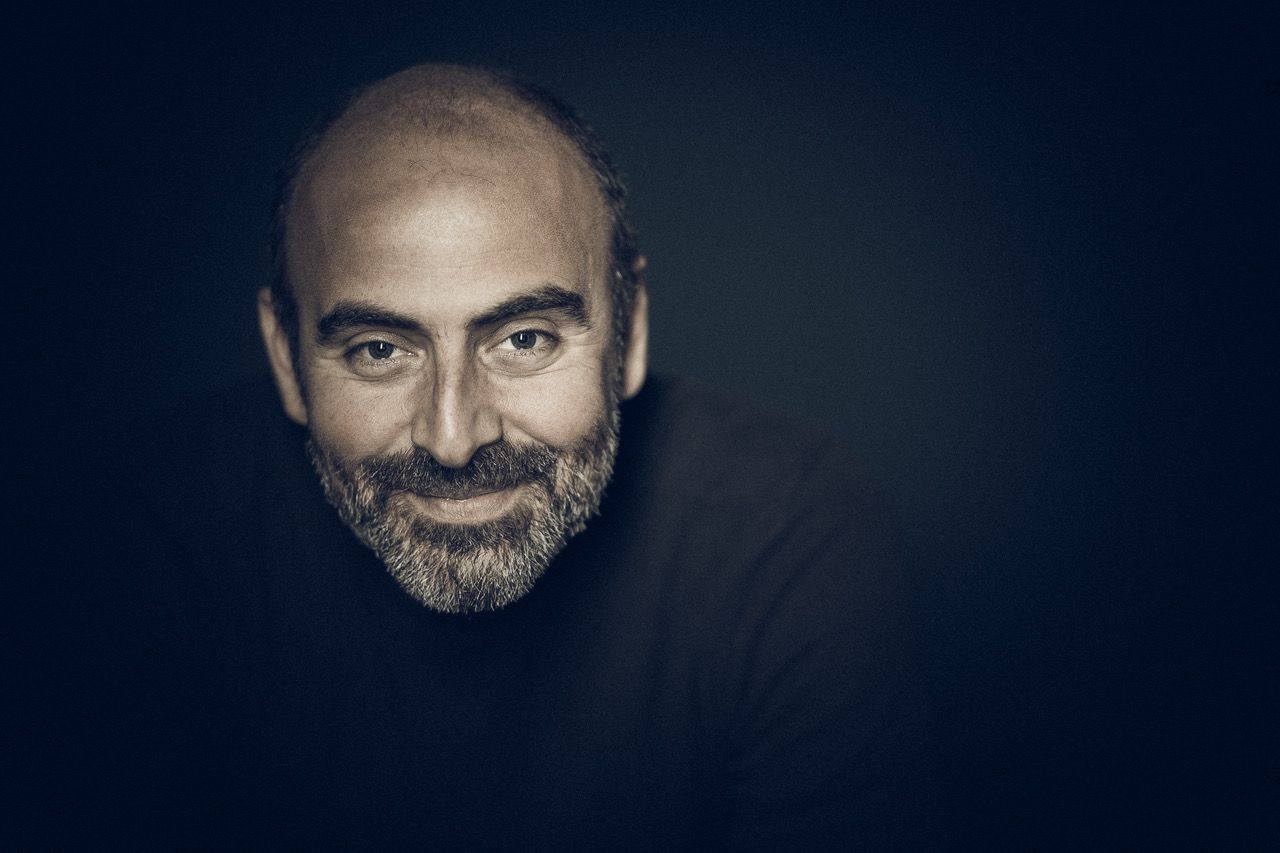
Name: Kinan Azmeh
Nationality: Syrian
Occupation: Clarinet player, composer
Recent release: Kinan Azmeh's new album with his CityBand, Live in Berlin, is out via Dreyer Gaido. It features himself on clarinet, Kyle Sanna (guitar), Josh Myers (bass) and John Hadfield (drums). Order the album at German retailer jpc, with excellent international shipping options available.
Also out now is Half Moon, a deep documentary about his work directed by Frank Scheffer.
If you enjoyed this Kinan Azmeh interview and would like to stay up to date with his music, visit his official website. He is also on Instagram, and Facebook.
For the thoughts of one of the ensembles who have championed and curated his work, read our Brooklyn Rider interview.
The borders between producers, sound artists, and even songwriters are becoming increasingly blurry. What does being a composer mean today, would you say?
I don’t separate my life as a composer from my performer and improvisor careers. I do believe that they all spill into each other seamlessly.
Being a composer means that you believe you have something meaningful to share with the world. It also possibly means that you have an emotional content inside of you which no other music that is out there already can capture. So you have to write new music to channel that.
It is exactly this what brought me to attempt wearing all my different hats at the same time many years back when I wrote my “Suite for improviser and orchestra,” a piece that can be played by any improviser on any instrument.
Many people perceive classical music and contemporary composition as having high barriers of entrance, both for listeners and musicians. What have your own experiences been in this regard?
This might be true from an industry perspective. Entering a concert hall where you are expected to dress up and know when to clap and when not, can be intimidating.
Exposure to all sorts of music from an early age is key. In my opinion, no music has high barriers of entrance if one gets exposed to it repeatedly and from early age.
As of today, what kind of materials, ideas, and technologies are particularly stimulating for you?
I have written instrumental works most of my life. Recently, and thanks to the Syrian revolution, I became more interested in poetry. I love how poetry crates a collective compass of a nation and it is wonderful tool to understand society and social changes.
This interest led me to the creation of my first opera “Songs for Days to come” which I premiered in Germany in 2022.
Where do most of your inspirations to create come from – rather from internal impulses or external ones? Which current social / political / ecological or other developments make you feel like you need to respond as an artist?
The inspiration to create comes from urgency: a feeling overwhelms you and you find yourself consumed by trying to understand it. This can be triggered by both external situations you have been exposed to, but also an inner urge to escape it all by creating your perfect inner world.
Artists are also human beings who react to the world like anyone else, but they have the luxury of reacting with beauty to a world that is full of ugliness and injustices.
Making music is an act of freedom by default, and practising that freedom is in itself an important political and social contribution.
Music has become a lot more global, and incorporating elements from other parts of the world or the musical spectrum is commonplace. Do you still think there are city scenes with a distinct, unique sound? How does your local scene influence your work?
I feel at home in a variety of geographical and musical worlds. For half of my life, I lived in Damascus Syria, learning Western classical music and being surrounded by Arabic, Kurdish and Armenian musics.
The second half of my life has been spent in New York City, a city that is the home of so many musical cultures. Having global influences for me has been the norm and not the exception, and I am sure some of these influences find their way into the music I create.
I realize now that so many of my pieces have names of places - "Dabkeh" on Maertense Street, "Jisreen," "Daraa," Love on 139th street.
Composing has always had an interesting relationship between honouring its roots and exploring the unknown. What does the balance between these two poles look like in your music?
I like to describe my music as ”music that is inspired by many traditions without being limited by any of these traditions”.
It is important for me to remember that what we consider today as traditions are the results of centuries of experimentations. You do yourself and the traditions a great service by learning them as deeply as one could, but then later by putting them aside during the creative process.
Traditions and contemporary music across genres form a continuum and I don't see them as two poles.
How much potential for something “new” is there still in composition? What could this “new” look like?
Mathematically speaking, the possibilities of “arranging notes and frequencies in a certain order” are infinite, which means that there will always be something new there to explore.
This “new” does not have to look different, it should sound original, and there is a big difference for me between the words “new” and “original.” “New” is short lived, “original” is moving and meaningful.
What role do electronic tools and instruments play for your creative process? What does your creative space / studio look like and what tools does it contain?
I always try to start with a pen and music paper, that's where some of the most original ideas appear first (without the limitations of any technology). Later on I might use the piano (and less frequently my clarinet) to try some ideas out.
The last part of the process is using Sibelius or any other notation program to create a score that another musician could read, understand and use.
It is my impression that adding a conceptual, non-musical dimension to one's work is almost a prerequisite for commissions and grants. How do you view this tendency and how “conceptual” is your own approach to writing?
Whether there was a grant or not, I always start with a concept. Some of these concepts are political, a story to be told, a poem, etc, or simply a musical concept (time compression, harmonic sequence etc). In both cases, the concept comes first always.
A concept, for me, is the idea that a composer wants to share with the world. The rest - such as your instrument or your skills on the instrument - are secondary, they are only there to serve the idea.
Working with long forms, complex concepts or new vocabulary is potentially more challenging today because they require us to remember things that happened perhaps minutes ago – while most of us are finding it hard to focus even on what's happening right now. Both as a composer and as a listener yourself, how do you deal with this?
I go back to the concept: the idea you are trying to tell will certainly dictate the length of the piece, otherwise the music will sound artificial.
Each story should be allowed the time it needs to be told.
For many artists, life-changing musical experiences take place live. Few works these days, however, are performed beyond their premiere. What, do you feel, does this mean for composers, and the music they write, and how does this reality influence your own work?
I am in a lucky situation as all of my works have been performed several times. It certainly helps a lot that I am an active performer myself and I bring these works to life as frequently as possible.
However, while I am composing I always put myself in the performers’ shoes: is it fun and meaningful to perform this work? I always remind myself that the best advocates for my music are my music colleagues who are performing these works, so I think of them when I write.
How, would you say are live performances of your music and your recording projects connected at the moment? How do they mutually influence and feed off each other?
I just released a new album, Live in Berlin, with my jazz quartet CityBand, so these two things could not be more connected for me at the moment.
There is something incredibly special about live recordings that you don't feel in studio projects. Live albums are not only about the music, but also about that given moment in time where all these people were together to be part of a unique experience. This gives the music an incredibly fragile nature.
Consequently, many compositional ideas come to me while I am trying something new in front of a live audience. These ideas end up showing up in the next piece I am working on.
To some, the advent of AI and 'intelligent' composing tools offers potential for machines to contribute to the creative process. What are your hopes, fears, expectations and possible concrete plans in this regard?
I think it will not be long before we see in fine print on a concert poster: “performed / composed by a real human.”
We might not be able to tell the difference at times but I trust that the fragility of the human soul and the imperfections that we collectively embrace will continue to be a source of inspiration and admiration.
Are there approaches, artists, festivals, labels, spaces or anyone/-thing else out there who you feel deserve a shout out for taking composition into the future?
I am big fan of two independent labels: the German label Dreyer-Gaido which have released most of my music, and also the US label In a Circle. Both labels think of music outside categories.
As for festivals, the Morgenland festival in Osnabrück and its director Michael Dreyer have both been key players in my creative life. That festival lives / eats / breathes “music that is inspired by traditions without being limited by these traditions.”
I am incredibly honoured that I was chosen to guest-curate this festival in the Summer of 2025.
The Montreux Festival intends to preserve its archive of recordings for future generations. Do you personally feels it's important that everything should remain available forever - or is there something to be said for letting beautiful moments pass and linger in the memories of those that experienced them?
Archiving and preserving history is incredibly important. In the digital world, you don’t have to erase the past to make room for the future. It is such a luxury for us to be able to go back and listen to the great masters.
On the other hand, it is very important for all of us (artists and audiences) to remember that enjoying a live performance is inextricably linked to knowing and believing that this moment will NEVER happen again, even when replayed on a recorded medium.