Published
Name: Kisu Min
Members: Basia Ciupińska (vocal, guitar, synths), Ola Sobańska (lead guitar, backing vocals), Agata Pyziak (drums, percussion), Michał Szafarz (bass guitar, backing vocals)
Interviewee: Michał Szafarz
Nationality: Polish
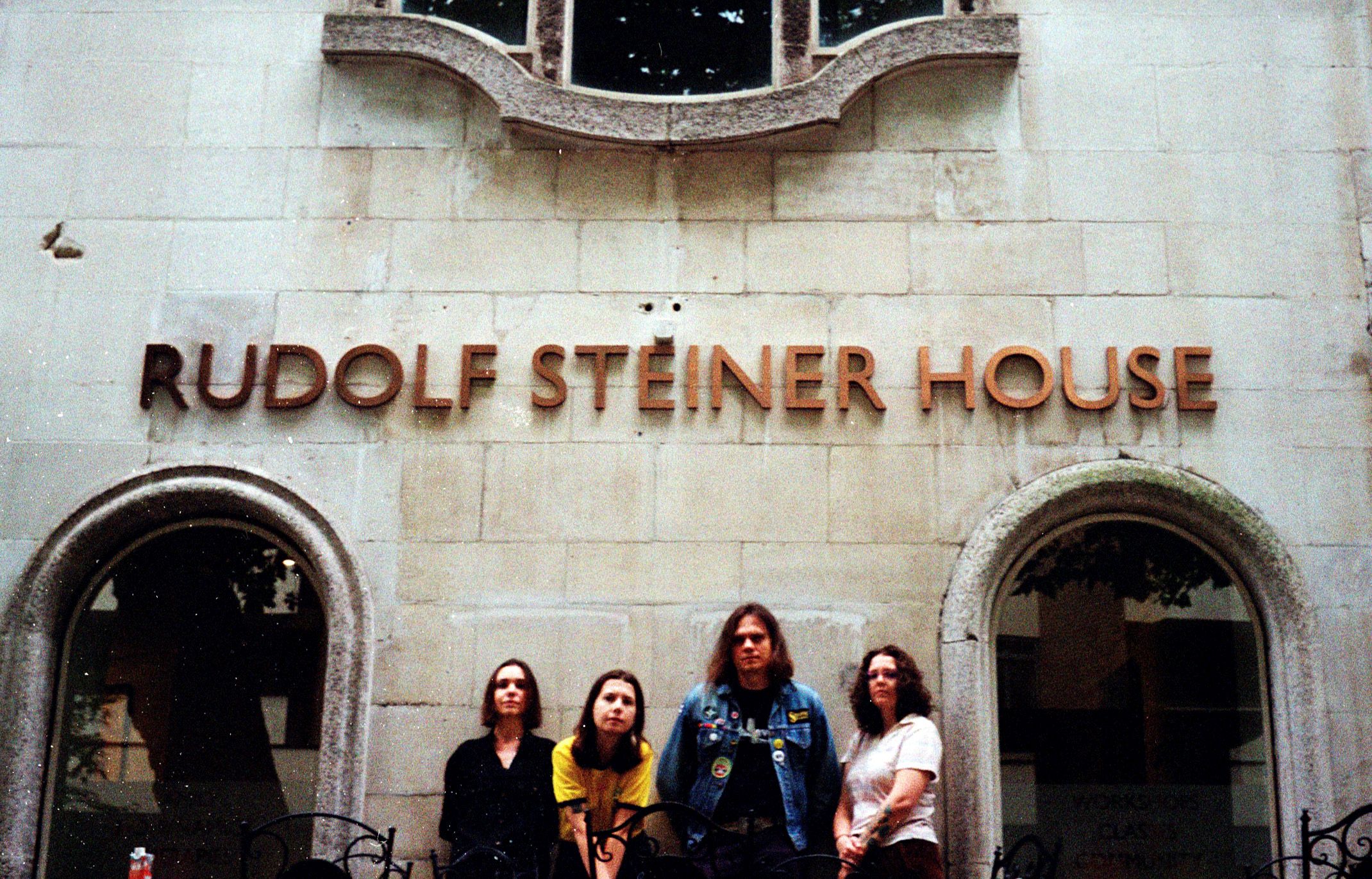
Recent release: Kisu Min 's new album Rudolf Steiner House is out via Antena Krzyku.
Recommendations for Łódź, Poland: Łódź is a relatively unknown city in the world, but it has many wonderful things to see. There are many post-industrial buildings, interesting revitalizations, Art Nouveau and modernist buildings. Łódź has beautiful parks and a famous film school, which has been attended by such outstanding filmmakers as Andrzej Wajda, Roman Polanski, Krzysztof Kieślowski, and Krzysztof Zanussi. David Lynch, who shot a film in Łódź, said that the city looks like something out of his deepest dreams.
Topics that I am passionate about but rarely get to talk about: I am interested in many things. Apart from culture in the broad sense, I also like small things such as geography and old trams. I love philosophy and have several electives in pedagogy, which is also my passion. Especially Waldorf pedagogy. I love the beauty that is realized through Waldorf kindergartens and schools, the atmosphere of these places. It is extremely creative, lively, close to life and nature. I love hiking in the mountains, it's wonderful to be able to experience the power of the mountains, and then when I get home, I take out my atlas and browse Wikipedia to learn as much as I can about these mountains.
If you enjoyed this Kisu Min interview and would like to stay up to date with the band and their music, visit them on Instagram, Facebook, and bandcamp.
Where does the impulse to create something come from for you? What role do often-quoted sources of inspiration like dreams, other forms of art, personal relationships, politics etc play?
This is certainly a profound question. Why, in general, does someone at some point begin to feel a kind of compulsion to create.
I remember when I was about 15 years old I was already strongly focused on creating something of my own. I was certainly inspired by artists who touched my emotions very strongly. It was so amazing that I wanted to be someone like that myself.
At first, of course, I was strongly inspired by what was going on in my emotional life I referred to relationships etc. Over time, however, I discovered that songwriting was more a matter of being able to convey experiences. Then Kisu Min's songs were created with inspiration from other cultural texts, politics, and social issues.
For you to get started, do there need to be concrete ideas – or what some have called a visualisation of the finished work? What does the balance between planning and chance look like for you?
After years of playing together, we don't think any of us give it much thought. We improvise in rehearsal, some larger piece of drums, bass and guitar appear, something that starts to sound like a verse or chorus to us. Then we look for something that we intuitively feel will fit, and so within two or three rehearsals we basically have the instrumental part ready.
At this stage we make a recording with a dictaphone and I, mostly being somewhere on the road, write the lyrics. I feel some emotion and try to combine it with what I am reading at the moment, for example. I transform the parts of the novel closest to me into an emotional impression.
And when I am moved by some political situation I try to capture its problem, but I avoid literalism.
Is there a preparation phase for your process? Do you require your tools to be laid out in a particular way, for example, do you need to do research or create early versions?
When I write political lyrics, I pore over books, read articles, and try to ensure that the subject is explored in a truly thorough manner.
When I was writing a piece inspired by Joan Didion, I bought her biography and read it from cover to cover.
Do you have certain rituals to get you into the right mindset for creating? What role do certain foods or stimulants like coffee, lighting, scents, exercise or reading poetry play?
Probably not.
When I write lyrics, I like to be on the move. I like to write on public transport or on the train. That's how most of my lyrics were written.
For Rudolf Steiner House, what did you start with? If there were conceptual considerations, what were they?
At first, we just wrote songs. Without any major plans. However, when a large number of lyrics began to revolve around social issues, we decided that we needed to give it a coherent concept.
One of the songs was titled “Rudolf Steiner House,” which is a real place. When I was visiting friends in London, I just passed by this place on the bus and thought, OK. London is the center of the world, so it's natural that something like this is here.
The song is quite impressionistic, a bit like jealousy that there is so much in London and not much in Poland ... Anyway, I'm a teacher at a Waldorf school, so Steiner is a figure very close to my heart.
A year later, we went to London with the band to visit this house. We took photos for the cover and inside the album. We soaked up the atmosphere of this extraordinary place.
Tell me a bit about the way the new material developed and gradually took its final form, please.
As I mentioned earlier, we just wrote songs. Then we spent a lot of time playing them really excitingly. Then we went into the studio and recorded the material live. We always do it this way because we care about organicity and sincerity.
Then Michał Kupicz mixed and mastered the whole thing. After that, we were in London, took photos for the cover, and Basia, our vocalist, put everything together ...
What makes lyrics good in your opinion? What are your own ambitions and challenges in this regard?
Writing lyrics is not easy at all. On the one hand, they have to flow, have their own melody and rhythm, and you have to know how to put words together.
On the other hand, I want my lyrics to be interesting and profound, and as you can probably guess, it's hard to judge for yourself whether the lyrics are good.
You can feel it intuitively, you can feel calm that this is it and it won't get any better, that you've exhausted the subject both in content and poetics.
What are areas/themes/topics that you keep returning to in your lyrics?
There are many literary themes in my writing; I read constantly, and this inspires me greatly.
In addition, there is Waldorf education, which I believe in deeply. It gives so much to children and young people, recognizing the phenomenon of the child and their needs. I often use anthroposophical symbolism in a literary way.
When my texts are more political, I try to use simple, soldierly language, but I sneak in an apt metaphor from time to time.
Many writers have claimed that as soon as they enter into the process, certain aspects of the narrative are out of their hands. Do you like to keep strict control or is there a sense of following things where they lead you?
I don't really feel that way. I just write, and sometimes it really feels like hard work.
There are many descriptions of the creative state. How would you describe it for you personally? Is there an element of spirituality to what you do?
Definitely not. I don't feel that creativity is particularly spiritual. It's simply a form of expression, and the only thing that has always fascinated me is the existence of the band.
How is it that four completely different people felt a similar desire to create, and each of them felt that they couldn't do it alone, that they needed companions? And then, at some point in their lives, they meet and form a social unit that has something in common with a family, but creates not material things, but metaphysical ones.
I see each song as the birth of a metaphysical being, and these four people are like parents. It's amazing.
Once a piece is finished, how important is it for you to let it lie and evaluate it later on? How much improvement and refinement do you personally allow until you're satisfied with a piece?
In our band, we rarely refine anything afterwards. Only minor things, some details.
For some time now, what we manage to work out at the beginning stands the test of time.
How do you think the meaning, or effect of an individual piece is enhanced, clarified or possibly contrasted by the EPs, or albums it is part of? Does each piece, for example, need to be consistent with the larger whole?
We definitely think in terms of albums and try to ensure that a group of songs can form a whole.
I believe that the length of the form itself is valuable. Especially in today's world. When you devote more time to one longer form, you give it a chance to have an impact in a completely different way than a quick post, tweet, or something like that.
It's worth it.
In terms of what they contribute to a song, what is the balance between the composition and the arrangement (including production, mixing and mastering)?
What we work out in the rehearsal room is sacred.
A song recorded live before mixing must have power. If it does, mixing and mastering are just the icing on the cake.
After finishing a piece or album and releasing something into the world, there can be a sense of emptiness. Can you relate to this – and how do you return to the state of creativity after experiencing it?
Of course, and I think we are going through this right now. I will use the family metaphor again: The band is a bit like a metaphysical family, and when the children, in the form of songs, leave the family nest, there is a void.
Then comes the second stage, where you have to deal with all the promotional and concert stuff, which is less enjoyable than the creative process. I think every real band is waiting for the moment when they can write, arrange, and record again.
I would love to know a little about the feedback you've received from listeners or critics about what they thought some of your songs are about or the impact it had on them – have there been “misunderstandings” or did you perhaps even gain new “insights?”
Nowadays, criticism is unfortunately very blunt, and we lack the opportunity to confront critical thinking about our work.
We are not offended by this. So far, the reviews about us have been positive, somewhat lukewarm, and we dream of stirring up such a hornet's nest that people will either love us or hate us.
Creativity can reach many different corners of our lives. Do you personally feel as though writing a piece of music is inherently different from something like making a great cup of coffee? What do you express through music that you couldn't or wouldn't in more mundane tasks?
I don't think it's that easy. You have to distinguish between art and craft. Art uses craft, but its goal is to create original, unique, and unrepeatable things. Things that give the viewer something they won't find anywhere else. Art is about introducing new things into the world, expanding its resources.
Mastery in making coffee is not about that. Coffee must be very good, but its taste must be repeatable in order to be enjoyed in large quantities. It's a completely different kind of experience.