Published
Name: KitschKrieg
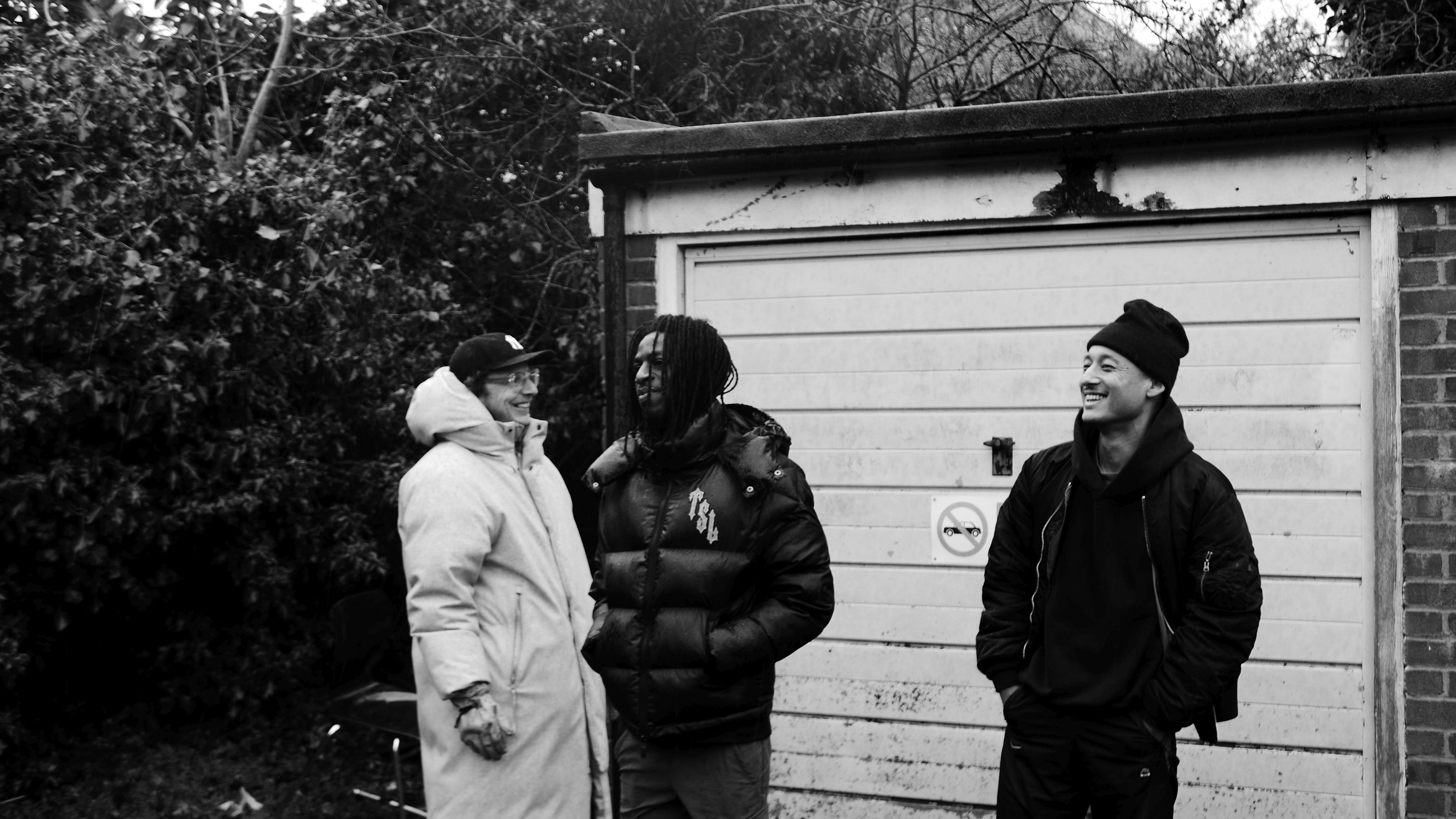
Members: Christoph Erkes (Fizzle), Christian Yun-Song Meyerholz (Fiji Kris)
Nationality: German
Current release: KitschKrieg's new album London's Calling, a collaboration with Dré Six, is out via SoulForce.
If you enjoyed this KitschKrieg interview and would like to know more about their collaborations, productions, and projects, visit their official homepage. They are also on Instagram, tiktok, and Soundcloud.
Debates around production tend to focus on gear. What, though, were some of the things you learned by talking to colleagues or through performing and/or recording with other musicians? What role does community play for your interest in production and getting better as a producer?
Fiji Kris: By being around other people in the studio you pick up a lot.
I remember one of the first studios I ever worked in had a Neve Pre Amp and I realized that it basically has two knobs, one for the input, one for the output and it sounded great. I realized good sound can be very simple and all the other stuff that was standing around wasn't even used. Good lesson.
Fizzle: Community or people you can look up too, a mentor, are very important and great obviously. You can learn a lot from other people and actually it's way more fun than learning from YouTube tutorials (which can be great too, though).
So: Go out and meet people, learn, talk to each other, ask questions. Don’t be ashamed, you don’t have to know everything and we are all just random people who came from somewhere.
Would you describe yourself as a very “technical” person with a natural affinity for technology, gadgets, electronic circuits, software, etc …? What is your relationship with technology in- and outside of music?
Fiji Kris: From the beginning, KitschKrieg has been about minimalism, which reflects in our choice of gear, “Laptop, Laptop, Lense”. Aside from a good pair of speakers and a Mic, we don’t need much at all. Knowing your Tools is important but more so they don’t get into the way of ideas.
We established a good workflow between each other that allows us to exchange ideas and take turns working on projects. We usually discuss ideas, then everyone gets to work individually, then we get together again for an exchange ... then rinse & repeat.
Fizzle: Well, me, I'm not a technical person at all. I know how to get a good vocal recording but that's pretty much it.
And for the stuff I’m doing, writing and recordings songs it doesn’t matter, other things are way more important. To get a good song going, vibe and writing and talking to each other are important and a simple recording doesn’t need much.
My recording "chain" is very simple, Neumann U87 (you don't even need that to be honest), an Apollo Interface and that’s it.
The word “production” as a separate item from “composition” suggests a creative processes with different stages. Do you see it that way – or are all the steps towards a piece of music always integrated and connected for you?
Fiji Kris: Yes. Obviously they go hand in hand in hand but they are - at least for us - two different things. Usually we compose music and then we think about who could sing or rap on it and that’s where production starts. From there, the composition rarely changes, some minor changes and customization is happening but the main composition stays the same.
The production has to to do the rest, make it fit, whit whatever is necessary. Even if it's leaving a session to buy a hookah cause the artist is missing it and can’t concentrate. Your job is to make it work, no matter what, that's production.
In terms of producing beats, the lines between production and composition (you could add in “mixing” as well) are blurred. Sound design can be as meaningful to a track as a chord progression or rhythmical pattern / sequence.
Also, we’re not skilled enough to write on a guitar or piano so the DAW serves as a writing tool at the same time.
Do you want technology and production to mainly “serve musical ideas” – or do you like to bring them to the fore and play with them?
It can be both. Sometimes it's good to leave what's ace for the song but sometimes there is a piece of music that is so strong that it's almost not important who sings on it, because the musical idea is a hit already.
In how far, would you say, was your evolution as an artist connected to the evolution of your music set-up? Were there shared stepping stones?
No. It's still one laptop with not too much plug ins and Logic.
There are artists who can realise their ideas best with a traditional – or modified – piano interface, others with a keyboard and a mouse, yet others by turning knobs or touching screens. What's your preferred and most intuitive/natural way of making music and why?
Fiji Kris: Believe it or not, most of our tracks were made using only the laptop's keyboard and trackpad.
I just love the fact that no complex setup is needed and it's all right there.
Tell me about one or two of your early pieces that you're still proud of (or satisfied with) in terms of production – and why you're content with them.
Fizzle: The song “Grauer Beton“ with Trettmann in Germany is a quite interesting pice of production and writing, that we still love to this day.
It tells the story of growing up in east Germany and how it was difficult to adapt to the new system when Germany was re united. It spoke to a lot of people, because it’s very honest and the production is clever and has a pretty iconic use of the 808 cowbell. Chris take over and explain.
Fiji Kris: In this case, we started out with that cowbell sound, which in itself consist of two notes. By pitching it around to create a melody, a chord progression almost wrote itself.
Then, that sound itself is so well known from productions of the 80s that it works as a reference, and helps to tell the story told in the lyrics.
Fizzle: We also really love what we did with Future, Mariah The Scientist & Fridayy on “Slow Down“.
It’s a really good example of the infamous KK minimalism and these three voices just float beautifully on this dancehall riddim.
Tell me about the space of your current studio/workplace and how you've set it up to optimise creativity.
Fizzle: We have a perfect sounding room left in Berlin with our ATCs and besides that, it's really just us and the laptop. You walk in, plug in to the Apollo and go. As simple as possible.
Fiji Kris: Then, there is a home studio in my Los Angeles apartment with the same pair up ATC scm45. I added a Trinnov Nova, but that’s it for equipment.
I like switching between different listening environments; The studio, Headphones, Earpods, the car.
Late producer SOPHIE said: “You have the possibility with electronic music to generate any texture, and any sound. So why would any musician want to limit themselves?” What's your take on that?
Fizzle: For us we like the limitation we set ourselves. Minimalism, a certain group of instruments (synths) & our monochrome aesthetics are a framework that we operate in.
And honestly it’s pretty amazing how much can be done in such a small world.
Fiji Kris: Self imposed limitation, ironically, feels freeing. You can get stuck in endless possibilities and even within those “limitations”, there is endless variation.
We want to tell a coherent story through our sound and aesthetics. So in order to make KitschKrieg recognisable, we like to keep certain elements consistent.
Just like a band, with the same drummer, same guitarist (and so on) on every song.
From the earliest sketches to the finished piece, tell me about the production process for London's Calling, please.
Fizzle: The current album London’s Calling was a bit of a mixture. Some of the songs you hear now started with Dré and his guitar. He wrote the songs as acoustic versions in his style and we took them and produced, almost remixed them.
Others started as beats by us and then we wrote together and recorded them. An example for this is the title track “London’s Calling“ which was done that way.
After we had the track, we went to London and recorded with 163Margs for the feature version.
Tell me about your aesthetic preferences for picking effects like reverb, delay, compression, chorus etc … - what was the role of these effects in the production of your current release?
Fiji Kris: On our latest project, generally more is less.
In the spirit of silence being equally meaningful as a sound, we don’t like to crowd the space with a cloud of reverb/ delay constantly. But when needed they’ll help build tension and release, and act as the glue between vocals and production.
In the end, audio generated in an FX send is treated just like any other audio track; its part of the arrangement, turned on & off, automated in volume etc.
Do you see a benefit in getting an external producer on board for your studio work? Do you see a benefit in recording or refining at least parts of your music in an external studio?
Fizzle: If we are working on our stuff it rarely happens and we try to figure it our ourselves.
On the other hand, of course, there is beauty in collaborating. We did a full album with Modeselektor (Berlin Techno Goats) where we did the production together and then recorded vocals and songs in Jamaica.
[Read our Szary of Modeselektor interview]
An external studio doesn’t add to what we are doing to be honest, because we are really 2 laptops and 1 lens. We don’t need more. We could use more if we wanted to, but we don’t need too, which is quite liberating.
Have you used AI or generative music tools for your own productions? If so, in which way and what did they add?
Fizzle: Yes we have and do.
We did radio edits for our album German Engineering Zwei for example.
We sketched demos with AI voices and use AI Plug ins for vocals restoration for example. It helps when vocals were recorded in different rooms and you want to get rid of reverbs and stuff. Pretty amazing possibilities to be honest.
Fiji Kris: There are a lot of new tools powered by AI algorithms and we keep an eye open for those. It's often about finding ways to (mis-)use these new tools, just like a back in the days, when a guitar amp wasn’t meant to be distorted, a turntable wasn’t meant to be scratched on.
We look at these new tools, find the knobs and see what happens when you turn them beyond 11.
We can watch videos on production, take producer courses, and exchange deep insights on gear forums. Amidst these options to improve one's chops/skills, how do you keep things playful?
Fiji Kris: There is a sweet spot of knowing your tools just enough to use them without too much friction, but still keeping an amateur-like enthusiasm.
In every field, not just music, there is the over-qualified over-thinker. We embrace being professional dilettantes.