

Name: Kneebody
Members: Shane Endsley (trumpet), Ben Wendel (saxophone), Adam Benjamin (keys), Nate Wood (drums, bass)
Interviewee: Shane Endsley
Nationality: American
Current Release: Kneebody's new album Reach is out via GroundUP.
Current event: Kneebody are currently on an extended tour through Europe. Catch them live at one of the following dates:
Oct 18 Nica Jazz | Hamburg DE
Oct 19 Blue Note Milano, IT
Oct 21 New Morning | Paris FR
Oct 22 Le Crescent | Macon FR
Oct 23 Klub Zak (Jazz Jantar) | Gdansk PL
Oct 24 Ha! Gent BE
Oct 25 Victoria Nasjonal | Oslo NO
Oct 26 Musig im Pflegidach, Muri CH
Oct 28 JazzDock, Prague CZ
Oct 29 De Doelen, Rotterdam NL
Oct 30 AB | Brussels BE
Shoutouts: Some of the people I have been most excited to hear recently are Immanuel Wilkins, Patrick Bartley and Logan Richardson. I guess I’m liking alto players these days :-)
Recommendations for Colorado, USA: If you come to Colorado I always recommend a trip to Red Rocks amphitheater. It’s one of the truly magical venues and it’s a national park that is open during the day. It’s stunning and inspiring for it’s natural beauty and for the story of it’s construction.
If you enjoyed this Kneebody interview and would like to know more about the band and their music and upcoming live dates, visit their official homepage. They are also on Instagram, Facebook, and bandcamp.
What were some of the musical experiences which planted a seed for your interest in jazz?
There was a lot of traditional jazz played in the house by my father. When I was 14 my cousin gave me a copy of Coltrane’s Blue Trane album and I was blown away.
I started going through my Dad’s vinyl collection and found recordings by Clifford Brown, Max Roach, Miles Davis, Freddie Hiubbard, etc. I was hooked.
What does the term jazz mean today, would you say?
I’m sure it’s different for everybody. The roots of the word itself are derogatory and racist and it should have gone away a long time ago.
As for the music itself, for me it is music that has improvisation and creative approaches to rhythm and harmony.
Where do most of your inspirations to create come from – rather from internal impulses or external ones? Which current social / political / ecological or other developments make you feel like you need to respond as an artist?
All of the above. There is a lot of inspiration from the political and social currents of this time. Internal inspiration is always present.
The culmination of personal experiences and emotions is what I draw on when I sit at the piano to compose.
Tell me a bit about the sounds & creative directions, artists & communities, as well as the colleagues & creative hotspots of your current hometown, please. How do they influence your music?
I grew up in Denver, CO. My parents were professional musicians and my father was my trumpet teacher all through high school. He was a brilliant musician and a giving mentor.
There was also a hub of very individual creative musicians in the area. Two of my most important mentors and inspirations were trumpeter Ron Miles and pianist Art Lande. They both made incredible music and were outstanding teachers.
What role do electronic tools and instruments play for your creative process?
Everyone in Kneebody is processing their signal with effects pedals and it is a very significant part of our sound and approach. It always has been for us.
It opens up an expanded array of sonic color and atmosphere that we draw from when we are writing and playing together.
Thanks to technological advances, collaboration has become a lot easier. What have been some of the most fruitful collaborations for you recently and what approaches to and modes of collaboration currently seem best to you?
We were able to create a movie score during the pandemic. It was one of the few chances we had to collaborate during the time of the lockdown.
Jazz has always had an interesting relationship between honouring its roots and exploring the unknown. What does the balance between these two poles look like in your music?
We engage in the roots a lot in our personal listening and practice.
We lean towards exploration and individualism in our recordings and performances.
How much potential for something “new” is there still in jazz? What could this “new” look like?
It’s endless. There can always be something new.
How, would you say are your live performances and your recording projects connected at the moment? How do they mutually influence and feed off each other?
They are very connected. Over the years Kneebody’s approach in the studio has grown ever closer to our approach to performing.
We don’t do extensive edits, overdubs, or post production generally speaking. We usually develop the music live and then document it in the studio.
The most recent recording was the opposite approach, but it is still composed of live group performance in the studio with minimal overdubbing of additional layers.
Ímprovisation is obviously an essential element of jazz, but I would assume that just like composition, it is transforming. How do you feel has the role of improvisation changed in jazz?
I suppose you could say the role of improvisation has generally expanded if you consider the beginnings of jazz improvisation being rooted in ornamenting a melody.
When we think of great jazz musicians now, we think of people who are brilliant virtuosic improvisers first and foremost.
What, would you say, are the key ideas behind your approach to improvisation?
For me personally - Beautiful sound, strong rhythm, creative phrasing and harmony.
The Montreux Festival intends to preserve its archive of recordings for future
generations. Do you personally feels it's important that everything should remain available forever - or is there something to be said for letting beautiful moments pass and linger in the memories of those that experienced them?
I’d say documenting and archiving is great.
Having that material stored for archival purposes shouldn’t impede the fond memories of an audience member. It’s usually a way to access that memory.

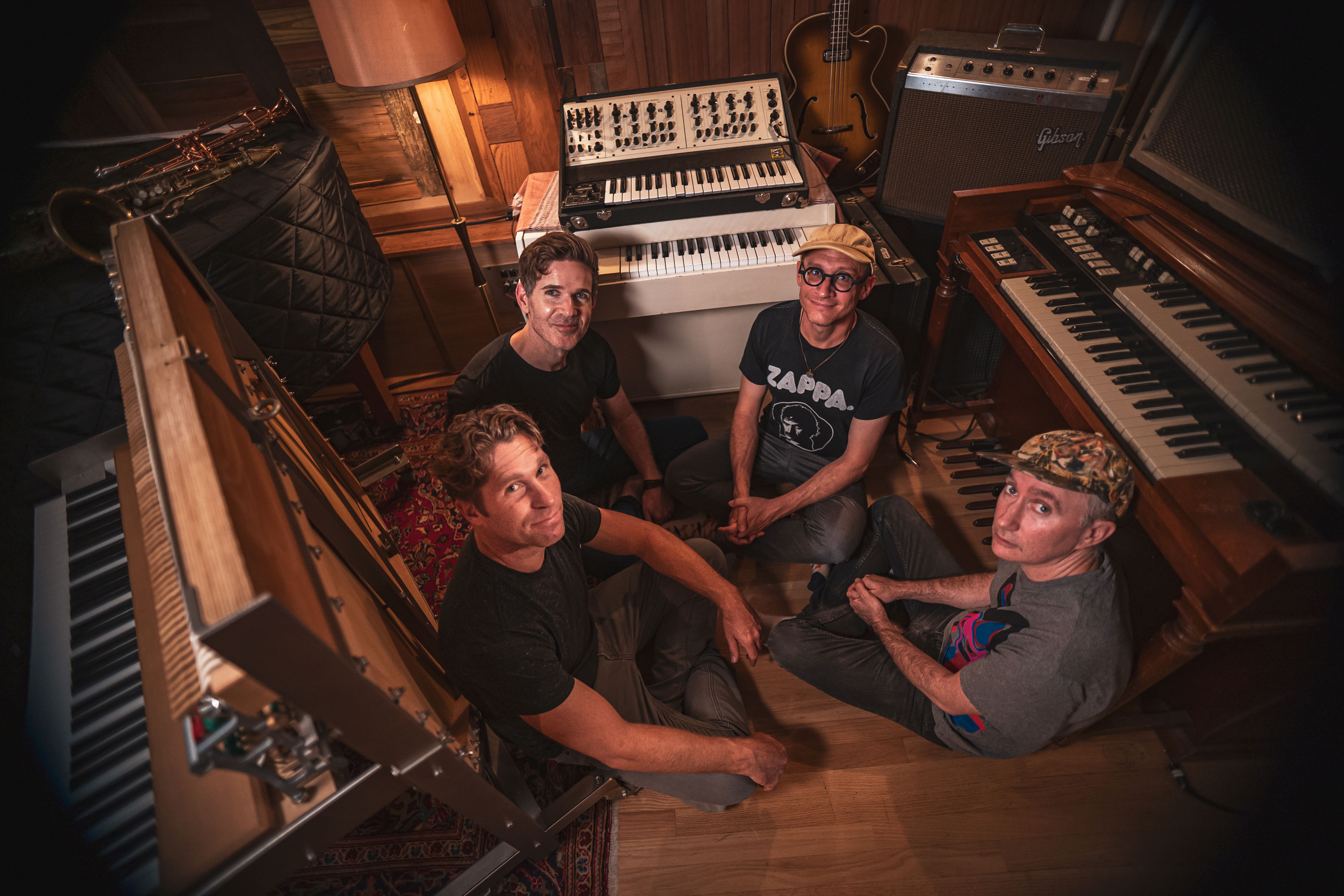 Kneebody Interview Image (c) the artists
“We engage in the roots a lot in our personal listening and practice. We lean towards exploration and individualism in our recordings and performances.”
Video
