Published
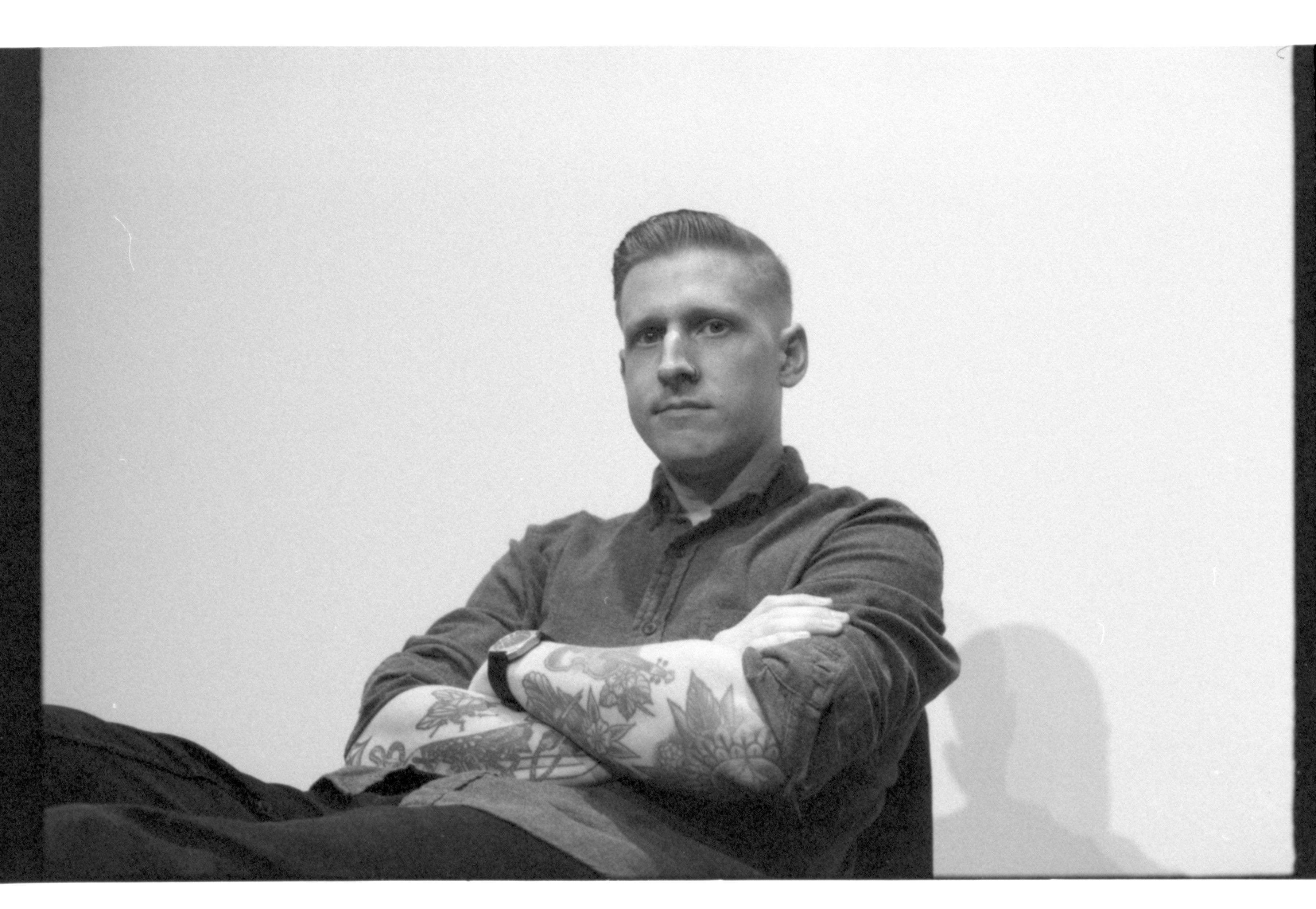
Name: Kory Reeder
Occupation: Composer, performer, label founder at Sawyer Editions and Sawyer Spaces
Nationality: American
Current release: Kory Reeder's new album In Place is out via Thanatosis.
Recommendation for Denton, Texas: Go to Recycled and do some book shopping, then get a drink at East Side, then head to Dan’s or Rubber Gloves for a show. If you’re in Kearney, Nebraska: head to Thunderhead for a Cornstalker and a Thunder Spud. If you’re just passing through: get Runza.
Things I am passionate about but rarely get to talk about: I read a ton of fiction; I’m way too into motorsports; and I recently got engaged, which I could certainly talk about for hours.
If you enjoyed this Kory Reeder interview and would like to stay up to date with his music, visit his official homepage. He is also on Instagram, and bandcamp.
The borders between producers, sound artists, and even songwriters are becoming increasingly blurry. What does being a composer mean today, would you say?
These lines are certainly blurred. I think everyone will have a different answer to this question because it depends so much on your own practice, and they are absolutely blurred within mine.
I write compositions for soloists, ensembles, orchestras, with works ranging from text scores, computer assisted improvisation environments, soundscape composition, traditional scores, and I even blur those lines within compositions.
This year, for example, I have written two orchestra pieces: one of them was traditional notation, the other had some traditional notation but was primarily poetry and text scoring. Not to mention the fact that I’m a dedicated performer and improvisor. It all depends on context and who I am working with.
Expanding the idea of “practice” even further, with the two labels I run, Sawyer Editions and Sawyer Spaces, I don’t see a huge distinction. As a producer, curator, etc. it is still a part of my creative practice.
What this means is very exciting: there are so many ways of being involved in music-making: playing, performing, writing, show-running, concert organizing, all the way to working the sound booth and working the door at shows. All of that forms a creative practice.
So, for me, it is all about being a musician and living a creative lifestyle. Perhaps “composer” is too granular, but perhaps “composer” is just a part of that creative lifestyle.
Many people perceive classical music and contemporary composition as having high barriers of entrance, both for listeners and musicians. What have your own experiences been in this regard?
To me, this question sets up a few things: there are, of course, often systemic barriers on many levels of training and access for folks in addition to cultural expectations around that training as well as within the institutions. This topic has been talked about by a lot of people much smarter than me, and a full discussion of this goes well beyond this forum.
But what I want is for folks to explore and find new music that draws them – whatever that may be or sound like – without being gate-kept by expectations either systematically imposed on them or within themselves. This is easier said than done, of course, but the need to explore and express my ideas has always been what draws me to music making. It is partially why I went from playing in hardcore bands to experimental music and composition: that’s what I was drawn to and what I felt I needed to explore and create.
With access to the internet, it is my hope that folks can come across or find the music that I make and take part in it and get something out of it – either pleasure, challenge, or stimulation, all of which I consider valuable.
At the same time, we as creators and teachers and anyone with a mentorship role need to welcome folks from all walks of life: nominally we do that, and many of us like to think we’re doing as much as we can, but we need to be self-critical and continue to work, listen, and grow in a way that welcomes folks and allows them to find their place and voice regardless of aesthetic.
From my perspective, it’s all about making music that I want to listen to, and I don’t think anything I’m going to come up with is so out-of-context that literally nobody else will get where I’m coming from. So, I hope people find something to connect with no matter their background.
As of today, what kind of materials, ideas, and technologies are particularly stimulating for you?
I have always been extremely attached to harmony and my harmonic language, but at the moment I’m in something of a transition phase. I’m trying a lot of new ideas and coming to the end of a lot of old ones and spending a lot of time reading and trying new things.
I’ve been interested in increasingly blurring the lines with scores and written prose. At the same time, I’ve been re-visiting older forms and traditional ideas like my last album Homestead.
That said, I’ve been exploring increasingly textured sounds and modes of music making. I’ve also been spending a lot of time this year touring and revisiting some old work, which has brought a lot of joy (and some embarrassment).
Where do most of your inspirations to create come from – rather from internal impulses or external ones? Which current social / political / ecological or other developments make you feel like you need to respond as an artist?
It’s hard to say exactly where ideas come from, and they really can come from anywhere and anything. I think a lot of my ideas come from listening, but also from reading: I listen to a ton of music and read a lot of fiction, nonfiction, and poetry; I am an amateur photographer, I write, I work at a venue, I’m extremely chatty … all of these things can inform my work.
More than anything, I try to be receptive to my own imagination, and if I get an idea for something I try to follow it through and see where things go. There’s no real rhyme or reason, but when an idea comes to you, you might not have any idea where it comes from in the first place but it doesn’t matter to me: I don’t think creativity is hierarchical like that. I think it’s rhizomic (but I wrote a whole dissertation about that, if you want more on that).
The second half of this question is a bit trickier. I think everything feeds into your practice in some way, and I think every gesture has a political connotation: to be “apolitical” is in itself a political act. To ignore the social spear is a political act as much as ignoring ecological crisis is an ecological decision.
Social/political aspects deeply inform my work: from the way scores are interactions with people, to the way I run my labels, to my ideas of “community,” and ecology and history informs my work from my field recording work, my label Sawyer Spaces, and history informs my recent exploration of American settler colonialism and my positioning within it.
Tell me a bit about the sounds & creative directions, artists & communities, as well as the colleagues & creative hotspots of your current hometown, please. How do they influence your music?
Denton, DFW, and the greater Texas scene is full of amazing artists doing amazing things. Rubber Gloves, Wild Detectives, New Media Contemporary, Dan’s Silverleaf, are all places I frequent which each host an amazing amount and variety of music.
More than anything though, I often think of my hometown Kearney, Nebraska and the DIY scene I was part of there and how that has influenced the way I tour. I think everywhere has potential for amazing work, and amazing things are happening around every corner but these zones might get overlooked because they are either too rural, not cosmopolitan enough, or just not on people’s radar.
In 2024 one of my favorite shows was in Jackson, Mississippi, and in 2025 one of the best artistic experiences has been in Matfield Green, Kansas (a village with a population of 52, but home to the Tallgrass Residency).
While I was in Matfield, I picked up a copy of PrairyErth: (a Deep Map) by William Least Heat-Moon which is about 600 pages all about Chace County, Kansas (population 2,572). A "deep map" is a detailed, multilayered representation of a specific place that goes beyond just physical geography. It integrates cultural, historical, emotional, ecological, and personal dimensions to provide a richly textured understanding of a location.
I think everywhere has a deep map, you just have to listen and learn.
Composing has always had an interesting relationship between honouring its roots and exploring the unknown. What does the balance between these two poles look like in your music?
I’m not very interested in “honoring the roots” of composition.
For me, a lot of this comes from what I call a “death cult” that is pretty ubiquitous in the conservatory-trained mindset, which is still heavily influenced by modernist modes of thinking and often conservative to a fault. At the same time, I think unhinged exploration can be extremely personally fulfilling, but not always artistically satisfying.
The way I write music changes depending on who I’m working with, but I can only create in ways I know how to create, using the tools I know how to use; I can learn new ways, yes, but that will depend on the situation.
Like I said earlier, I want to create the music I want to listen to and work with people in the modes that best fit that situation. There are times when this calls for exploring the unknown, and there are times when this calls for doing my thing the best way I can.
How much potential for something “new” is there still in composition? What could this “new” look like?
There is so much potential for new voices and new ideas in composition, as well as finding “new-to-you” voices and ideas that might be just as exciting and productive.
I couldn’t prescribe what “new” would look like: I want folks to find their voice and show me that thing that makes them unique and new.
Working with long forms, complex concepts or new vocabulary is potentially more challenging today because they require us to remember things that happened perhaps minutes ago – while most of us are finding it hard to focus even on what's happening right now. Both as a composer and as a listener yourself, how do you deal with this?
Perhaps, but I’m also the guy that wrote a 24-hour long piece (and have several other pieces ranging from 45 minutes to 9 hours).
I empathize with the attention-economy, but I think this is a biproduct of capitalism and a need to consume more and more “content” which often renders folks an inability to thoughtfully engage with the things they love. Unbinding your mind from this takes work, but I’m as guilty as anyone for brain rotting on my Instagram Reels from time to time.
Still, if there’s something you want to do or be part of, it takes work and it takes time to give that full attention. I’ve told my students: “if you can’t be bothered to listen to your whole piece, why should I be bothered to listen to it?”
These huge pieces of mine weren’t explicitly made to go against the logic of the attention economy, but I’m happy to go against that logic for the work that I care about. I love long pieces, I love long books, and I love to see artists really stretch their legs into a big artistic statement.
When I see a composer has a piece that’s 25 minutes long, for example, I get excited because I know that the composer is going to take me somewhere rather than show me something.
For many artists, life-changing musical experiences take place live. Few works these days, however, are performed beyond their premiere. What, do you feel, does this mean for composers, and the music they write, and how does this reality influence your own work?
I’m not sure what this means for other composers, but I came from a rural town far from any strong experimental or contemporary scene. This meant that recordings of music and access to materials online were essential for me.
Because of this, I have an immense preoccupation with making recordings of my work and making myself easy to find – my parents blessed me by spelling my name the way they did (it’s made me extremely Google-able). If someone comes across my work and they want to find more, it’s very important to me that it is easy to find more and explore my work.
So, I spent a lot of my time making recordings of my work and a lot of these pieces have never been performed live in the first place. I will always prefer live experiences to recordings, but sometimes that’s not possible, and sometimes folks can’t be there.
So for me, the more people that can engage the better.
To some, the advent of AI and 'intelligent' composing tools offers potential for machines to contribute to the creative process. What are your hopes, fears, expectations and possible concrete plans in this regard?
This is something I’ve really been struggling to come to any concrete conclusions on. On the one hand it is horrifying, and on the other hand it is exciting.
More than anything, I don’t want AI to substitute for the human ambition to be creative and make creative decisions, nor do I want it to ever substitute for one’s ability to think critically. These things can be tools, but they shouldn’t be a substitute for your own mind.
The ecological and economic implications, on the other hand … that is something I am deeply worried about.
The Montreux Festival intends to preserve its archive of recordings for future generations. Do you personally feels it's important that everything should remain available forever - or is there something to be said for letting beautiful moments pass and linger in the memories of those that experienced them?
I love and understand both perspectives here.
I love archives, libraries, museums, repositories, etc. and it is a real blessing to have tools like the internet to access to much music, art, literature, ideas, and history. I think collections – from archives to ephemera – are invaluable pieces of human history and culture, and I think this warrants the hard work folks put in to archiving and saving material, especially if it is available to the public and not gate-kept beyond the light of day.
At the same time, the ethereal quality of passing moments, performances, words, and images can hold deep power for the lucky few that experienced them. I don’t think watching a whole concert through your phone is a worthy endeavor: be there, and be present.