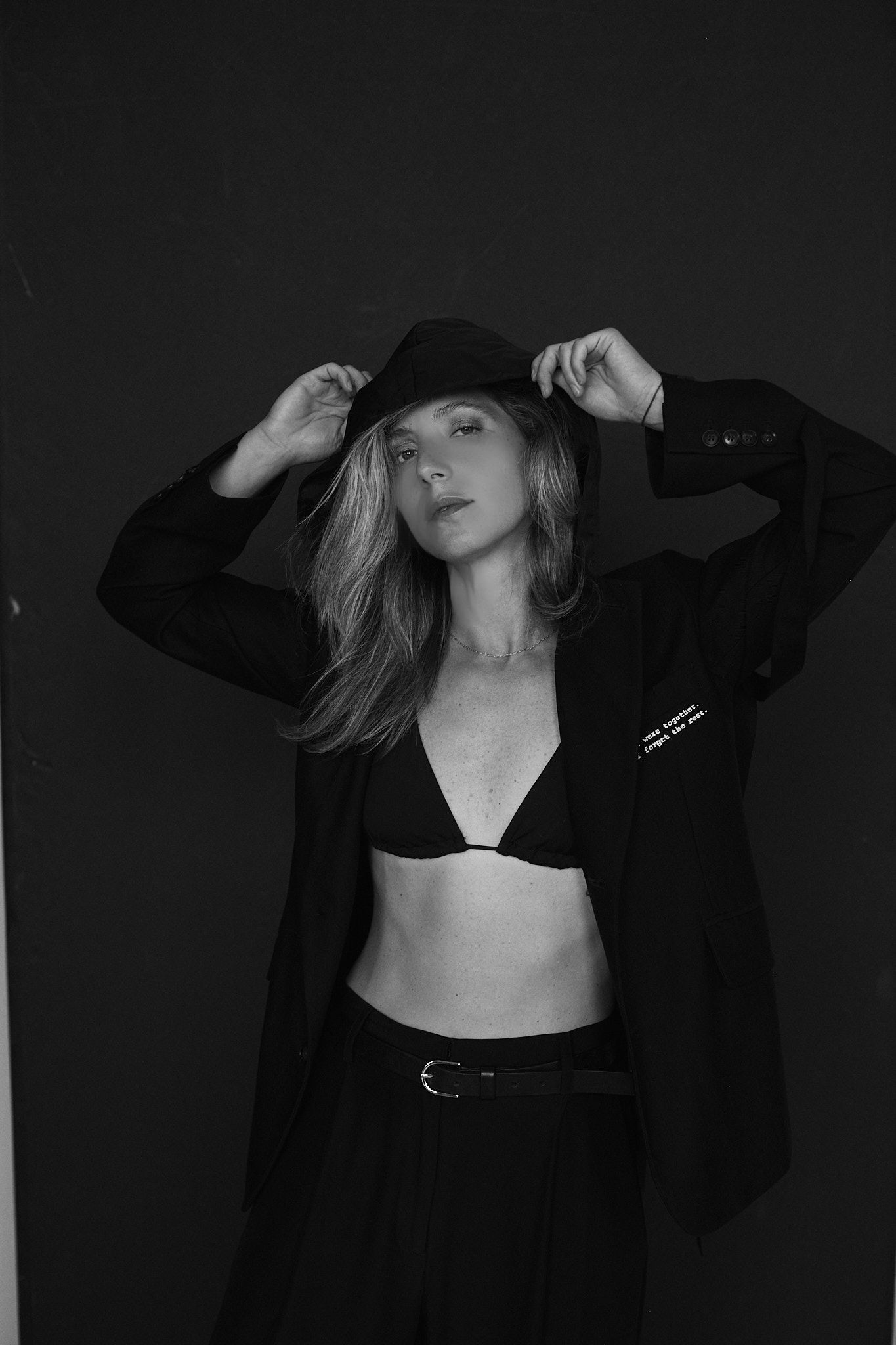
Published
Name: Alana Michelle Josephs aka Lanz Pierce
Nationality: American
Occupation: Rapper, songwriter, entrepreneur, agency founder at Luminary
Recent release: Lanz Pierce's new single "GET IT" is out now via Luminary.
If you enjoyed this Lanz Pierce interview and would like to stay up to date with her music, visit her on Instagram.
Your early years in the music business look like a wild and fast ride. With some hindsight, do you feel like they solidified and strengthened or rather questioned your love for music?
Those times definitely strengthened the love. Young, wild, and free!
Yes, those days I treasure—everything was so new. I was doing exactly what I wanted, my way, with the legends I dreamed of. The makings for a good film. At 17, I had zero fear, zero hesitation, simply because there wasn’t much life context or contrast yet. As an adult, I realize now how much our inner story plays such a significant role in our decision-making.
There was a time I stopped making music because I was angry at my deal not yielding the stardom I imagined. It’s hard to stay away from anything you really love for too long. I questioned my place in this game and, like any person who meets with what feels like resistance, you second-guess yourself—that’s good. It’s when the iron in the fire becomes the sharpened blade.
When you come up in the music business young, you’re thrown into the deep end fast. It can either break you or define you. I eventually channeled the frustration, the passion, the pain and the hunger to prove myself into fuel. I learned patience, business acumen, and how to stay authentic to my craft when everyone is telling you to be who they think you need to be in order to thrive.
Today, it’s all about building something that lasts and enjoying the ride.
Some people might consider producing and releasing music independently from a major label a step back. For you, it seems to be the other way around. How do you define success for yourself when it comes to your music?
I can understand that—perhaps there’s even some truth to it on a certain level. The world validates credibility by association with recognizable names, and having a machine behind you with capital and influence certainly allows for a bigger chance at success.
When you don’t have that, though, what do you do? There are only two choices—remain idle and do nothing, or stop at nothing until you win. Red or blue pill moment. I don’t know how to sit still.
Success for me is freedom—creative freedom, financial freedom, being in control of your time, and ultimately ownership. Being independent allows me to call my own shots, to release music, and to build my brand and catalog as an asset. It’s not about charting the traditional path; it’s about longevity and control.
It is still fairly rare for most musicians to pursue a “commercial” career at the side of their musical one. In hip-hop it’s pretty common. How do you explain this intimate connection between hip hop and business?
Hip-hop has always been entrepreneurial. From day one it was about creating value out of the available resources you have—pressing mixtapes, throwing parties, selling merch, hustling. The culture itself is built on that hustle and leveraging the community around you. The streets will mobilize faster for a representative of the people rather than a corporation.
Look at our current icons and moguls, Jay-Z being the most relevant to highlight. “I’m not a businessman, I’m a business, man” said it all. The ownership of utilizing your own brand and what you stand for is the difference between being paid for your time, which will always have a threshold and a going rate, versus being compensated for your IP and your creativity.
Hip-hop took the from-nothing-to-something soul and brought it to the world stage and then into the boardroom. Michael Jordan told Nike, he had to have ownership of his likeness, the jumpman that they use to sell Air Jordans, that's a check ( pun intended ) in perpetuity!
It makes sense that artists in hip-hop naturally translate into business. The two worlds feed each other. I am absolutely a product of that teaching.
Can you tell me a bit about what sparked your interest in brand building and how Luminary was founded?
Founders of startups and Series A companies have adjacent pain points to artists on labels. You get signed to a record deal, or a VC makes an investment, that's just proof of concept capital, and it's all recoupable. The artists must pay back the label on first monies in, the startup founder and the VC need to return LP dollars.
I looked at my own story and understood the importance of team, the real goal for artists and founders is to find product market fit, aka connect with their buying audience.
I built Luminary as a natural extension to my creativity, first as a production company, I directed music videos and brand campaigns, and built production teams. I’m a highly effective operator, I manage budgets well, build vision and concepts, bring together the capable creatives to execute and deliver.
I got close to happy clients who wanted more, they wanted me to become a fractional COO or CMO as part of their teams, build their marketing, their digital assets, execute strategy and increase their revenue. At some point I recognized that every company reaches an inflection point where they need more capital to keep the lights on and scale.
Luminary now functions at the intersection of brand capital and deal flow matching high-potential companies with thesis aligned investors.
Luminary refers to itself as a “brand incubator.” What does this mean in practice?
Incubation means we don’t just design a website, or logo and walk away—we help shape the DNA of a brand from the ground up, or help institutional companies re-brand to deepen their impact and engagement. That includes identity, story, positioning, investor relations, and long-term strategy.
We’re building with founders at critical stages, so our work is important, it's valued, and it's about helping leaders finetune their vision and voice to result in scale.
Luminary has an impressively broad brand portfolio. What is the common thread with all these brands, especially when it comes to tech?
The common thread is vision. We partner with smart innovative people. Brands that have breakthrough ideas and real cultural relevance.
Especially in tech, it’s about humanizing innovation—translating complex products into stories people can connect with. Whether it’s music tech, marketplaces, AI, or consumer brands, the through line is clarity, elegance, and emotional resonance.
You clearly have a very deep sensitivity for what brands need. My impression is that your musical background is related to this. What makes musicians so particularly gifted at understanding what brands need?
Musicians are storytellers. We know how to take emotion and translate it into an experience people feel. Branding is the same—you’re creating an emotional resonance around a product or company.
Musicians also understand the power of the audience instinctively: we’ve lived and breathed connecting with people on a deep level. That makes us uniquely equipped to understand how a brand’s offer can do the same for its consumers.
Musicians are also increasingly involved as designers and creative advisers for many brands. From your experience, what makes for a good match between a brand and an artist?
Authenticity. If the collaboration feels forced, the audience feels it immediately.
A good match happens when there’s alignment in values, aesthetics, and story. When an artist truly believes in the brand and the brand respects the artist’s vision, the result is magic.
For you personally, how does the creative work you do within the tech-oriented, brand-building context of Luminary compare to the creative work in the studio?
It’s the same muscle, just different instruments.
In the studio I’m crafting sound and lyrics, using my flow and unique identity to tell my story. At Luminary I’m shaping visuals, and messaging, to empower a brand’s story through design and strategy.
Both require intuition, and vision. Both are about creating something that didn’t exist before.
When it comes to a new brand campaign, what do you usually start with?
A compelling narrative and north star—otherwise the visuals and campaigns fall flat. Once we have the why at the center, and the what and how anchored, everything else—design, copy, investor messaging—flows from that center.
I took a look at your past references and all of them share a strong sense of unity between design, images, text, and product. What role does music play here?
Music is rhythm, harmony, unity. That sense of cohesion is ingrained in me from making records. I have certain aesthetics I’m deeply inspired by—filmmaking where the beginning starts with the end, and we watch it in reverse, putting the pieces together and allowing the audience to play a role in what they think the story is saying.
French Noir—I love a black-and-white opacity on top of visuals; it automatically makes it nostalgic. Color as a foreshadowing tool—both Hype Williams in BELLY and Quentin Tarantino in Kill Bill do that so perfectly. And using tight shots into the eyes or lips of a subject to create intimacy and take the viewer out of the observer's perspective into the first-person participant—like it’s them.
And lastly, of course, music as an indelible character itself. Look at Drive with Ryan Gosling & Eva Mendes—just long silences with no dialogue, and epic music and sound design carried scenes and kept you engaged.
So you see, it’s all a similar discipline—from music artistry to branding—making sure the visuals, the words, and the product you create resonate.
The tune.fm campaign was particularly remarkable. Can you very briefly explain your strategy? How do you convince people to invest in a market that many claim is not financially viable?
We positioned Tune.fm not just as a music platform but as a revolution in how artists and fans engage, both as a streaming platform and a marketplace.
The strategy was to make Web3 feel accessible to anyone, so we removed words like crypto, blockchain, and tokens, and focused on marketing it like a platform similar to a jukebox—allowing you to simply buy credits to listen to artists and pay them directly. Every time you listen, the credits you bought go directly from your wallet to the artist’s wallet—no middleman.
We empowered artists to truly own their brand and utilize the marketplace to sell merch, tickets, backstage passes—ultimately giving fans more direct access. I wanted to show the bigger picture: the shift towards ownership, micro-payments, and Web3 as a means to settle instant music royalties.
Many are sceptical about tokens as a means of empowerment for artists, myself included. What is your view of them today?
Skepticism is healthy.
Tokens alone aren’t the solution—it’s about how they’re implemented, the utility. When used correctly, they allow for transparency, they can give artists control, and new revenue models. But they have to be backed by solid infrastructure and community, otherwise they’re just hype.
Technology can be used as a tool to take away rights from artists or to ensure them. You know both sides of the equation – where do you feel the industry is moving towards?
I believe the momentum is moving towards decentralization and ownership—but it’s about education, unfortunately my creatives don’t know how the systems they depend on work. That means others can control you.
If you want to be in a position of leverage you need power, and that starts with knowledge. I believe artists and innovators will keep pushing for that outcome and then we need policies to support it. The future will mean more automation, the artist’s that use this to their advantage will win.
You’ve been extremely productive in 2025 and 2024 with three new singles. What’s next for you?
More music, always. I’ve got new projects in the pipeline, exits in the either, collaborations I’m excited about, and I’m continuing to grow Luminary alongside it.
For me, it’s about keeping both worlds booming—the artistry and the business—and showing they don’t just coexist, they elevate each other.