Published
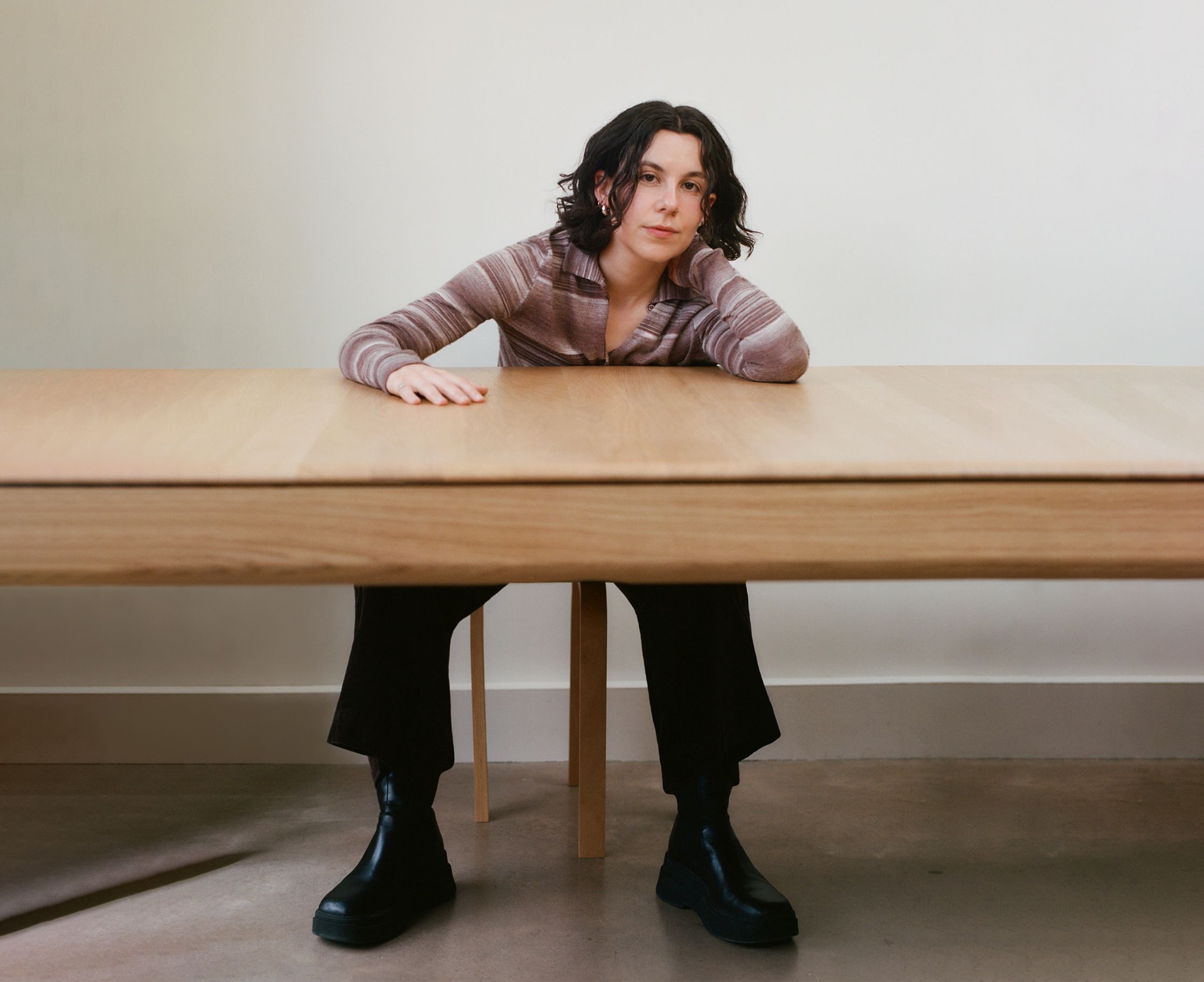
Name: Tilly Scantlebury aka Lazy Day
Nationality: British
Occupation: Singer, songwriter
Current event: Lazy Day's new album Open the Door is out via Brace Yourself.
Recommendations: Go look at the huge multi-media paintings by Mickalene Thomas, or the latex sculptures of Louise Bourgeois, or the large format photographs of Catherine Opie.
If you enjoyed this Lazy Day interview and would like to know more about their music, visit their official homepage. They are also on Instagram, tiktok, and Facebook.
Do you think that some of your earliest musical experiences planted a seed for your interest in writing lyrics?
One of my earliest memories is sitting in the back of the car listening to Joni Mitchell. My parents in the front and my two brothers either side of me. My mum knew every word, and sang them loudly.
The importance of the words was obvious, even then. Not necessarily because I understood them, but I understood how much they meant to my mum.
What were some of the artists which inspired you early on purely on the strength of their lyrics?
There are so many different styles and modes of lyric writing, but some of my favourite lyricists are: Elliott Smith, Sue Tompkins (Life Without Buildings), Adrianne Lenker, Karen O.
Entering new worlds and escapism through music and literature have always exerted a very strong pull on me. What do you think you are drawn to most when it comes to writing?
When words can put you in someone else's position, and allow you to see from another perspective. When words feel specific enough to be true, or weird enough to be transportative, or sad enough to be effective, or banal enough to feel present.
How do you see the relationship between words and music?
I don’t think there’s an intrinsic link between the two, but they can definitely be great friends, or even adversaries — working with or against each other — either can be productive.
When working on music, when do the lyrics enter the picture? Where do they come from? Do lyrics need to grow together with the music or can they emerge from a place of their own?
It really depends on what song I’m writing.
I’ll often start the lyrics writing process by just humming or mumbling or talking gibberish, focussing more on the melody and rhythm rather than the words themselves. But sometimes during that process full phrases can come out, like a great surprise from the back of my brain.
Most of the songs on Open the Door are very short, but the shortest one is the final song on the album called “All The Things That I Love,” at just 1 minute 15 seconds.
I’ve always enjoyed the economy of words, making them count, but for that song I chose the words carefully, line by line, needing to get it just right.
Do you feel like the music triggers specific words inside you? Or is more of a feeling or a memory? Would you say there is instantly an entire idea in front of you or does the story grow as you keep listening to the music?
With a song like “Concrete” from the album, I was really writing lyrics that are like snapshots that actually happened. But rather than tell the full story, I wrote in vignettes of the actualities whilst leaving some gaps or absences.
I’m excited by lyrics that feel capacious and abstract at the same time as feeling really particular.
When you're writing song lyrics, do you sense or see a connection between your voice and the text? Does it need to feel and sound “good” or “right” to sing certain words?
Some words are just really fun to say, or feel really good to sing.
I found that throughout the album I’m often answering and asking a question, like there’s certainly a connection between my voice and the text, but that the subject position is unstable, or likely to change.
This is definitely true of ‘Falling Behind’ where I sing: “You don't wanna be mad, do you? / I just feel like I'm falling behind.”
How far are you consciously aware of the meaning of the lyrics you're writing during the creative process? Do you need to have a concrete concept or can the words take the lead?
Sometimes I’m not aware at all, until well after the fact. Like with a song on the album called “Not Now,” the meaning of the words became clear to me after I’d recorded it.
But other times, the words are driving the songwriting, like in a song called “Squirm” from the record: I had a strong image of myself as this sad, pathetic, wriggly worm, and so I wrote just that. I didn’t need to mince my words.
How do you see the relationship between harmony, rhythm and melody? Do you feel that honing your sense of rhythm and groove has an effect on your lyrics-writing skills?
I love playing with the rhythm of words, especially with the groove of the drums. The interaction between the kick drum and the pattern and syllables of the words is a big technique of my songwriting process.
Creativity can reach many different corners of our lives. Do you feel as though writing or performing a piece of poetry is inherently different from something like making a great cup of coffee? What do you express through music that you couldn't or wouldn't in more 'mundane' tasks?
How cool that art can transcend the day-to-day of life, but how wonderful when it can embed itself within it, too.
Open the Door as an album is situated within the domestic, but in a way that is also concerned with imaginative thinking, dreaming big, being optimistic and future-focussed.
I don’t want to draw stark lines between the mundane and the brilliant, I think that both can be both.