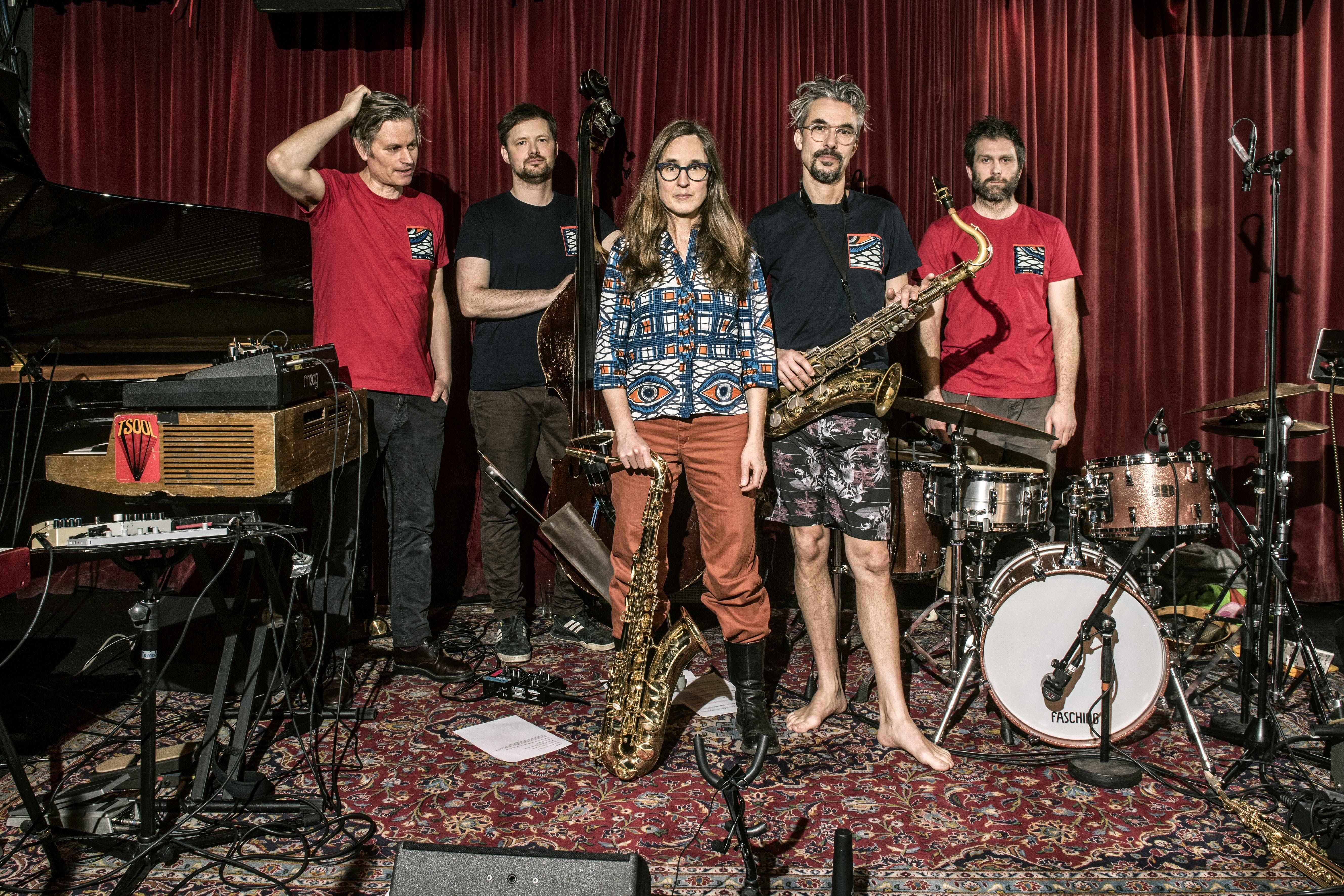
Published
Name: Lina Langendorf
Nationality: Swedish
Occupation: Saxophonist, composer, improviser
Current Release: Lina Langendorf assembles her band Langendorf United for their new album Undercover Beast, out now via Sing a Song Fighter. It features Lina Langendorf (compositions,saxophone), Daniel Bingert (keys, guitar), Martin Hederos (keys, viola), Ole Morten Vågan (double bass), Andreas Werliin (drums)
Recommendation for Stockholm, Sweden:
1. Fasching! Amazing venue with top concerts. A beautiful vibe coming from both the stage, the audience and the fantastic people working there.
2. Svedjan Bakery (best coffee, cardamom buns from heaven and an amazing staff).’
3. Kulturfestivalen. A festival filled with music, dance and art. With artists from both Sweden and abroad. Taking place in the middle of august and it is totally free/no admission.
If you enjoyed this Lina Langendorf interview and would like to know more about her music and upcoming live dates, visit her official homepage. She is also on Instagram, and Facebook.
What were some of the musical experiences which planted a seed for your interest in jazz?
When my parents brought me to the local jazz club in our hometown Härnösand.
Although a very small town (25 000 inhabitants in the whole county) the club was known and celebrated for being very forward thinking/contemporary. I was blown away by the different live experiences I got there as a child.
All the different mix tapes that me and my friends made for each other when studying the music program at highschool. And of course the music that the teachers shared with us. It opened up new worlds in music for me.
What does the term jazz mean today, would you say?
I always carry Wayne Shorter's wisdom words with me. ”Jazz means - I dare you!”
For me that also includes to dare myself to throw myself out into something that for me is still unknown.
As of today, what kind of materials, ideas, and technologies are particularly stimulating for you?
Oh there are many things. It can be a groovy bicycle elevator sound or a freezer in the supermarket that is kind of broken and therefore sounds as if it sings a number of different chords (it turned out that another musician had noticed that, too, and recorded it as well lol). One day when walking by a tree where a bird sat and started singing I even said ”Yeah” out loud because it was so groovy lol.
When it comes to technologies I always get very inspired and stimulated by listening to the people that master the music, although I have no knowledge about it myself. Maybe one day I will find my way into that world and start using it as part of my own playing too …
Where do most of your inspirations to create come from – rather from internal impulses or external ones? Which current social / political / ecological or other developments make you feel like you need to respond as an artist?
Music, as in bass lines, melodies or riffs, often comes to me when I’m out walking or riding my bike. Or suddenly when waking up in the morning.
Like with the melody of “So-Ma-Li.” I got so inspired just by seeing the band members of Langendorf United, so there was music coming to me all of a sudden some days after.
So it is an ode to the four other band members Martin, Daniel, Ole Morten and Andreas (MDOMA) since they give me so much inspiration by their pure existence.
Apart from that, I get very inspired when going to concerts. To just be in music as it is created in the moment.
When it comes to different developments we have a saying in Swedish, ”the big in the small” which also can be translated to meaning that making a small change where you are at this very moment, makes a big change in the long run. I keep that with me wherever I go in my everyday life.
Music in itself has an enormous power in different ways. It can make hope blossom. I believe that we as humans need to nourish faith and trust in each other and music has that power. To unite people and give us strength. In that way music is political in itself (whether you want it or not). Music is the healing force of the universe! Wisdom words and music from Albert Ayler.
Tell me a bit about the sounds & creative directions, artists & communities, as well as the colleagues & creative hotspots of your current hometown, please. How do they influence your music?
I love the legendary jazz club Fasching and I go there to absorb live music at least once a week. I would say that this is what influences my music most. To listen to artists from many different places in the world (Stockholm artists included) when they play live. To get inspired by the different stories that they tell.
The best thing is when venues book artists from many different genres/ don’t just focus on a certain genre. In that way, the chance of people stumbling over some music they did not know about or did not think that they would like become so much bigger and that is beautiful.
Stockholm is a big city (for being in Sweden) so of course there are many different venues. Slakthusområdet and Kollektivet Livet are two other places that have started up quite recently and where you will find a lot of inspiring concerts happening. Sara Parkman and her Supertraditional (both record label and arranging concerts) have started a beautiful concert series (mainly folk music) and so has Källarbyn.
There (at Källarbyn) I went and listened to Aloghte Oho and his Sounds of Joy. That was kind of surreal since an international artist/band like that usually play in much bigger venues. Now it felt as if I was back in Bamako at one of the venues where all the super star musicians were standing there playing on the same floor as the audience was seated (so no high stage what so ever).
What role do electronic tools and instruments play for your creative process?
The voice memo on the phone and a music program in the computer is like a treasure trove (and rubbish bin lol) for all my ideas.
Either recording me singing or playing the saxophone as these ideas can pop up very suddenly (the entire song “Hymn” came to me all of a sudden when out at sea, so I sang the whole theme into the voice memo right there and then). I also use a midi keyboard to record some bass lines on the computer.
So all the music I send to the band are very simple demo versions of the songs, with just saxophones and a midi bass (maybe I’ll have added a shaker too but not always). It is the core of the song and then, when we meet up in the studio together, we paint the full body around this core.
So both our albums were created that way. Everybody listens to the demo versions on their own, I might have sent some ideas about instrumentation with these demos and then we meet up in the studio and play these songs together for the first time as we record them.
Last time we recorded I sent the last demo (“Cesária”) 1 1/2 month before the recording session and then some ideas about the form of each song came two weeks before the recording session. Andreas (the drummer in the band) thinks we should release these demo versions too one day, since they sound quite funny and raw due to how I record them.
I love all the synthesizers that we have in the band but so far I have to leave it to the other guys. They are very passionate about it and always have a big devotion about finding new sounds for each album.
For some reason I don’t have the patience to sit down and dig deep into the electronic tools/ instruments myself. I sure do wish I did …
Thanks to technological advances, collaboration has become a lot easier. What have been some of the most fruitful collaborations for you recently and what approaches to and modes of collaboration currently seem best to you?
It sure is amazing with the technological advances and how we can send recordings to each other from one side of the world to the other.
Some of the collaborations I have been part of, like the song ”La Musique Du Cœur” with Assiko Golden Band De Grand Yoff would never have happened if it wouldn’t have been for this technology.
The same with the Yorkston/Jaycock/ Langendorf-album. It would not have happened if it wouldn’t have been for this technology.
I must say though, I prefer to be present at the same place together with the people creating. There is something with that vibe and also to be present in the same room, at the same moment when the music unfolds.
Jazz has always had an interesting relationship between honouring its roots and exploring the unknown. What does the balance between these two poles look like in your music?
In any music genre I believe in honouring the roots by listening to and learning from the maestros that have created something new with their musical expression. That wisdom will eventually merge with our own expression and makes way to continue to develop our own sound, to explore and find new paths.
Just by listening to music we get very influenced from both tonality and rhythm whether we think about it or not. Including all the music that our parents listened to and therefore we also listened to as kids.
I just realized the other day that the bass line in the “Hope” part of the song “Prayers, Faith and Hope” sounds as if it is very inspired by the sound and rhythm of Hassan Bahs kongoma (a legendary percussionist that also plays this instrument that in Guinee is called kongoma) and whom I have played a lot with here in Stockholm since 2010.
For me music is all about sound (rhythm incl.). When composing I might be searching for a certain vibe in a melody, to an already existing bass line idea of mine, so then I will start listening for a certain voice or a certain mode.
Like in the songs “Alemayehu,” “So-Ma-Li” or in “Undercover Beast.” I could hear Alemayehu's voice singing as this melody unfolded through me.
With “So-Ma-Li” it was first a choir of Somalian woman singing in my head and then when the B-part came to me many days later, all of a sudden I was hearing female voices singing more in the Mali tradition and telling a story about the amazing MDOMA.
“Undercover Beast” started with a bass line. Then I was looking for a melody to express a certain mode/a certain story in the beginning of the song when it is just saxophone and bass. It took some time but all of a sudden I found it.
How much potential for something “new” is there still in jazz? What could this “new” look like?
I believe there’s always potential for something new in music, whether it is jazz or any other genre. As long as curiosity is with you, new things will sprout and blossom.
What this new looks like is of course hard to predict but I sure am curious about it and love to be surprised by it each time that it happens.
For many artists, life-changing musical experiences take place live. How do you see that yourself?
I remember my first trip to Bamako. Hanging out with Toumani Diabaté and his band at Toumani's club Le Hogon (it was outdoors). Playing together with the band and also attending as an audience. If there would have been a roof it would have lifted by the energy and the groove created there and then, including the warm and joyful atmosphere. There was a feeling of unity. An ecstatic vibe.
From that day my musical path changed completely and eventually took me to where I am now, which sure is life-changing.
The first release concert with Langendorf United was a life-changer, too, indeed. Our first gig ever as a band and the second time we met all the five of us and played together (so no rehearsal whatsoever). How we connect with each other and with the audience feels mindblowing. The people in the audience where blown away and many of them expressed to us that this was one of the best concert experience of their whole lives.
Now, 2 1/2 year later, there are still people coming up to me to express their gratitude for this experience that we gave to them and that we shared together.
How, would you say are your live performances and your recording projects connected at the moment? How do they mutually influence and feed off each other?
When it comes to Langendorf United we have the same vibe in the studio as when playing live. We have the core of the songs and then we throw ourself out into the unknown with complete devotion.
Humor, playfulness and curiosity play a big part in our approach to music. As well as an urge to become one/to unite in the music. When playing live that includes the audience too, of course, and that is kind of a spiritual feeling, when the band and the audience unite in this musical journey together.
What, would you say, are the key ideas behind your approach to improvisation?
I want to tell a story. To give up myself and let music speak through me.
When recording From "Longitude to Lassitude - Lullabies and Laments" and listening to it in the control room, Andreas (the drummer) said it was as if I was preaching with my saxophone in the solo.
The Montreux Festival intends to preserve its archive of recordings for future generations. Do you personally feels it's important that everything should remain available forever - or is there something to be said for letting beautiful moments pass and linger in the memories of those that experienced them?
How amazing of Montreux Festival! We can always learn and get inspired from masters from the past as well as the present so it is beautiful to have these recordings for future generations and also for us who lives now.
When it comes to the audience being present in the moment at the concerts though, I find the cell phone filming that many concert visitors focus on nowadays, is taking away exactly that beautiful moment of just existing in the music from them. That kind of preservation is not needed if you ask me lol …
Is there a topic that you are really passionate about but rarely get to talk about?
I love meeting people. To take care of these short ordinary day moments when standing in a queue or maybe sitting in a café. To start talking to the person next to me.
At least one of these meetings has led to a life long friendship. With my dear friend Marga (one of the three women that the song “Cesária” is dedicated to, and the only one of these three women who is still alive). 92 years old and still going strong. She’s actually coming to the release concert with Langendorf United at Fasching on September 24!
I love to just exist in music. The feeling of being part of something bigger, an energy that is very physical although you cannot touch it. This, not only as a musician but also as an audience.
Many times the musicians that have been playing thank me for being so present in the music. The amazing legend/ maestro Hermeto Pascal, for example. When he played at Fasching/ Stockholm he had a talk between two of the songs and then he thanked me particularly and also handed over a very beautiful gift, a piece of art made by himself. That was a huuuuuge honor!
Joe Lovano also thanked me at Fasching, when he and the band came back to play an encore. Instead of walking up on stage he went straight up to me, where I was standing, and then faced me and played the song straight to me. Two absolutely incredible experiences that I carry with me in life, along with the musical experience/the whole concert in it self.
I have even gotten hired as a woodwind player due to how I am present in music as an audience. So Robert Forster (from The Go - Betweens) had never heard me play and had never had saxophone on any of his albums before. As soon as the Swedish band that he was playing with, told him I’m a great saxophone player he decided to have me playing on his next album.