Published
Name: The Liquid Dude
Occupation: Producer, DJ
Nationality: Spanish
Recent release: The Liquid Dude's debut album Can I Music? is out via Liquid Freaks.
Recommendations for Gran Canaria, Spain: If you ever find yourself in Gran Canaria, I definitely recommend exploring its nature. The island has this incredible variety of landscapes, from volcanic mountains and rugged cliffs to lush forests and hidden beaches. Being out there, surrounded by that raw beauty, is really inspiring and fuels creativity in a way nothing else does. Whether it’s hiking, chilling by the ocean, or just soaking in the views, Gran Canaria’s nature is something special you shouldn’t miss.
Topic I am passionate about but rarely get to talk about: I love restoring vintage cars, there’s something magical about bringing old machines back to life, understanding their history, and working with my hands to make them run again. It’s a different kind of creativity, very tactile and rewarding.
I’m also passionate about cooking. I enjoy the process of experimenting with flavors and textures, kind of like producing music but with food. It’s about finding that perfect balance and creating something that connects people.
On top of that, I direct videos and photo shoots, especially indie-style projects. It’s another way for me to tell stories and capture moods visually. These passions all feed into each other and keep my creative energy flowing, even if they don’t always come up in conversations about music.
If you enjoyed this The Liquid Dude interview and would like to stay up to date with his music, visit him on Instagram, Soundcloud, and bandcamp.
The path to becoming a producer is a process – but from many interviews, it seems like there are one or a few defining moments. If this was the case for you, what were they and why were they so incisive?
I’ve been lucky on this journey to travel and meet incredible people from around the world — from Chicago to Detroit, Istanbul, Treviso, Ibiza, Berlin, and beyond.
Working in studios with people from different cultures has really opened up my mind. Getting to know different perspectives and approaches, understanding the "why" behind each person’s process, often makes you question your own habits. That self-reflection has been key.
These experiences helped me broaden my vision and pushed me to explore ideas I wouldn’t have otherwise considered. If I had to point to defining moments, it’s those collaborative exchanges that shaped me most.
Tell me about one or two of your early pieces that you're still proud of (or satisfied with) in terms of production – and why you're content with them.
It’s not super early in my journey, but I’m still proud of a track I made under one of my previous aliases, GVK - “Warmwest.” That was around 2012 when I was living in L.A., and the California vibe really influenced the process, mellow, groovy, funky sampling with a laid-back flow.
What made it special was how old-school the process was, the studio setup at the time encouraged that kind of workflow. Even today, some of my friends and colleagues still listen to it and say it instantly takes them back to that sexy, sun-drenched California mood. That’s something I’m still proud of capturing.
Another piece I’m deeply connected to is one I composed under a different alias, Vince Osel – “Balance.” It was the main score for the documentary Los días que vivimos, which focused on the 2021 volcanic eruption on the island of La Palma. I was there at the time, witnessing the eruption unfold with my own eyes, a dramatic, overwhelming, and strangely beautiful experience.
That proximity shaped everything about the composition. “Balance” was born from trying to translate that intense mix of awe, fear, and fascination into music. It wasn’t just scoring a story, it was processing something I had lived through, in sound.
Both tracks came from very different places, but they share a common thread: they were rooted in real, emotional experiences. That’s what gives them their lasting weight for me.
In how far would you say your evolution as an artist was connected to the evolution of your music setup and studio? Were there shared stepping stones?
Definitely. Travelling and sharing studio space with friends and collaborators helped me adapt to different setups and gear. That flexibility taught me not to depend too heavily on any single environment.
Over the years, I focused a lot on mixing, once you understand how to get your instruments sounding right, you can make music with almost any setup. I actually enjoy working in different environments and exploring the possibilities of what’s available, even if it’s minimal.
I believe that if you're in the right mindset, you can make something great with almost nothing.
Some artists prefer traditional piano interfaces, others use a mouse and keyboard, while others turn knobs or use touchscreens. What's your preferred and most intuitive way of making music, and why?
I definitely need a keyboard and some knobs to get things going, they bring that human touch and vibe into the process.
I love the analog synth environment, but I don’t dismiss digital at all. Synthesis methods like spectral and granular synthesis, even though they’re digital, can offer amazing sound design possibilities. So I keep both worlds in play.
But when it comes to intuition and feel, nothing beats hands-on control for me.
Tell me about the space of your current studio/workplace and how you've set it up to optimize creativity.
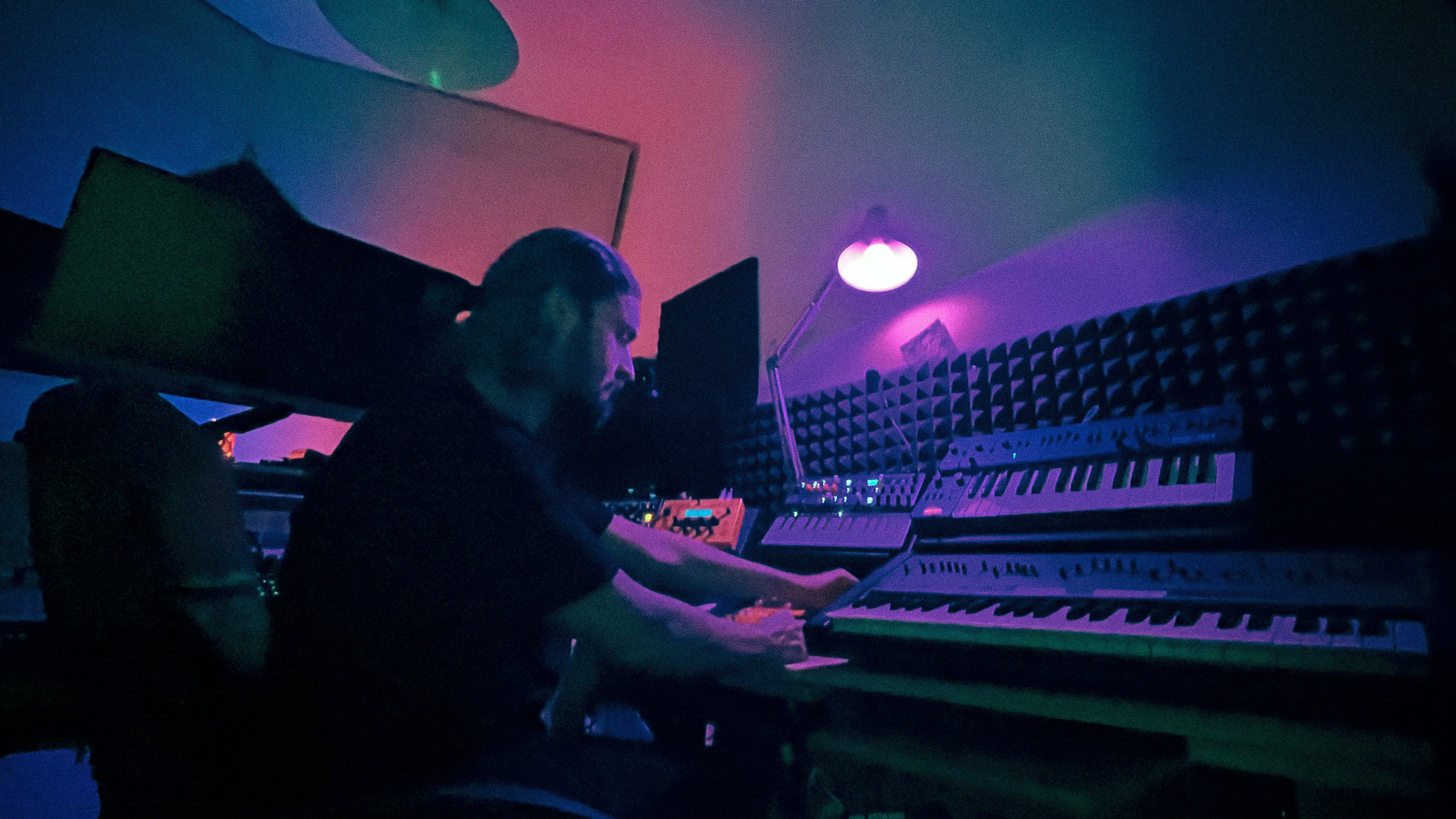
For this album, I worked between Gran Canaria and Ibiza. In Gran Canaria, the setup was pretty basic, just a MIDI keyboard, Roland TR-8, Digitakt 2, SH-101, a TD-3, and a turntable for sampling old 7-inch vinyls. In Ibiza, I added a few more elements: a Minitaur, Mopho, Microfreak, and a Vermona DRM1.
I like to keep everything within arm’s reach so I can jam and interact with all the gear without breaking the flow. Once I’m in that zone, I just dive in and get the most out of what I’ve got.
From the earliest sketches to the finished piece, tell me about the production process for Can I Music.
My process is kind of reversed, I usually start by jamming to capture the raw idea, then gradually refine it and strip it down until it reaches a clean, polished shape.
I often begin with basslines and synth elements, then move on to the groove, and finally into parallel processing, adding effects, textures, glitches, and background details. On some tracks, I sampled old 7-inch records to bring in a bit of that dusty flavor.
The goal is to get as many elements working together as possible, then I carefully carve things out, both in terms of sound and composition, to let the idea shine through.
Late producer SOPHIE said: “You have the possibility with electronic music to generate any texture, and any sound. So why would any musician want to limit themselves?” What's your take on that?
Absolutely agree with that. Speaking about this point, I’d like to mention a past project of mine called Land Sines, which really pushed the boundaries of what electronic music could be.
The concept was to extract the natural fundamental harmonics from raw, uncontained environmental sounds.
For that purpose, I travelled to the Svalbard Islands, deep in the Arctic Circle, with a tape recorder and a set of microphones to capture some of the purest, least-processed sonic material I could find, things like glacial movements, wind patterns, and the eerie silence of remote Arctic landscapes.
Back in the studio, I analyzed those recordings to isolate and extract their harmonic content, then resynthesized them into entirely new sonic forms. The resulting soundscapes were both organic and otherworldly, a kind of intersection between untouched nature and technology that felt uniquely alive. It was one of those projects that reaffirmed for me how infinite the creative possibilities in electronic music really are.
As a side note, I always encourage artists to take risks and explore, not just follow trends. Sound is a science as much as it is an art, and it has the potential to influence fields far beyond music. If we confine ourselves only to what’s commercially viable, we miss out on the deeper, more meaningful possibilities that this medium can truly offer.
Tell me about your aesthetic preferences for picking effects like reverb, delay, compression, chorus, etc. — what was the role of these effects in the production of your current release?
These effects are the hidden magic behind my current process.
As I mentioned before, I always use a lot of effects in parallel, combined with constant automation to create a subtle background chaos, something the ear doesn’t consciously notice, but the brain perceives. It’s like nature: almost every natural environment has a very subtle background noise that our brains can still pick up on.
So I put a lot of effects on the track, with continuous tweaks of their parameters to make them more vibrant and dynamic. These might include distortion, transient designers, bit resamplers, delays, and reverbs, among others.
I believe this approach makes the music feel much more organic and enjoyable.
Producers work with sound in a very direct way for very long stretches of time. What are some of its qualities that you appreciate now more than before, and how do you try to bring these to the fore in your work?
Spending so much time with sound really changes the way you perceive it, not just as something functional or rhythmic, but as a living texture with emotional depth. Over the years, I’ve come to appreciate the subtleties much more, the small artifacts, the space between sounds, the imperfections that add life to a track.
I’ve learned to value silence as much as sound, knowing when to leave room, when to strip things back, and how to let certain frequencies or textures breathe. I try to bring those qualities forward in my work by building layers that interact in organic ways, using processing and effects not just to shape the sound, but to let it evolve and move.
Even when I’m working with minimal setups, I focus a lot on dynamics, color, and atmosphere. It’s less about how many sounds you use, and more about how they speak to each other. That’s something I didn’t fully grasp at the beginning, now it’s central to how I approach music.
The current production process allows for fast and infinite variations. Can you tell me about how you deal with this potential for the infinite and what ultimately decides on how many iterations to create and which version to release?
Coming also from a background in movie scoring and ambient music, I’ve learned that each type of sound world demands a different mindset. With club-oriented tracks, especially when I’m working in that acid/glitch/industrial/garage zone, I have to consciously switch out of the more “open-ended” ambient approach and commit earlier. That mindset shift is key.
In ambient or score work, you often explore textures endlessly, building tension over long stretches. But in dance music, it’s more about capturing a moment, a pulse, a raw energy, something that hits right away. So I try to trust my gut. Once a jam gives me that feeling, even if it’s a bit raw or incomplete, I stop. I’ve learned not to over-polish, because sometimes what feels unfinished actually has the most character.
I usually let a few versions breathe, maybe test them out, but the one I release is almost always the one that still gives me that same gut reaction after a few days. That’s when I know it’s honest, not overthought, just alive.
Tell me about the role collaboration played in your recent productions – and how you see the potential for machines as collaborators compared to humans.
To be honest, for this recent album, it was more of a solo journey. I didn’t really collaborate in the studio this time around. But what did play a key role were a few good friends and fellow producers, people like Nico Lahs and Luigi Rossi, who encouraged me to come back with some tracks aimed at the electronic club scene. Their support and belief in the project definitely gave me the push I needed to dive back in.
Even if I wasn’t collaborating directly, that energy and encouragement shaped the process. Sometimes just knowing that people you respect are behind you can be just as powerful as being in the room together.
As for machines, they’ve always been like silent collaborators to me. Especially with analog gear or semi-random sequencers, they can throw you curveballs that push you into unexpected places.
They don’t replace the human connection, but they add their own flavor and inspiration.
Production, as opposed to live performance, can be a lonely process and feedback from listeners isn't always tangible. What is it about it that gives you satisfaction?
Absolutely, production is a more isolated process, and unlike playing live, you don’t get that immediate energy from a crowd. But at the same time, that solitude can be where the real magic happens.
For me, it’s about locking into a certain headspace, when you're totally immersed and the music starts shaping itself. That’s where the satisfaction is: when the track begins to speak back to you, like it’s revealing something you didn’t plan.
With this album, that feeling came on strong. I actually made the whole thing in just four days. I got into a flow where everything just clicked. I didn’t overthink it. I trusted the instinct, the raw vibe of the moment. And even if the process felt fast and intense, it was deeply personal. I think sometimes the best things come out when you don’t give yourself too much time to second-guess.
So yeah, there may not be a crowd in the room, but when you hit that moment where a track feels right, that’s already a complete experience in itself.
We can watch videos on production, take producer courses, and exchange deep insights on gear forums. Amidst these options to improve one's chops/skills, how do you keep things playful?
For sure, all those tools and knowledge are important, but if you get stuck following rules too closely, you lose the spark.
To keep things playful, I try to risk it with some craziness. I don’t want to just recreate what I’ve heard or learned; I want to break boundaries, bend the rules, and throw in unexpected twists. Sometimes that means messing up a pattern on purpose, pushing a synth into distortion, or layering sounds that technically “don’t fit” but somehow work. I love when things get a little wild or imperfect because that’s where the magic happens.
Breaking out of the usual constraints keeps the process exciting, it’s less about perfection and more about discovery. That’s how you find your own voice and keep the music alive.
AI is already capable of making something most people would recognise as music. I am curious, though, and will keep this question somewhat broad on purpose: What do you think that means?
I think for mainstream production, stuff that follows clear formulas and patterns, AI can totally replace or at least replicate it. It’s great at analyzing what works, predicting trends, and generating music that fits those moulds.
But when it comes to music made with heart, driven by exploration and a refusal to stick to boundaries, I don’t think AI will ever be capable of that. That kind of music comes from a place of emotion, risk-taking, and personal experience, things that aren’t just patterns or data.
So yeah, AI is a powerful tool, and it might dominate certain corners of music, but the kind of raw, boundary-breaking creativity that comes from human spirit, that’s something I believe machines can’t touch.
Creativity can reach many different corners of our lives. Do you personally feel as though producing a piece of music is inherently different from something like making a great cup of coffee? What do you express through music that you couldn't or wouldn't in more 'mundane' tasks?
I’m really passionate about restoring vintage cars and cooking, and I also direct indie videos and movies. Surprisingly, I find the creative process quite similar across all these fields. You get your mind and being flowing, start to notice patterns, and explore them until something takes shape. It’s like solving a puzzle, once the pieces start fitting, everything falls into place.
Making music fits into that same flow state for me. But what sets it apart is how much freedom it gives to explore abstract emotions and ideas, things you can’t always express through restoring a car or cooking a meal, even if those are creative acts in their own right.
In music, I can dive deep into moods, textures, and stories that go beyond the physical world. It’s a space where I can really push boundaries and let the unexpected happen. So while the process shares that flow and exploration with other passions, music lets me express parts of myself in ways that feel more intangible and personal.