Published
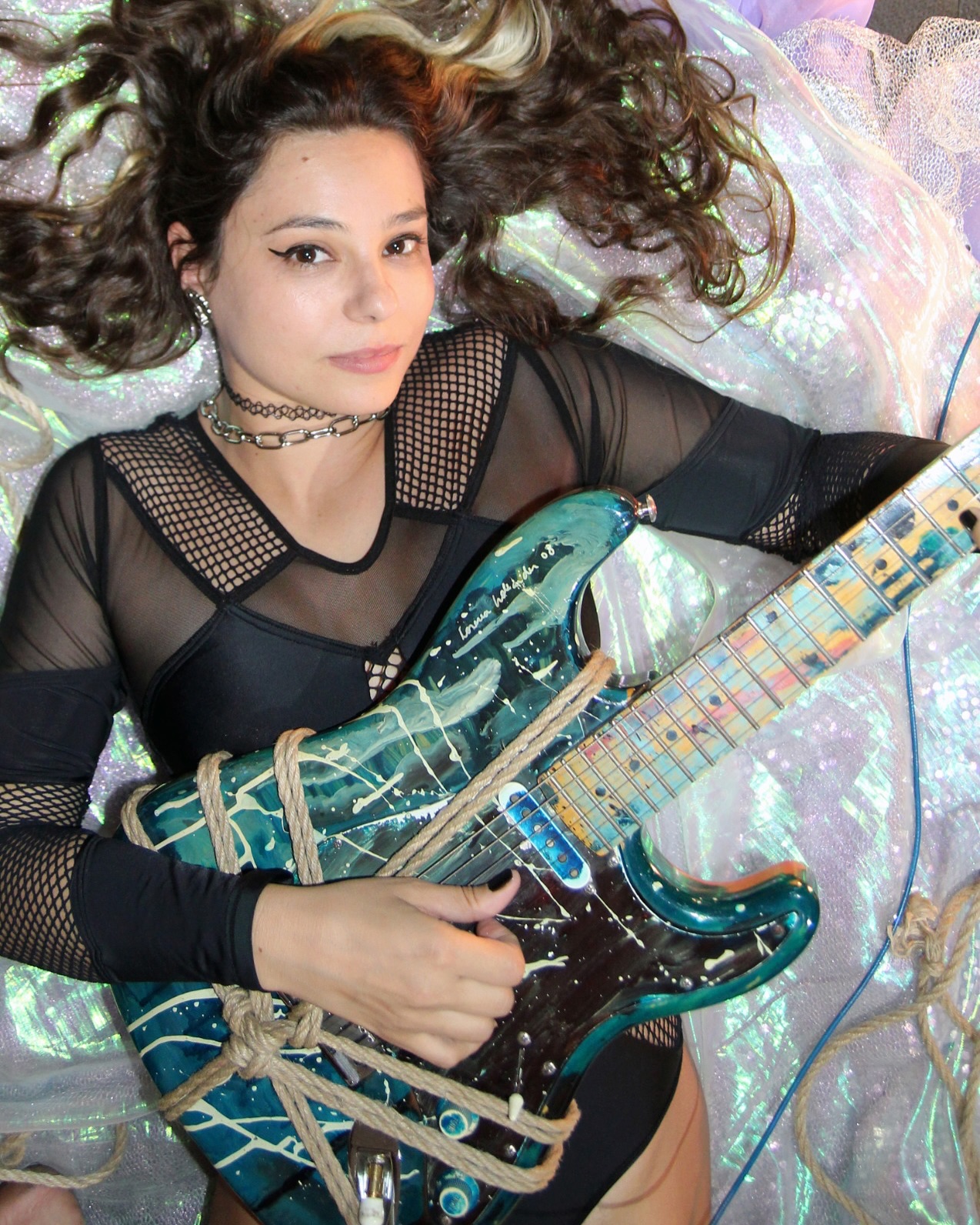
Name: Lorena Hollander aka USHAN
Nationality: Brazilian
Occupation: Composer, guitarist, vocalist, producer
Current Release: Lorena Hollander's single "As Águas/Sword" is out via Protomaterial.
Recommendations for São Paulo, Brazil: São Paulo is one of the most chaotic cities I know—and I actually appreciate that chaos. It’s not always easy, but it’s full of contrasts and intensity. If someone visits, I always recommend going to the city center. It gives you a sense of what São Paulo is. There, you’ll find places like the Municipal Theater, which offers music, dance, and all kinds of cultural events. The center is also one of the few areas where you can still see older architecture, since the city hasn’t preserved much of its historical buildings.
Things I am passionate about but rarely get to talk about: I have many interests that are deeply connected to my music—nature (as in the videos for “Utopia” and “Já Acontecemos,” filmed in beautiful Brazilian landscapes), mysticism, symbolism, and spirituality have always been essential to how I create and express myself. I’m also passionate about performance, movement, and dance, which I often incorporate into my live shows.
But one passion that fewer people know about is my more alchemical side. For several years, I made my own cosmetics—researching the properties of oils, herbs, and natural ingredients. I loved creating my own formulas, and I still frequently make some recipes.
If you enjoyed this Lorena Hollander interview and would like to know more about her music, visit her on Instagram, and Facebook.
When it comes to experiencing the sensation of “energy” as a listener, which albums, performances, and artists come to mind?
Some of the most powerful experiences I’ve had with music felt like energetic imprints—moments that marked me deeply, almost etched into my heart.
Two of my earliest musical memories are of the song “Paratodos” by Chico Buarque, …
… and being in the sea with my mother as a child while she sang a Jorge Ben song. I kept asking her to repeat it so I could memorize the words—it was “W Brasil.”
As a teenager bands like Smashing Pumpkins and Radiohead also made a strong impression on me. There’s something raw and emotional in their music that speaks directly to the spirit—beyond words.
Later in life, learning to play the koto—a traditional Japanese harp—felt like an inexplicable pull. I started before even knowing Alice Coltrane, whose music now transports me to deeply spiritual places.
The harp’s sound, in general, has an elevating quality—it feels like it connects to higher frequencies.
There can be many different kinds of energy in art – soft, harsh, healing, aggressive, uplifting and many more. Which do you tend to feel drawn to most?
I’m quite eclectic, and my work reflects that. I’ve always listened to many styles, so it’s hard to define my music in just one genre. I’m drawn to different energies depending on the moment—sometimes introspective, sometimes the opposite.
I’m especially interested in what’s not obvious—sounds or visuals that are intriguing, even unsettling at first. I’m also attracted to darker, more mysterious tones, that make you think or feel in unexpected ways.
I love exploring duality—not just light or joy, but also the unknown and all the emotions in between.
I have had a hard time explaining that listening to death metal calms me down. When you listen to a song with a particular energy, does it tend to fill you with the same energy – or are there “paradoxical” effects?
For me, it’s usually more of a correspondence—I tend to absorb the energy the music carries. If a song is calming, it calms me; if it's intense, I feel that intensity.
But I do think there’s a kind of paradox in how attention works. Sometimes, if a song is very dense or noisy, it demands my full focus—and that shift in attention can be grounding in its own way.
So even if the music is chaotic, being fully immersed in it can bring a kind of clarity or presence.
In as far as it plays a role for the music you like listening to or making, what role do words and the voice of a vocalist play for the transmission of energy?
Words tend to be more direct than music, which often evokes abstract sensations. When lyrics appear, they guide the listener in a more specific direction. I deeply believe in the symbolic power of words—they can suggest meaning, trigger memories, or shape emotion. But while music often speaks directly to the unconscious, words pass through the mind first.
I like to think of lyrics as gentle guides or invitations—offering meaning to those who wish to follow them closely. At the same time, I love using the voice as an instrument itself.
I often improvise, using vocalizations that carry emotion and energy even without words. That kind of vocal expression can also guide the listener, but in a freer, more open-ended way.
When it comes to experiencing the sensation of “energy” as a creator, how would you describe the physical sensation of experiencing this energy? (Where do you feel it, do you have a visual sensation/representation, is there a sense of release or a build-up of tension etc …)
One of the things I find most beautiful about sound and music is how it moves through the body. With a painting or a visual artwork, it’s something you perceive inwardly—it generates imagery within you. But music is physically vibrating air—it literally enters and moves through us.
For me, the experience is very physical. I feel the energy of the sound traveling through my body. Of course, our ears receive and interpret the frequencies, but I also feel like I “listen” with my whole body. It’s pure energy in motion—like a small version of the universe unfolding in real time.
I also connect deeply with the philosophical side of sound. In some Eastern traditions, like in Indian philosophy, the primordial sound “Om” is said to be the origin of creation. That idea resonates with me—the notion that vibration is the very beginning of everything.
When it comes to composing / songwriting, are you finding that spontaneity and just a few takes tend to capture energy best? Or does honing a piece bring you closer to that goal?
In general, I do believe in spontaneity and that initial moment when a song still feels fresh—it gives it a very specific character. I’ve tried re-recording vocals that were originally just demo takes, and no matter how many times I redo them, they never quite capture the same feeling.
Of course, it’s not always the case—sometimes you do need several takes to get something right. But I usually prefer not to overthink or aim for perfection, because too much control can strip away that raw quality, that unexplainable “something” that gives a take its soul.
Sometimes, the most technically imperfect version is the one that truly resonates.
How much of the energy of your own music, would you say, is already part of the composition, and how much of it is the result of the recording process?
It’s hard to quantify, because sometimes it’s the recording process that really brings the song to life. Recording and composing can feel like two different creative acts—and sometimes like the same one. Then, when you perform live, everything can shift again. I love that. It keeps the music alive, not frozen in its studio version.
When I perform live, I often create multiple versions of the same piece. I also love including songs by other artists—sometimes completely transforming them while keeping only the lyrics. I feel like the energy of a song is always present, but it can reveal different sides of itself depending on how you approach it.
In the studio, the challenge is to really listen to what the song is trying to say—to let it guide you. If you’re open enough to follow that, the song will show you the version it wants to become. It’s all about staying receptive throughout the process.
For As Águas/Sword, what kind of energy were you looking for?
Each track carries a different kind of energy.
"As Águas" is more politically engaged—it evokes the strength and force of water, almost like a wake-up call. It’s a way of urging people to pay attention to what’s happening in the world, to the signs nature is giving us. We talk about the environmental crisis globally, but the response still feels far from what’s needed. "Sword," on the other hand, carries a more spiritual energy. It connects with inner strength and resilience.
This year I released a single called “Connected.” It’s a more sensual song, but it also speaks to something deep—the invisible connection we build with someone we love.
One of the inspirations behind it was the image of shibari ropes, and the Japanese legend of the red thread that ties destined people together.
I’ll be releasing the video for “Connected” soon, and it brings that sensual energy through shibari and the tenderness of human connection.
How do you capture the energy you want in the studio?
I think a lot of the energy you want to bring into a song comes from the instruments—after the lyrics and the core elements like harmony, rhythm, and scales.
I pay close attention to these choices. Sometimes I use less common scales, like certain Japanese scales, or I work with textures that feel unique. Synth layers, deeper frequencies, and timbral choices all shape the emotional and energetic atmosphere of the song.
The second part is about stepping into the mood the music is asking for. If it’s an introspective song, I try to get into a more meditative state before recording. If it’s something more high-energy, I prefer to record it on a day when I’m feeling physically and emotionally strong.
Being in the right state of mind definitely helps channel the energy the song needs.
What role do factors like volume, effects like distortion, amplification, and production in general play in terms of creating the energy you want?
I manipulate sound a lot in my live performances, so by the time I’m recording, those elements are already an essential part of the music. In the studio, they become even more crucial. I’d say no detail is too small when you're recording.
I usually record with the same effects I use live—delays, distortions, flanger—because they’re not just added later. These textures, along with choices around volume and dynamics, really help convey the emotional landscape I want to create.
In terms of energy, what changes when you're performing live on stage, with an audience present, compared to the recording stage?
I’ve been exploring different formats in my live shows. Sometimes I perform with a band, and sometimes I play solo. In solo sets, I might use playback, or I build the backing tracks live on the synthesizer—just like they were originally created.
Depending on the venue, I try to understand what setup fits best. Some places have the structure and budget to bring musicians, and others are more intimate or require a more minimal approach. I've realized I enjoy both ways equally, even though they’re very different experiences.
Performing live adds a whole other layer of energy. There’s a real exchange with the audience that can’t be replicated in the studio. But I also find something powerful in the solitude of creating in the studio, you can connect to some energies that demand more quiet and stillness.
How does the presence of the audience and your interaction with it change the energy of the music, and how would you describe the creative interaction with listeners during a gig?
There’s something very alive and unpredictable about live performance. You can feel the collective energy in the room, and it shapes the music in real time.
Sometimes I stretch a part longer because I feel the audience is with me in that moment, change the setlist, or I shift the intensity depending on the vibe. It becomes a shared space of this energy exchange.
What kind of feedback have you received from listeners or concert audiences in terms of the experience that your music and/or performances have had on them?
The feedback that moves me most is when someone tells me they felt transported, as if they had traveled somewhere else through the music—almost like being under the influence of something, but purely through sound and atmosphere.
When I hear that, it feels like we’re creating something that goes beyond the everyday—a space where people can access something different, deeper.
Would you say that you prefer to stay in control to be able to shape the energy or do you surrender to it and allow the music to take over? Who, ultimately, has control during a live performance?
I think it’s a dance between both. There’s a part of me that prepares, that sets intentions, shapes the structure—but once I’m on stage, I try to surrender as much as possible. That’s when unexpected things happen—when you surprise yourself.
And I feel the audience responds more deeply when I’m fully present and open like that. In the end, I think control is shared—between me, the music, and the audience.
The energy that music is able to generate can be extremely powerful. How, do you think, can artists make use of this energy to bring about change in the world?
I deeply believe in the power of art—and in change that starts from the inside out. Transforming the self can lead to transforming the world. Art is a powerful tool to help people shift internally.
But at the same time, we need a more urgent and practical mindset. There’s no time to waste—we need change. Artists can use their platforms not only to inspire, but to take action—especially those with visibility and resources. Supporting emerging artists who are working toward transformation—whether social, environmental, or spiritual—can also be a powerful force for change.
We need both: inner transformation and collective movement. And I believe music can be a force in both.