Published
Name: Lucie Antunes
Nationality: French
Occupation: Composer, drummer, percussionist
Current release: Lucie Antunes's new album Silence, featuring Wolfgang Tillmans, Clara Ysé, and Louisahhh, is out June 12th 2026 via Bell.
[Read our Louisahhh interview]
[Read our Louisahhh interview about her creative process]
If you enjoyed this Lucie Antunes interview and would like to know more about her music and upcoming live dates, visit her on Instagram, tiktok, bandcamp, and Facebook.
Where does the impulse to create something come from for you? What role do often-quoted sources of inspiration like dreams, other forms of art, personal relationships, politics etc play?
Creating is my reason for being. It gives meaning to everything in my life; without it, it’s as if I couldn’t breathe. It’s my guiding thread, in a way.
Other forms of art are a major source of inspiration for me—whether it’s watching films by David Lynch, visiting exhibitions, or drawing from photographers like Nan Goldin and Wolfgang Tillmans, or performance artists such as Marina Abramović. I’m inspired not only by their work, but by the way they create.
For example, Marina Abramović describes in her autobiography a way of living—her house in Amsterdam was designed with one floor per function. Whenever I can (since it requires a lot of space), I draw on this method, which helps me a lot with writing.
I also attend a lot of contemporary dance performances—we’re really lucky in Paris—as well as concerts. I’m very interested in new hybrid forms. I love the stage universe of Peaches, the performances of Rebecca Chaillon, and the shows by Marlene Monteiro Freitas.
Today, I think it’s important to break codes—to push against walls and even move through them, to quote Marina. I don’t find much meaning in simply sitting down and watching a pleasant show. I need to be shaken, to feel a sense of commitment—political, yes, but it can also come through form, through how bodies are represented on stage, for example.
As for my personal relationships, music has always been a place of release for me. Last year, I went through a very intense professional breakup—a toxic relationship that affected me deeply, at a time when the world itself was already raising many questions for me—and I felt the need to write Silence.
For you to get started, do there need to be concrete ideas – or what some have called a 'visualisation' of the finished work? What does the balance between planning and chance look like for you?
I do need a deadline, a clear goal—like a Sagittarius shooting an arrow and rushing toward its target. Then, within that very precise timeframe, I allow myself complete freedom.
With Silence in particular, I knew I was going to write for dance. I had met the incredibly talented performers who would embody this music, so I could already visualize quite a lot. I also knew I wanted to move toward a much more experimental form than anything I had done before, and that the space would allow me to feel free alongside the choreographer Mathilde Monnier.
I was also in a state of intense vertigo, as I had just parted ways with my label and management, whom I had worked with for ten years and who had often told me I would never succeed without them. So I was also driven by a sense of necessity and urgency—I needed to create a work of art that would mark me forever, something that would evoke death, emptiness, and silence.
To achieve that, I could only work collectively, and I left a lot of room for instinct and encounters—with Louisahhh, with Canblaster, who was an incredible ally in this journey, or with Wolfgang Tillmans. I had no choice but to trust my instinct completely; the choices I made, which I can’t always explain, were all deeply connected to the present moment.
Is there a preparation phase for your process? Do you require your tools to be laid out in a particular way, for example, do you need to do 'research' or create 'early versions'?
For each creation, the process is different. In fact, the process is what shapes all the material itself.
For Silence, I recorded in the stables of the Le Centquatre-Paris in Paris. This arts center used to be one of the city’s largest funeral services hubs, and 300 horses were housed in the stables, transporting around 150 coffins every day. It is there that I composed Silence, in this vast space with a very long reverb. The idea was to keep all the voices and winds, but not the drums, as it was impossible to use percussion with such an extended reverb.
Later, we went into a studio to re-record the drums, and finally, together with Canblaster, we realised that the reverb of the stables had actually created the mood of the album—we couldn’t do without it anymore.
For Silence, what did you start with? If there were conceptual considerations, what were they?
There are several stages in this process, but I always start with choosing the place where I will create, which is very important to me, followed by a lot of experimentation. Then fairly quickly, I visualise the entire work in order to see what might be missing or what might be unnecessary. And I don’t hesitate to make drastic choices as long as they serve the final piece
This might be a next step. I enter a kind of work tunnel, especially for this creation, for which I had very little time to write. So I don’t think much about my well-being; my only nourishment at that moment is creation itself—and the place I’m in, which puts me in a particular mood.
In the stables, I stayed there for three weeks, almost day and night. I need to be completely immersed in what I’m doing; eating and drinking almost feel like a waste of time… But I think this is going to change.
I only started questioning the role of space quite late. I have this feeling that I might meet a shaman who will guide me through all these questions, and that I will realise—like a shock—that paying attention to my well-being at that moment of creation would probably nourish the music I’m writing.
Tell me a bit about the way the new material developed and gradually took its final form, please.
My sound engineer, Stéphane Lebrun, built a studio across four bays of the Le Centquatre-Paris stables: one bay = one function. He showed me how the mixing console worked, and once he left, I started with an unexpected feedback loop that I managed to control. I left it running in the background as a drone, a drone in D, and I wrote the first piece of Silence.
Death, emptiness, and silence were at the core. But it was about the silence you search for within an ultra-sonic environment—the meditative trance state created through asymmetric rhythmic patterns, which kind of “mindfuck” the brain until you let go, and those rhythms become an obvious flow that passes through the body. I wanted to create a passage between myself and the invisible, perhaps a way of finding some peace in what awaits us.
I invited Canblaster as a guest. He then stayed throughout the entire creation process as co-director and music producer. As with all the choices for this record, everything happened in the present moment, instinctively, often at the last minute—like clear, self-evident decisions that there wasn’t time to question.
We worked a lot on sonic spaces and real-time sound processing. We routed all the voices through modular systems, and that’s where Canblaster worked his magic. He transformed the material by placing it into almost cosmic spaces—it wasn’t just about adding effects. I was right behind him as he was feeding the voices into the modular setup, letting himself be guided by what he was hearing in the moment.
For me, it was an extraordinary experience; I was witnessing a performance that I was recording forever. The first take was often the right one—I could tell because I could feel it vibrate in me, I have no other explanation. And this was the case with all the invited artists. We captured the present moment: improvisations, explorations, ideas, conversations, and our different visions of silence.
What makes lyrics good in your opinion? What are your own ambitions and challenges in this regard?
I commissioned a booklet from a French author named Laura Vazquez, and it became my guiding thread.
As for the lyrics by Louisahhh, Wolfgang, or Halo Maud, they had complete creative freedom—I invited them to share their vision.
What are areas/themes/topics that you keep returning to in your lyrics?
My relationship to text is similar to the universe of Meredith Monk, John Cage, or Steve Reich.
I use the voice a bit like children do, through onomatopoeia; I play with a word or with vocal textures that become an additional instrumental line. I’m not looking for any meaning, just sensations …
Many writers have claimed that as soon as they enter into the process, certain aspects of the narrative are out of their hands. Do you like to keep strict control or is there a sense of following things where they lead you?
I let myself be entirely guided by what things become …
There are many descriptions of the creative state. How would you describe it for you personally? Is there an element of spirituality to what you do?
Yes, it calms me; it is often cathartic and deeply moving. Creation shakes my entire life.
In this case, for Silence, it allowed me to feel close to my invisibles.
Once a piece is finished, how important is it for you to let it lie and evaluate it later on? How much improvement and refinement do you personally allow until you're satisfied with a piece?
It all depends on the time I have … Here, we absolutely wanted to release the record before a major event in Avignon at the beginning of July. So I had six months to write everything and think everything through.
It’s true that I need to be 100% aligned with what I write, and I always ask myself: will I still agree with this in ten years when I listen to this record again?
But here, I have engraved memories, collaborations, and I have the intuition that this is the work I have created with which I feel the most in phase.
How do you think the meaning, or effect of an individual piece is enhanced, clarified or possibly contrasted by the EPs, or albums it is part of? Does each piece, for example, need to be consistent with the larger whole?
I always think in terms of the overall whole of a work.
I don’t know how to write a story without thinking about the beginning, the end, and the great central journey in between.
In terms of what they contribute to a song, what is the balance between the composition and the arrangement (including production, mixing and mastering)?
On this record, everything is interconnected. Every person who contributed to it added a stone to the building. I invited each of them to bring their personality and their vision.
The mixer introduced to me by Canblaster, Si Begg, an incredible English artist, first sent me versions that were very close to my pre-mixes. I then suggested he move towards something that aligned with his own vision. And that’s when this genius took the tracks far beyond anything I could have imagined …
It’s truly a collective album, and I think everyone had a lot of fun. Maybe as soon as you give freedom, you open incredible doors …
Music and the accompanying artwork are often closely related. Can you talk about this a little bit for your current project and the relationship that images and sounds have for you in general?
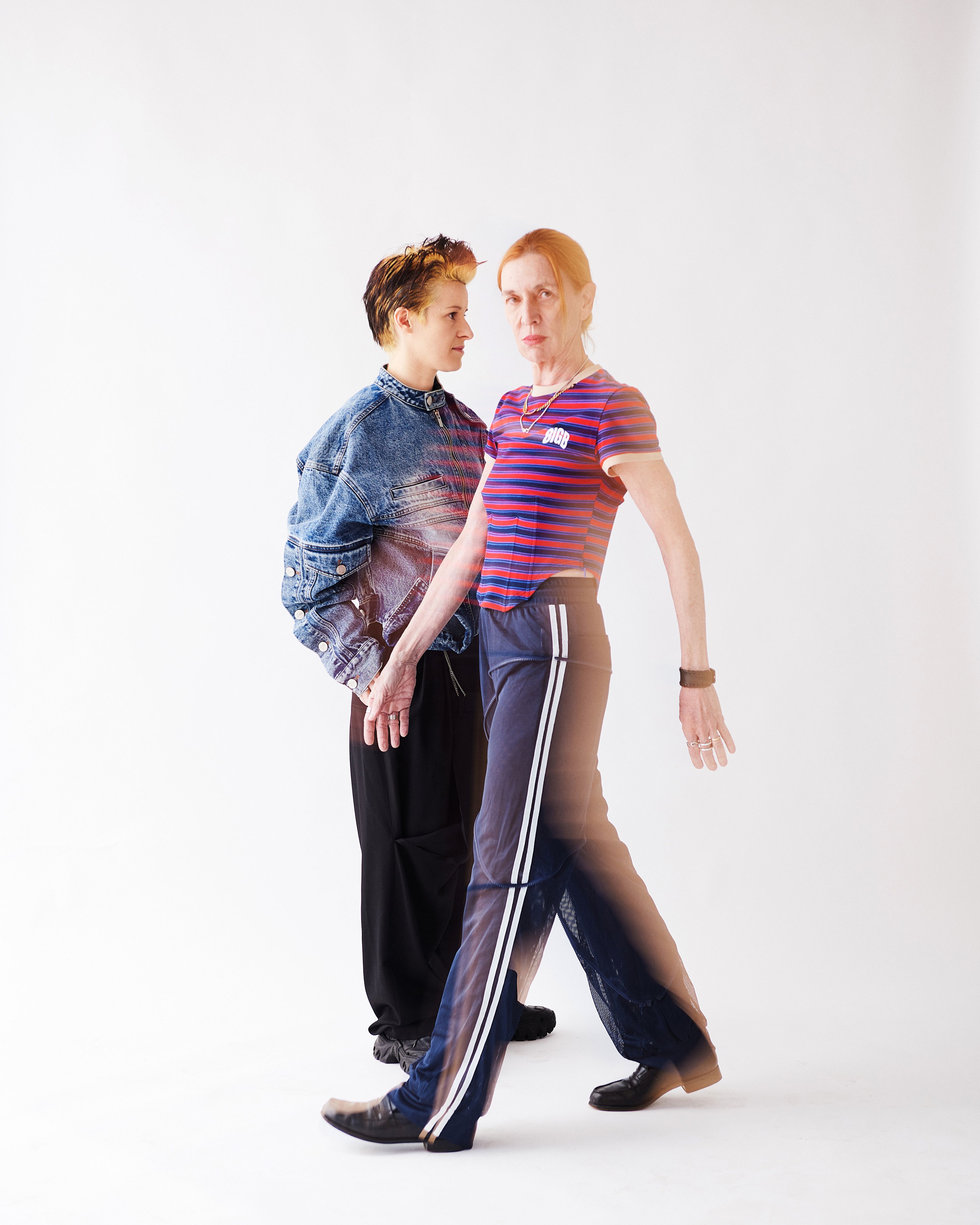
Here too, for the visual aspect, I asked the photographer who accompanied us throughout the process to bring their own vision. We talked a lot about our personal journeys, and again about the idea of death and silence.
Since I’m a big fan of the people I invited, it was easy for me to leave a lot of space for their proposals.
After finishing a piece or album and releasing something into the world, there can be a sense of emptiness. Can you relate to this – and how do you return to the state of creativity after experiencing it?
Wow … yes, we’re right in the middle of it.
Because I do everything at 1000 percent, the emptiness is immense. I’ve spent months working on a piece about death, emptiness, and silence, and convincing myself that I had finally found peace … haha.
Returning to a creative state is very easy for me—precisely because it helps me overcome what I might feel as emptiness. The question is: when will I be able to live with this emptiness peacefully, without always needing to create? Is that even possible?
I think I want to learn to close my eyes, feel the fresh air on my face, listen to the birds, and tell myself: I am here, I am okay. That in itself is already a big task for me.
I would love to know a little about the feedback you've received from listeners or critics about what they thought some of your songs are about or the impact it had on them – have there been “misunderstandings” or did you perhaps even gain new “insights?”
I have the impression that people listen in a sensory way rather than an analytical one. That they perceive the record as a UFO …
… and I’m fine with that.
Creativity can reach many different corners of our lives. Do you personally feel as though writing a piece of music is inherently different from something like making a great cup of coffee? What do you express through music that you couldn't or wouldn't in more 'mundane' tasks?
I have never really known how to properly express my emotions. Music helps me identify and bring out something larger within me that I don’t know how to express otherwise.
And it is the only place where I never question why I am here. I simply feel good.